News
They eliminate the National Road Directorate - by cronywell 07/07/2025 » 19:19
Presidential spokesman Manuel Adorni announced Monday that President Javier Milei signed a decree that eliminates the National Highway Directorate and other agencies in the area, after the confirmation of Cristina Kirchner's conviction for acts of corruption in the construction of roads.
"This body was created to simplify corruption," Adorni said at a press conference at the Government House.
In this context, he pointed out that Milei "ordered the definitive closure of the National Highway Directorate and also of the National Commission of Traffic and Road Safety and the National Road Safety Agency."
"In this way, the National Commission for Transport Regulation, known as the CNRT, will be reorganized, which will be renamed the Agency for Control and Concessions of Public Transport Services and will be the enforcement authority in terms of rules and administrative acts related to the inspection of road concessions," he explained.
In this context, he anticipated that the Government will begin the bidding process for 9120 kilometers of roads that "after decades of waste and corruption were degraded as never before in history."
"Corruption in public works has its death certificate signed today and has just been signed by the president," remarked the spokesman and clarified that the closure of the agencies occurs within the framework of the powers delegated by the Congress of the nation to the Executive Branch.
Adorni, in addition to highlighting the use that the libertarian government gave to these powers, stressed that Milei did not extend their validity, as did other presidents who preceded him.
"It starts with a symbol, it ends with a symbol. It begins with INADI which, as Manuel said, is for us the clearest representation of the political use of the State and to use the State to impose an ideological vision on Argentines, and ends with Vialidad, which is the icon of Kirchnerist corruption," added the Minister of Deregulation and Transformation of the State, Federico Sturzenegger. responsible for changes.

What do the changes in Roads imply?
"The National Highway Commission, an organization that incredibly controlled itself, that's why we had the Vialidad case. The National Road Safety Agency was eliminated, which could not control traffic without the support of the security forces, now the task is carried out by the Gendarmerie, which controls 2.5 million cars per year, at 80,000 checkpoints," Adorni explained.
Federico Sturzenegger said that Javier Milei will entertain on Wednesday some 200 officials responsible for the deregulation of the State
He also said that the CNRT had been left "practically without competences with the deregulation of Transport" and that the functions of control of trains and public services will pass under the orbit of the new agency created.
Ads linked to the Health area
Adorni also announced that the administrative, financial and legal management of five national hospitals was unified: Sommer, Posadas, Carrillo, Bonaparte and Inareps, constituting the National Administration of Health Establishments.
He also reported that the federal health delegations were eliminated; the power of the national Executive Branch to create new hospitals under the figure of the Comprehensive Medical Care Service for the Community (SAMIC) was annulled; the National Cancer Institute was transformed into an organizational unit of the Ministry of Health, and functions were reorganized at the ANLIS Malbrán.
The National Institute of Tropical Medicine and the Institute of Cardiovascular Diseases were dissolved; and the Agency of the National Hemp and Medical Cannabis Industry, which said that the latter is "the example of agencies that are created with the sole purpose of making money".
Other announcements
Among the announcements made on Monday by the presidential spokesman, he explained that the National Institute of Family, Peasant and Indigenous Agriculture; the National Institute of Seeds; Inadi; the Juan Domingo Perón Institute and the Permanent Commission in Tribute to General Juan Domingo Perón, among other organizations, were dissolved.
He also reported that national institutes such as the Sanmartiniano, Theater and Viticulture, INTI and Tecnópolis, among others, were transformed into organizational units; and the National Institute of Agricultural Technology (INTA); the National Bank of Genetic Data, among others, and that the Museum of the former ESMA and the National Archive of Memory were merged into the International Center for the Promotion of Human Rights.
In addition, the National Electricity Regulatory Entity (ENRE) and the National Gas Regulatory Entity (Enargas) merged, constituting the National Gas and Electricity Regulatory Entity; the Transport Safety Board changed its functions and its name to the Aviation Accident and Incident Investigation Agency.
In the case of the Financial Information Unit (FIU), he said that "it was adapted to the standards required by the Financial Action Task Force, known to you as the FATF."
With regard to Anses, he announced that "credits were eliminated" so that "the State does not give away retirees' money at ridiculous rates for political purposes."
In that process, he mentioned:
- The automotive transport of cargoes was deregulated, including the RUTA
- The request for free debt to sanitary works was eliminated.
- Removed builder registration.
- The auto parts market was simplified.
- Unnecessary procedures that limited competition in digital services were eliminated.
- The mandatory "Educating in Equality" days were eliminated.
- The National Fund for the Construction of Military Service Housing was eliminated.
- The Mint was transformed.
- The privatization of Intercargo, Corredores Viales and Energía Argentina Sociedad Anónima was authorized.
- Layers of programs, training, registrations and promotions of the SME Law were eliminated.
- Imports for science and technology were liberalized.
- The regimes for the promotion of sheep farming, llamas, silkworms, goat activity, cattle farming in arid and semi-arid areas, water buffaloes and cotton production were repealed.
- The import of batteries was deregulated.
- The market for bottles was deregulated and imports were liberalized.
- 29 trust funds were dissolved.
- The National Entity of Water Works of Sanitation was dissolved.
- It merged by absorption of the construction of housing for the Navy by Playas Ferroviarias de Buenos Aires Sociedad Anónima.
- Energy laws 24,076 and 24,065 were modified so that any private party can contract electricity with the supplier of their choice.
- Private initiative was freed up for the expansions of the electricity grid to promote the expansion of the grid.
- Tourism Law 25,997 was amended in order to eliminate state interventions that distort the market and national competencies in the field of regional tourism, such as the social hotels of Chapadmalal and Embalse.
"This has been the result of this first stage of the chainsaw plan that, as you know and we have said it a thousand times, this chainsaw as far as we are concerned is infinite," Adorni concluded.
Argentina under polar wave - by cronywell 25/06/2025 » 10:21
Argentina under polar wave
The polar wave in argentina is a meteorological phenomenon characterized by a sudden and significant drop in temperatures, due to the entry of a mass of cold air from the Antarctic continent or the south of the country. These polar waves tend to especially affect the central, southern and eastern regions of Argentina, although they can sometimes extend northwards.

Explanation of the phenomenon
Polar waves occur when a high-pressure system pushes very cold air from Antarctica towards Argentine territory. This can happen due to:
- Advance of a cold front associated with a low pressure system.
- Influence of the polar wind, which carries frigid air to lower latitudes.
- Loss of cloudiness, which favors nighttime cooling (frost).
Duration
A polar wave in Argentina usually lasts between 3 and 7 days, although in extreme cases it can persist longer, especially in Patagonia. The lowest temperatures are usually recorded during the early morning and early hours of the morning.
Geographical scope
The most affected regions are:
- Patagonia (Chubut, Santa Cruz, Tierra del Fuego): temperatures below zero, snowfall and intense winds.
- Center of the country (Buenos Aires, La Pampa, Córdoba, south of Santa Fe): intense frosts, minimums close to 0°C or below.
- Cuyo and northern Argentina (in extreme cases): notable decline, although less intense than in the south.
Impact
- Agriculture: Damage to crops due to frost.
- Energy: Increase in electricity consumption due to heating.
- Health: Risk of hypothermia and respiratory diseases.
- Transportation: Possible road closures due to snow or ice (especially in Patagonia).
Example:
In June 2024, a polar wave affected much of Argentina, with temperatures of -12°C in Bariloche and -5°C in Buenos Aires, accompanied by unusual snowfall in low-lying areas.
Israel launches preemptive strike - by cronywell 13/06/2025 » 16:05
Israel launches preemptive strike on Iran, killing IRGC's top commander
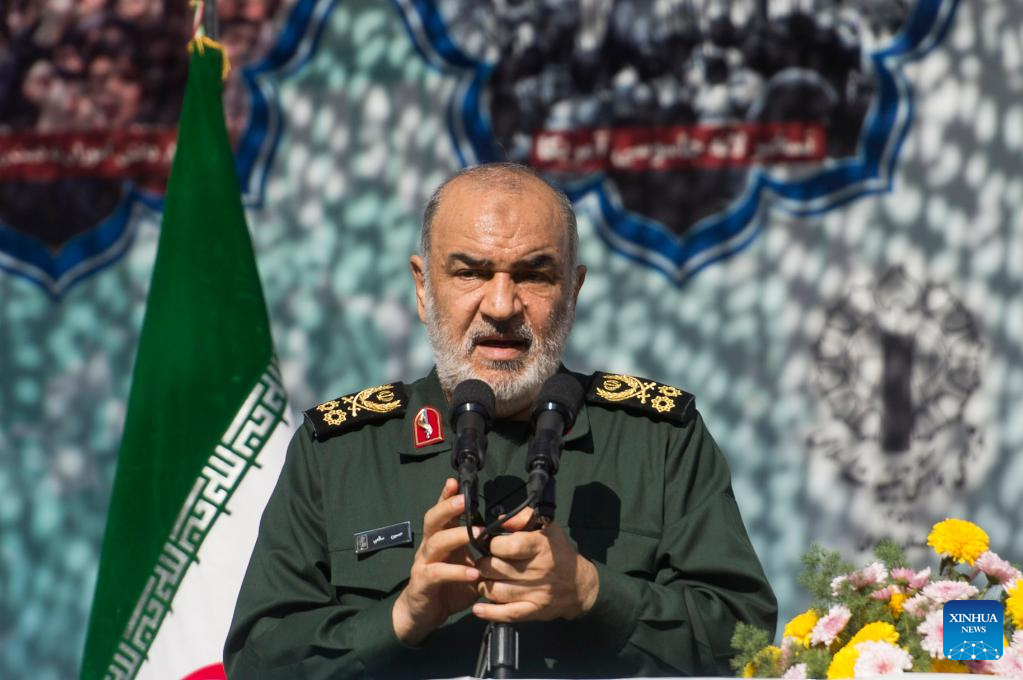
This file photo taken on Nov. 4, 2021 shows Chief Commander of Iran's Islamic Revolution Guards Corps Hossein Salami speaking at a rally in Tehran, Iran. Israeli Defense Minister Israel Katz said on Friday that Israel has launched a "preemptive strike" on Iran. Chief Commander of Iran's Islamic Revolution Guards Corps Hossein Salami and Gholam-Ali Rashid, commander of Iran's Khatam al-Anbiya Central Headquarters, were assassinated as a result of the airstrikes, the official news agency IRNA reported. (Photo by Ahmad Malek/Xinhua)
TEHRAN/JERUSALEM, June 13 Israeli Defense Minister Israel Katz said on Friday that Israel has launched a "preemptive strike" on Iran.
Israel Defense Forces (IDF) confirmed in a statement that its jets have completed the first-stage attack, notably strikes on dozens of military targets, including nuclear targets in different areas of Iran.
Chief Commander of Iran's Islamic Revolution Guards Corps Hossein Salami and Gholam-Ali Rashid, commander of Iran's Khatam al-Anbiya Central Headquarters, were assassinated as a result of the airstrikes, the official news agency IRNA reported.
The Israeli airstrikes also killed two Iranian nuclear scientists, identified as Mohammad-Mehdi Tehranchi and Fereydoun Abbasi, the report said.
Israeli Prime Minister Benjamin Netanyahu said in a video address that the goal of the ongoing operation is "to strike Iran's nuclear infrastructure, Iran's ballistic missile factories, and Iran's military capabilities," and will continue "for as many days as it takes."
Explosions were reported in Tehran and counties of Natanz, Khondab and Khorramabad, the Iranian state TV reported, adding that multiple casualties, including women and children, were reported in a residential building in Tehran.
Both Israel and Iran closed their airspace following the attack. Israel has declared a nationwide state of emergency.
In a statement, U.S. Secretary of State Marco Rubio denied any U.S. assistance or involvement in the "unilateral" attack, adding that Israel had told Washington that it believed the strikes were necessary for its self-defense.
Earlier on Thursday, U.S. President Donald Trump warned of a possible "massive conflict" in the Middle East, saying that "I don't want them going in" as direct talks between the United States and Iran are ongoing.
"I want to have an agreement with Iran. We're fairly close to an agreement ... As long as I think there is an agreement, I don't want them going in because that would blow it," he told reporters in the White House. ■
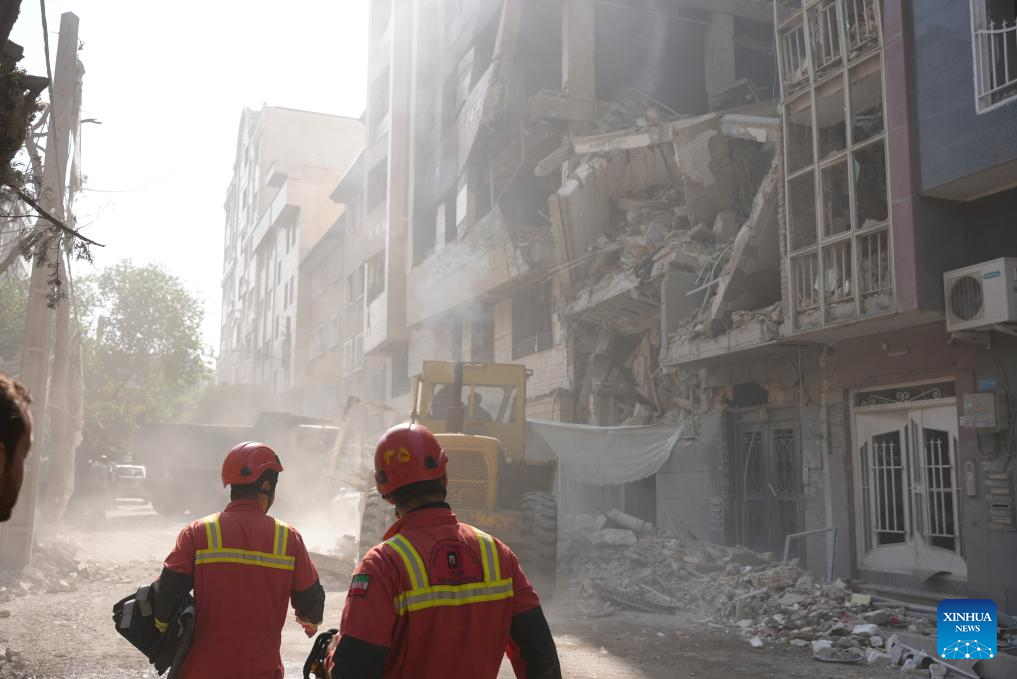
This photo taken on June 13, 2025 shows buildings damaged during Israeli strikes in Tehran, Iran. Israeli Defense Minister Israel Katz said on Friday that Israel has launched a "preemptive strike" on Iran.
Chief Commander of Iran's Islamic Revolution Guards Corps Hossein Salami and Gholam-Ali Rashid, commander of Iran's Khatam al-Anbiya Central Headquarters, were assassinated as a result of the airstrikes, the official news agency IRNA reported. (Xinhua)
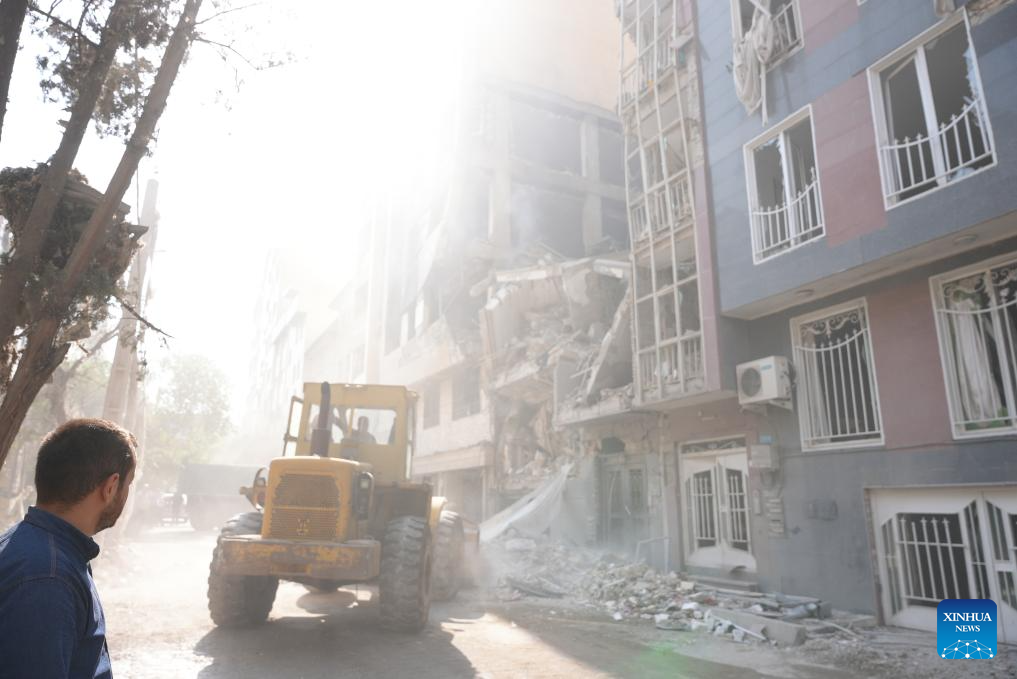
This photo taken on June 13, 2025 shows buildings damaged during Israeli strikes in Tehran, Iran. Israeli Defense Minister Israel Katz said on Friday that Israel has launched a "preemptive strike" on Iran.
Chief Commander of Iran's Islamic Revolution Guards Corps Hossein Salami and Gholam-Ali Rashid, commander of Iran's Khatam al-Anbiya Central Headquarters, were assassinated as a result of the airstrikes, the official news agency IRNA reported. (Xinhua)
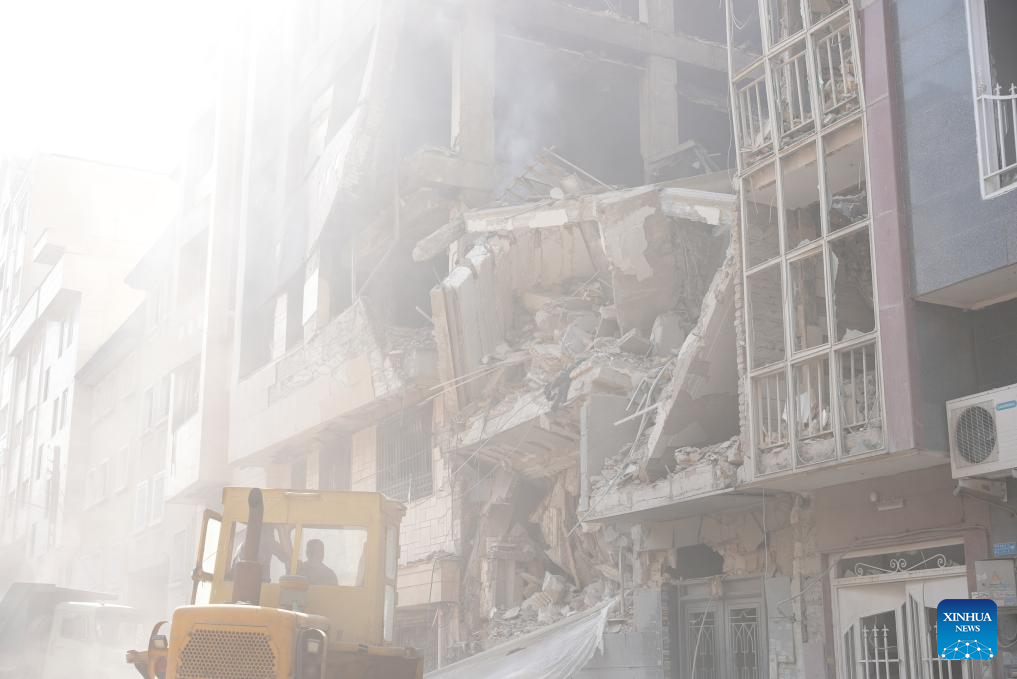
This photo taken on June 13, 2025 shows buildings damaged during Israeli strikes in Tehran, Iran. Israeli Defense Minister Israel Katz said on Friday that Israel has launched a "preemptive strike" on Iran.
Chief Commander of Iran's Islamic Revolution Guards Corps Hossein Salami and Gholam-Ali Rashid, commander of Iran's Khatam al-Anbiya Central Headquarters, were assassinated as a result of the airstrikes, the official news agency IRNA reported. (Xinhua)
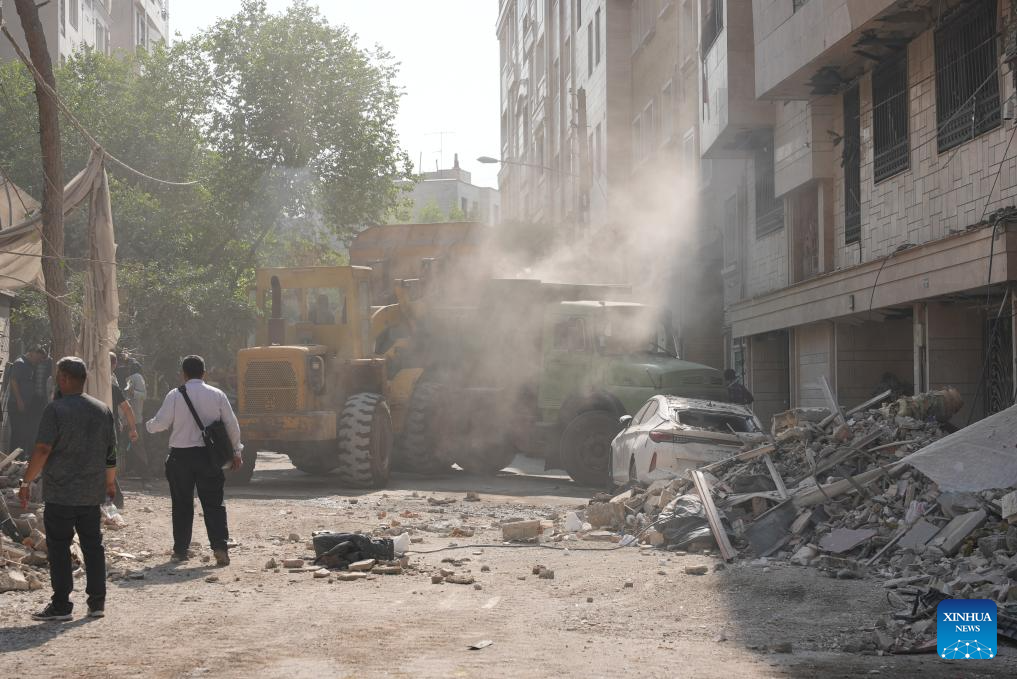
Engineering vehicles remove debris of buildings damaged during Israeli strikes in Tehran, Iran, June 13, 2025. Israeli Defense Minister Israel Katz said on Friday that Israel has launched a "preemptive strike" on Iran.
Chief Commander of Iran's Islamic Revolution Guards Corps Hossein Salami and Gholam-Ali Rashid, commander of Iran's Khatam al-Anbiya Central Headquarters, were assassinated as a result of the airstrikes, the official news agency IRNA reported. (Xinhua)
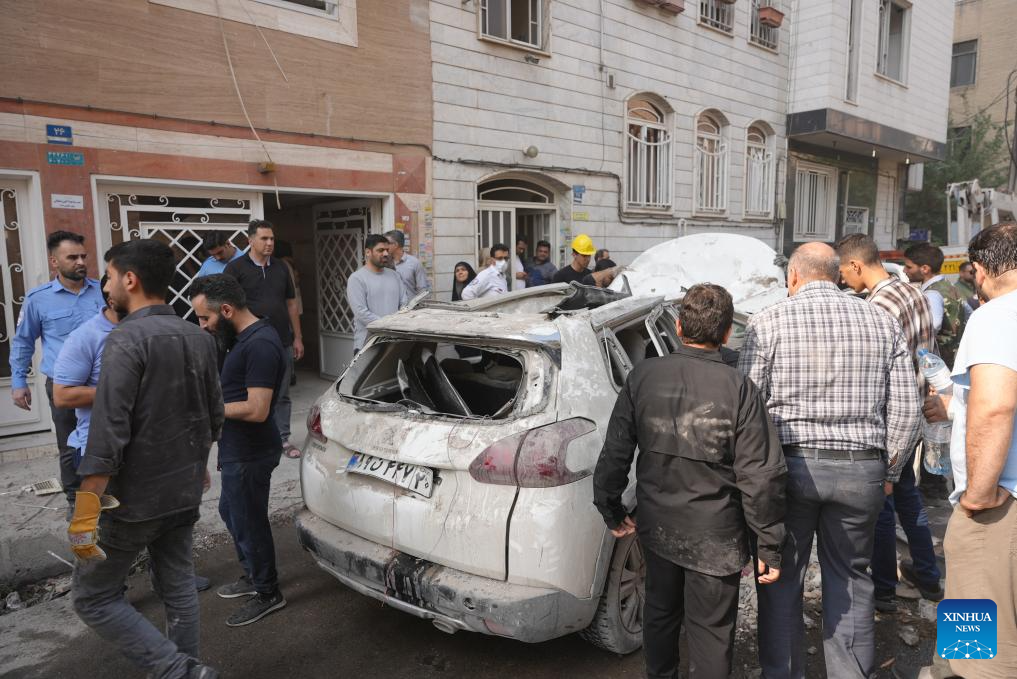
People check a vehicle damaged during Israeli strikes in Tehran, Iran, June 13, 2025. Israeli Defense Minister Israel Katz said on Friday that Israel has launched a "preemptive strike" on Iran.
Chief Commander of Iran's Islamic Revolution Guards Corps Hossein Salami and Gholam-Ali Rashid, commander of Iran's Khatam al-Anbiya Central Headquarters, were assassinated as a result of the airstrikes, the official news agency IRNA reported. (Xinhua)
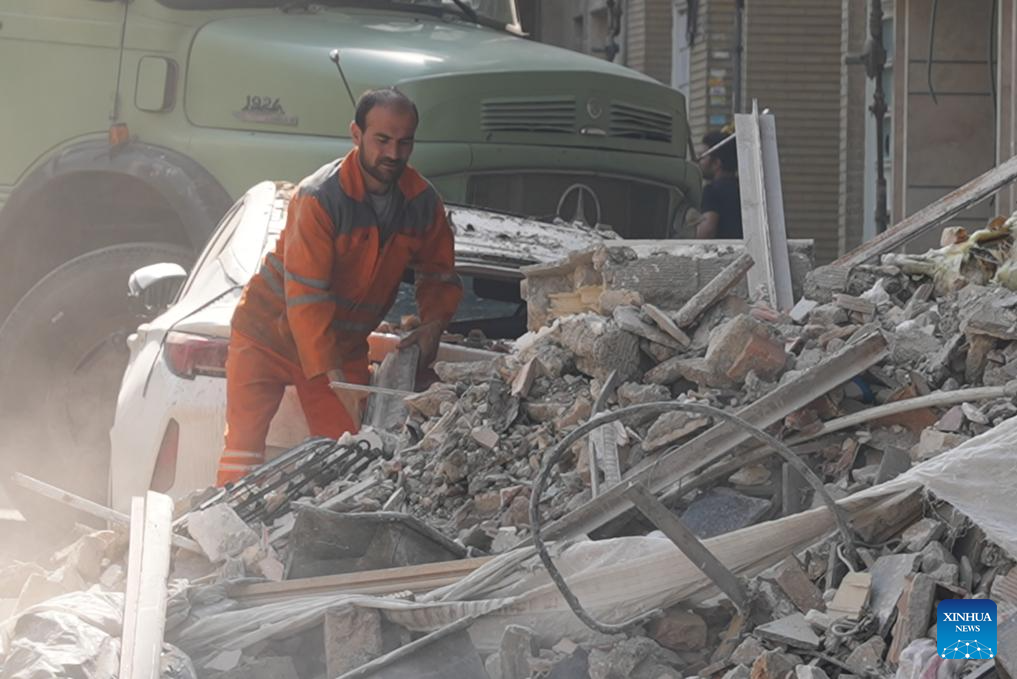
A rescuer attempts to remove debris of buildings damaged during Israeli strikes in Tehran, Iran, June 13, 2025. Israeli Defense Minister Israel Katz said on Friday that Israel has launched a "preemptive strike" on Iran.
Chief Commander of Iran's Islamic Revolution Guards Corps Hossein Salami and Gholam-Ali Rashid, commander of Iran's Khatam al-Anbiya Central Headquarters, were assassinated as a result of the airstrikes, the official news agency IRNA reported. (Xinhua)
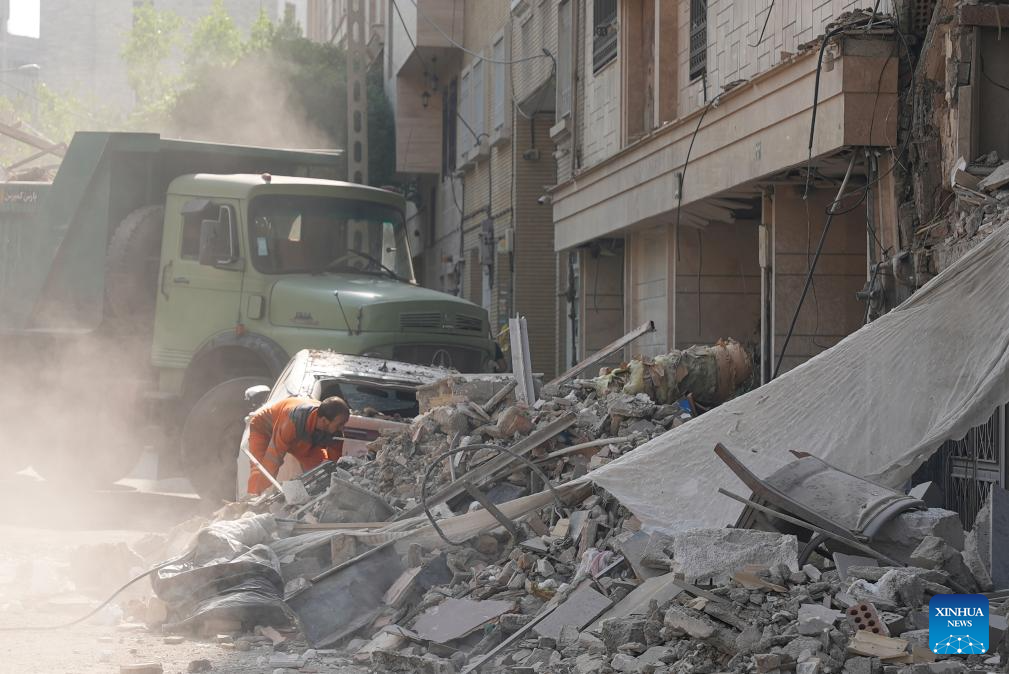
A rescuer attempts to remove debris of buildings damaged during Israeli strikes in Tehran, Iran, June 13, 2025. Israeli Defense Minister Israel Katz said on Friday that Israel has launched a "preemptive strike" on Iran.
Chief Commander of Iran's Islamic Revolution Guards Corps Hossein Salami and Gholam-Ali Rashid, commander of Iran's Khatam al-Anbiya Central Headquarters, were assassinated as a result of the airstrikes, the official news agency IRNA reported. (Xinhua)
NASA and CSA to assign astronauts for Artemis II - by cronywell 30/05/2025 » 16:47
NASA and CSA to assign astronauts for Artemis II
NASA and the Canadian Space Agency (CSA) will announce the four astronauts who will venture to the Moon's surroundings. The announcement will be made during an event to be held at 11 a.m. EDT (10 a.m. CDT) on Monday, April 3, at NASA's Johnson Space Center's Ellington Field in Houston.
Artemis II is the first crewed flight test in the Agency's plan to establish a long-term scientific and human presence on the lunar surface.

NASA and the Canadian Space Agency (CSA) will announce the four astronauts who will venture to the Moon's surroundings. The announcement will be made during an event to be held at 11 a.m. EDT (10 a.m. CDT) on Monday, April 3, at NASA's Johnson Space Center's Ellington Field in Houston. The astronauts will travel aboard NASA's Orion spacecraft during the Artemis II mission, the first crewed flight test in the agency's plan to establish both a long-term scientific and human presence on the lunar surface.
The event will air on NASA Television, the NASA app, and the agency's website.
Media are invited to attend the event and talk to astronauts about their assignments. Other experts working on Artemis missions, including Spanish speakers, will also be available. On Tuesday, April 4, there will be more opportunities to remotely interview crew and other experts.
International media wishing to attend should contact NASA by 5 p.m. CDT on Friday, March 17. U.S. media should contact NASA by 5 p.m. CDT on Monday, March 27. Media can RSVP to the Johnson Center Newsroom by calling +1 281-483-5111 or emailing: jsccommu@mail.nasa.gov.
Artemis II is the first crewed mission aboard NASA's critical infrastructure for deep space exploration with humans: the Space Launch System (SLS) rocket, the Orion spacecraft and the ground systems needed for its launch. The mission, which lasts approximately 10 days, will test the life support systems of the Orion spacecraft to demonstrate the capabilities and techniques necessary to live and work in deep space in a way that only humans can.
The crew will include three NASA astronauts and one CSA astronaut, highlighting the agency's strong international partnerships and global alliance exploring deep space for the benefit of humanity under Artemis. Artemis II builds on the successful Artemis I flight test, which launched an uncrewed Orion spacecraft, mounted on the SLS rocket, on a journey of about 2.25 million kilometers (1.4 million miles) beyond the Moon to test the systems before astronauts fly aboard the systems on a mission to the Moon.
Document generated in 0.01 second