







News
ECONOMY · WHOLESALE INFLATION
Wholesale inflation jumped to 2.1% in August and reopens the political debate after official celebrations for its slowdown
The IPIM measured by INDEC accelerated 1.3 percentage points compared to July, surpassed retail inflation and revived the discussion on the direction of prices, just a month after the Government celebrated the slowdown of the indicator.
|
📅 September 17, 2026 |
⏱️ Reading: 5 minutes |
✍️ Economy Editorial Team |
Wholesale prices accelerated again in August. According to INDEC, the Internal Wholesale Price Index (IPIM) rose 2.1% compared to July, when it had marked only 0.8%. The rebound, of 1.3 percentage points, placed the indicator above the retail CPI and returned to the center of the scene a discussion that the Government itself had taken for granted a month earlier.
📊 The data that set the agenda
The general level of the IPIM registered a monthly increase of 2.1% in August, with a year-on-year variation of 29.8% and a cumulative 19.1% in the first eight months of 2026. The result was 0.4 points above the Consumer Price Index of the same month, which was 1.7%, which anticipates a possible pressure on retail prices in the coming months, given that wholesale costs tend to be passed on to the shelves with a lag.
The rise was explained by an increase of 2.1% in products of national origin and 2.9% in imports, the latter driven by the behavior of the exchange rate and dollarized inputs. Within the index, primary products climbed 4.6%, while manufactured products and electricity advanced at a more moderate pace, of 1.3%.
⛽ The items that pushed the index the most
Among the divisions with the greatest positive impact was "Crude oil and gas", which contributed 0.71 percentage points to the general result. It was followed by "Agricultural products" (0.25 p.p.), "Food and beverages" (0.17 p.p.), "Refined petroleum products" (0.14 p.p.) and "Motor vehicles, bodies and spare parts" (0.10 p.p.).
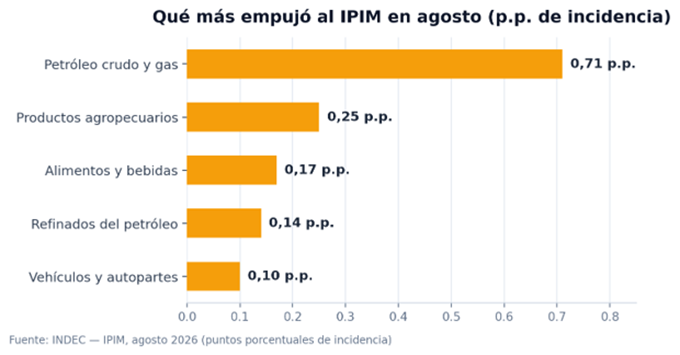
Graph: Authors' elaboration based on INDEC — IPIM data, August 2026. Incidence in percentage points.
📈 A series with ups and downs during 2026
The performance of the IPIM had strong ups and downs throughout the year. After a jump of 5.2% in April, the index began a sustained slowdown: 2.5% in May, 1.1% in June and 0.8% in July, the lowest record of the year and which the economic management had publicly highlighted as a sign of the success of the stabilization plan. August ended this downward streak and returned the indicator to an area above 2% per month, although still far from the peaks of April and May.
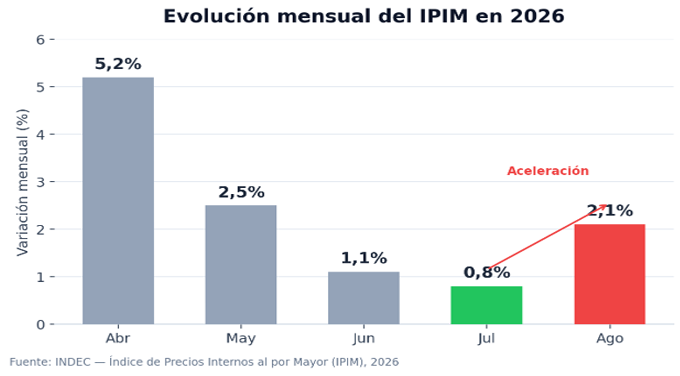
Graph: Authors' elaboration based on INDEC data — Monthly variation of the IPIM, April-August 2026.
🏛️ From official celebration to the blow of acceleration
The August data comes just weeks after national officials celebrated the slowdown in July as a confirmation of the economic course. The Minister of Economy, Luis Caputo, had maintained in different public appearances that inflation could pierce 1% per month during the second half of the year, and President Javier Milei himself repeatedly set the objective of bringing the index closer to values close to zero by August.
The August result contrasted with those expectations and revived criticism from the opposition, which had questioned the official reading of the slowdown in previous months as premature or partial. On his social networks, Caputo attributed the rise to the evolution of domestic and imported products, in a message that replicated, without delving into the root causes, the figure released by INDEC.
🗣️ An indicator that anticipates forward pressure
Economic analysts closely follow the IPIM because its behavior tends to anticipate subsequent movements in retail prices: when production and import costs rise, that pressure tends to be transferred – with lag – to the prices paid by the final consumer. For this reason, the acceleration in August generated caution among those who project retail inflation for the coming months, in particular due to the weight of energy and fuels within the cost structure.
INDEC's System of Wholesale Price Indexes also released two other complementary measurements: the Basic Domestic Wholesale Price Index (IPIB), which rose 2.3% (2.2% in domestic products and 3% in imports), and the Basic Producer Price Index (PPI), which advanced 2.3%, with a rise of 4.6% in primary products and 1.3% in manufactured goods and energy.
🔮 What to watch from here on out
The economic team itself had insisted that convergence to low-single-digit inflation, or even close to zero, would depend on maintaining control of monetary issuance and fiscal balance. The upturn in August does not modify that declared roadmap, but it does force the government to explain a figure that departs from the narrative of linear deceleration that it had installed in previous months, in a year also marked by the electoral agenda.
✅ Key points
✔ The IPIM rose 2.1% in August, 1.3 points more than in July (0.8%).
✔ The year-on-year increase was 29.8% and the accumulated increase in 2026 reached 19.1%.
✔ The IPIM was 0.4 points above the CPI for August (1.7%).
✔ Imported products (+2.9%) rose more than domestic products (+2.1%).
✔ "Crude oil and gas" was the item with the highest incidence, with 0.71 p.p.
✔ The data interrupted three consecutive months of slowdown in the index.
📚 Sources consulted
🔗 INDEC — Wholesale Price Index System (MPI), August 2026
🔗 INDEC — Official Statistics Portal
🔗 Infobae — Wholesale inflation accelerated to 2.1% in August
🔗 El Cronista — Against the retail industry: wholesale inflation accelerated to 2.1%
🔗 Río Negro — Wholesale inflation rebounded in August 2026
🖼️ Reference image — INDEC headquarters (external source, illustrative use)
Note on images: the two graphics included in this note are our own elaborations based on official INDEC data. For copyright reasons, photographs of third parties are not reproduced; it is suggested that the editorial staff incorporate a royalty-free cover image (own or Argentina.gob.ar image bank) before publication.
❓ Frequently asked questions (for FAQ schema and "people also ask")
Q: How much did wholesale inflation rise in August 2026? — A: INDEC's IPIM rose 2.1% compared to July.
Q: How was the year-on-year wholesale inflation? — A: It accumulated a 29.8% increase in the last twelve months.
Q: Did wholesale inflation exceed retail inflation? — A: Yes, it was 0.4 points above the CPI for August (1.7%).
Q: Which products increased the most? — A: Imports (+2.9%), above domestic products (+2.1%).
Q: Which item explained the increase the most? — A: "Crude oil and gas", with 0.71 percentage points of incidence.
 2027 Budget: the keys to the bill that reaches Congress
- 15/09/2026 » 19:41 by cronywell
2027 Budget: the keys to the bill that reaches Congress
- 15/09/2026 » 19:41 by cronywell
ECONOMY AND MARKETS
2027 Budget: the keys to the bill that reaches Congress
Growth, inflation, dollar, fiscal result, income and spending: what the initiative presented by the Argentine Government contemplates and what are the points that should be debated during its legislative treatment.
September 15, 2026 · Approximate reading time: 9 minutes
|
GDP 20274% |
Average inflation21.1% |
|
Inflation Dec./Dec.≈18% |
Average salary+25.4% |
|
Average dollar$1,728 |
December dollar$1,847.6 |
|
Financial result≈ +0.2% GDP |
Exports> US$130,000 M |
📰 Introduction
On September 15, 2026, the Argentine Government presented the draft Law on the General Budget of the National Administration for the 2027 fiscal year and sent it to the Chamber of Deputies to begin its legislative treatment. The shipment took place within the period provided by the regulations for the project corresponding to the following year.
The initiative comes at a particularly relevant time: 2027 will be a presidential election year and the Budget will function as one of the main references for evaluating economic policy priorities, the fiscal trajectory and the allocation of public resources. The text is not yet a law: its figures and provisions are subject to parliamentary debate, eventual modifications and final approval.
The first variables released by the Government place the real growth of the Gross Domestic Product (GDP) at 4% for 2027. The average inflation forecast stands at 21.1%, while for December 2027 a year-on-year variation of close to 18% is projected. The average salary appears with an estimated increase of 25.4%.
In fiscal matters, the bill contemplates a positive primary result and a financial surplus. The figures released by different journalistic sources indicate a primary result of around 1.3%–1.5% of GDP and a financial result of 0.2% of GDP; the final figure must be read directly in the official text and its spreadsheets when its publication and parliamentary processing are completed.
📊 The main macroeconomic variables
The Budget not only distributes items: it also builds a macroeconomic scenario that serves as a basis for calculating income, expenditure and financing needs. For this reason, the assumptions on activity, inflation, wages, exchange rate and foreign trade are decisive.
• GDP: the government projects real growth of 4% during 2027.
• Inflation: average inflation is estimated at 21.1% for the year and a year-on-year variation of approximately 18% towards December.
• Salaries: the average salary would increase 25.4%, according to the variables disseminated.
• Exchange rate: the project contemplates an average annual exchange rate of $1,728 and a nominal exchange rate of $1,847.6 for December 2027.
• External sector: exports of goods and services would exceed US$130,000 million and the positive balance of goods and services would be above US$15,000 million.
These figures are budgetary assumptions, not guarantees or independent forecasts. They are useful in establishing a framework for calculating resources and expenditures; they can then be compared with the actual performance of the economy and with the expectations of the private sector.
💰 The fiscal axis: surplus as a reference rule
The fiscal result occupies a central place in the project. The Government maintains that the 2027 Budget seeks to preserve the balance of the public accounts and projects a positive financial result equivalent to approximately 0.2% of GDP.
The primary result – before the payment of interest on the debt – would be around 1.3% to 1.5% of GDP according to the different communications released on the project. The difference between the two figures and their exact formulation will have to be verified in the articles and in the official spreadsheets.
The approach is consistent with the fiscal framework that the Executive Branch has been using since 2024: limit spending to the level compatible with available resources and prevent the deficit from becoming a permanent source of monetary financing.
For readers, one distinction is important: primary surplus and financial surplus do not mean the same thing. The former excludes interest on public debt; the latter incorporates the result after those payments. Therefore, achieving a financial surplus implies a higher fiscal requirement.
📈 Revenues: a collection that should grow above inflation
The first guidelines released indicate that tax collection could increase by around 30.6% during 2027, while the total resources of the Public Administration would grow by about 26.2%.
If the projected average inflation is 21.1%, these nominal rates would imply real growth in resources, provided that the macroeconomic assumptions are fulfilled. The comparison, however, must be made carefully: the collection also depends on the level of activity, wages, consumption, foreign trade, imports, exports and regulatory changes.
The project thus acquires an additional dimension for companies and consumers. Higher revenue may come from a larger economy and a larger tax base, but it may also be modified by changes in rates, exemptions, collection regimes or evolution of certain taxes.
🏛️ Public expenditure and the composition of the Budget
The guidelines released place the nominal growth of total expenditure at around 25.2%, with an increase of close to 25.3% in current expenditures. Capital expenditures would have an evolution approximately aligned with projected inflation.
The aggregate data, however, is not enough to know the impact on each area. To understand the Budget, it is necessary to look at the items by purpose, jurisdiction, agency, and program. It is also important to distinguish between current expenditure – salaries, benefits, transfers and operation – and capital expenditure, which includes public investment and certain works and equipment.
In the weeks prior to the sending, different journalistic analyses had indicated that pensions and debt service presented high levels of execution in 2026. Increases or reinforcements linked to Defense and Foreign Affairs were also reported. These issues will have to be contrasted with the final spreadsheets of the 2027 Budget, because a nominal modification does not necessarily equate to a real increase in spending.
🛡️ Defence, sovereignty and strategic priorities
The 2027 Budget incorporates an additional discussion on Defense and Argentine foreign policy. In the days prior to the shipment, the Government announced a greater emphasis on issues related to national sovereignty and the Malvinas Islands. Press reports also pointed to budgetary reinforcements for Defense and Foreign Affairs.
These items must be analyzed within the Budget as a whole: the relevant data is not only how much a jurisdiction increases in current pesos, but what proportion it represents over the total, how it evolves in the face of inflation and what specific programs receive the resources.
The parliamentary debate will allow us to know more precisely the credits allocated to equipment, infrastructure, personnel, operations and strategic projects.
🎓 Health, education, pensions and social protection
Social areas account for a substantial part of national spending and, due to their direct impact on households, will be one of the focuses of the budget debate.
In the 2026 Budget, approved by Law 27,798, the purposes of social services represented the largest component of expenditure by purpose. For 2027, the analysis should focus on the real evolution of retirements, pensions, allowances, health, education and social programs.
It is not enough to observe the nominal increase of an item. If an item rises 20% in a scenario of inflation of 21.1%, its budgetary purchasing power could decrease slightly; if it increases 30%, it could grow in real terms. This reading will be essential to interpret the figures when the effective execution is known.
🏗️ Public works and investment
Public investment is another key element. In a budget oriented towards a positive fiscal outcome, capital expenditure usually faces direct competition for available resources.
For provinces and municipalities, the central point will be to determine which national works have been assigned, which continue from previous years and which incorporate new financing. It will also be relevant to distinguish budgeted works from those that only appear as projects or that depend on agreements and transfers.
The legislative treatment may modify specific items, especially those that impact on road infrastructure, transportation, housing, water and sanitation, and regional development.
💵 Dollar and inflation: how to read the numbers
The budgeted exchange rate deserves an explanation. The figure of $1,728 as an annual average and $1,847.6 for December 2027 should be interpreted as a hypothesis used to build the fiscal scenario, and not as a promise about the daily market price.
Projected inflation also requires prudence. The government uses 21.1% as average inflation and approximately 18% year-on-year as of December. The difference exists because average inflation compares the average price level of the year with that of the previous year, while year-on-year inflation compares December against December.
For companies, businesses and households, the real value of these hypotheses will be in their relationship with wages, costs, rates, interest rates, rents, taxes and wholesale prices. A Budget can be right or wrong in its macroeconomic variables and, consequently, substantially modify the actual execution of the items.
📦 Exports and the external sector
The project contemplates a scenario of strong growth in foreign trade. Exports of goods and services would exceed US$130,000 million, while the balance of goods and services would be positive by more than US$15,000 million.
The hypothesis is relevant because Argentina needs foreign currency to sustain imports, meet external obligations and reduce financial vulnerabilities. Energy, agribusiness, mining and other export complexes may play a significant role in this scenario.
The figure, however, depends on international prices, exported volumes, real exchange rate, productive capacity, investments and commercial conditions. The effective result can only be evaluated with 2027 data.
🏦 Debt and financing
The sustainability of the financial result is closely linked to the cost of public debt. A financial surplus means that, under the budgeted scenario, the result of income and expenses after interest remains positive.
The structure of maturities, interest rates, market access and the composition between debt in pesos and foreign currency will be determining variables during 2027.
Therefore, the analysis of the Budget should not be limited to primary expenditure. Debt servicing can alter the financial result even when the State maintains a positive primary result.
🏛️ The legislative path
The bill entered the Chamber of Deputies, where it must be sent to the corresponding commissions and later discussed in the chamber. The Budget and Finance Committee will have a central role in the discussion.
The parliamentary procedure may include statements by officials, requests for information, modifications to the articles and changes in the expenditure and resource schedules. After the eventual approval in the Chamber of Deputies, the bill must go to the Senate.
Therefore, the figures released on September 15 constitute the starting point of the legislative process. The Budget that finally becomes law may differ from the original project.
🔎 What to watch during the debate
To follow the 2027 Budget with economic and journalistic criteria, it is advisable to look at at least ten indicators:
1. Primary result and financial result.
2. Budgeted inflation versus the inflation actually recorded.
3. Expected and observed GDP growth.
4. Real evolution of retirements and pensions.
5. Health and education in nominal and real terms.
6. Public investment and works by province.
7. Subsidies and transfers.
8. Public debt service.
9. Tax resources and tax pressure.
10. Assumptions about the dollar, exports and imports.
This methodology makes it possible to avoid a reading based exclusively on nominal increases. In an inflationary context, comparing real percentages is essential.
📌 Conclusion
The 2027 Budget proposes a scenario of growth of 4%, average inflation of 21.1%, year-on-year inflation close to 18% towards December, an increase in the average salary of 25.4%, expansion of exports and continuity of the positive fiscal result.
The main analytical challenge will be to determine how much of these goals depend on macroeconomic assumptions and how much is supported by concrete spending and revenue decisions. It will also be key to observe how the fiscal effort is distributed among the different areas of the State and how the allocations impact provinces, companies, workers, retirees and households.
Like any budget law, the document combines planning and legislative authorization. Its true result can only be known through the execution during 2027 and the comparison between what was budgeted and what was actually carried out.
MiDire will follow the parliamentary treatment and the evolution of the main variables to offer an updated reading of how the 2027 Budget can be translated into resources, expenses, investment and economic activity.
⚠️ Update note and methodology
This article was prepared with information available as of September 15, 2026. The 2027 Budget is a project under legislative treatment and should not be confused with a law already passed. Macroeconomic figures are attributed to the scenario presented by the Government and contrasted with parliamentary and journalistic information. When there are differences between preliminary communications and journalistic publications, the range is indicated or it is recommended to verify the official text and its final spreadsheets.
🖼️ Absolute images and links
Casa Rosada — image from Wikimedia Commons — license/source page: https://commons.wikimedia.org/wiki/File:Casa_Rosada_Buenos_Aires.jpg · direct archive: https://commons.wikimedia.org/wiki/Special:Redirect/file/Casa%20Rosada%20Buenos%20Aires.jpg
Palace of Congress — image from Wikimedia Commons — license page/source: https://commons.wikimedia.org/wiki/File:Palacio_del_Congreso_de_la_Nación_Argentina.jpg · direct archive: https://commons.wikimedia.org/wiki/Special:Redirect/file/Palacio%20del%20Congreso%20de%20la%20Nación%20Argentina.jpg
📚 Sources consulted
Chamber of Deputies of the Nation — Committee on Budget and Finance — https://www.hcdn.gob.ar/comisiones/permanentes/cpyhacienda/reuniones/
Presidency of the Nation — 2026 Budget / official background — https://www.argentina.gob.ar/economia/sechacienda/ley-de-presupuesto-2026
Official Gazette — Law 27,798, Budget 2026 — https://www.boletinoficial.gov.ar/detalleAviso/primera/337027/20260102
LA NACION — Axes of the 2027 Budget, 09/15/2026 — https://www.lanacion.com.ar/politica/los-ejes-del-presupuesto-2027-que-el-gobierno-de-milei-presento-en-el-congreso-nid15092026/
Bloomberg Line — Macroeconomic variables of the 2027 Budget — https://www.bloomberglinea.com/latinoamerica/argentina/presupuesto-2027-que-plantea-el-gobierno-de-milei-para-la-inflacion-el-pbi-y-el-dolar/
El Cronista — Fiscal priorities and collection — https://www.cronista.com/economia-politica/las-prioridades-del-presupuesto-2027-superavit-consumo-recaudacion-y-baja-de-impuestos/
Scope — Economic keys to the 2027 Budget — https://www.ambito.com/presupuesto-2027-dolar-inflacion-pbi-y-superavit-las-claves-economicas-del-gobierno-el-proximo-ano-n6322727/
Infobae — Preparation and submission of the 2027 Budget — https://www.infobae.com/politica/2026/09/15/el-gobierno-ultima-detalles-del-presupuesto-2027-y-pule-la-redaccion-del-proyecto-por-malvinas/
Document prepared for editorial publication in MiDire · Recommended review before publishing any updates after 15/09/2026.
 🥇🔍 The AGN admits that it could not verify the destination of the Argentine gold sent abroad
- 15/09/2026 » 00:02 by cronywell
🥇🔍 The AGN admits that it could not verify the destination of the Argentine gold sent abroad
- 15/09/2026 » 00:02 by cronywell
LAST MINUTE · RESERVATION CONTROL
🥇🔍 The AGN admits that it could not verify the destination of the Argentine gold sent abroad
The external watchdog confirmed that it did not have face-to-face access to the bullion transferred in 2024, while the BCRA and the opposition are crossing paths over their real location: Switzerland or London?
|
📖 READING TIME ≈ 8–9 minutes |
🗓️ UPDATED September 14, 2026 |
🏛️ ORGANIZATIONS AGN · BCRA · Senate |
🥇 IN GAME 13 tons of gold |
The Auditor General of the Nation (AGN) set off alarms by confirming that, so far, it has not been able to verify in person the destination and status of the gold bars that the Central Bank of the Argentine Republic (BCRA) sent abroad in 2024. The external control body of the public sector maintains that the restrictions imposed by the monetary entity itself prevented it from gathering sufficient evidence to close the review, in open contradiction with the statements of the president of the BCRA, Santiago Bausili, who had assured the Senate that the operations already had audits without observations.
🥇 The origin: 13 tons of gold heading abroad
The conflict dates back to mid-2024, when the Central Bank made four transfers of bullion abroad: on June 18, July 2, July 31 and August 13. According to official documentation released by the AGN, 250 bars were transferred in each of these shipments, for an estimated total of 13 tons of gold, a relevant portion of the issuing agency's reserves.
The operation remained under reserve for almost two years, until Bausili himself confirmed its existence on September 9, 2026 before the Senate Budget and Finance Committee, within the framework of the debate on the reform of the BCRA's Organic Charter. The official explained that the decision responded to a market opportunity: part of the Argentine bullion, smelted between the 1960s and 1990s, had less commercial acceptance due to their age, and a strong international demand for gold made it possible to reduce the cost of exchanging them for higher quality pieces.
🏦 The official version: Switzerland and the Bank for International Settlements
Bausili said that the bullion was deposited in an account linked to the Bank for International Settlements (BIS), an organization that functions as a "bank of central banks" based in Basel, Switzerland. The official also defended the confidentiality of the operation, arguing that disclosing in real time the financial positions of the Central Bank could facilitate market maneuvers against the interests of the country.
Asked by Senator Juliana Di Tullio about the status of that placement, the head of the BCRA was categorical: the information is available, it is audited and the audit reports are there, he remarked to the legislators. That statement is precisely the one that the AGN came out to contradict days later.
🇬🇧 The Counterversion: Basel or London?
The controversy escalated when Di Tullio herself questioned the geographical accuracy of the official explanation. According to the legislator, although the bars are registered under a BIS account, their real physical custody would be in the Bank of England, in London, and they would never have passed through Basel. Bausili lied to the Senate, the gold is in London, in the Bank of England, the senator said in dialogue with Infobae, in an accusation that the Government rejected.
🇨🇭 BCRA version: the bullion is deposited in an account of the BIS, based in Switzerland.
🇬🇧 Opposition's version: the physical custody would be at the Bank of England, in London.
📄 Common point: Exact traceability – ownership versus physical location – has not yet been certified by an independent watchdog.
🔍 What the AGN found (and what it could not do)
According to the reconstruction published by Ambito, when the AGN first requested the documentation to audit the four transfers of 2024, the Central Bank did not explicitly refuse, but neither did it deliver the minutes, opinions and other actions necessary to move forward. The only concrete proposal that the audit team received was to approach and review the information directly from the entity's computers, without the possibility of taking backup copies.
Added to this was a striking response from the BCRA itself to one of the requests for information: the contracts for the placement of gold bars with the BIS or another foreign depository do not exist to date and there were none as of December 31, 2024, according to the official documentation cited by the audit. In addition, on December 22, 2025, the Federal Administrative Court had ordered the Central Bank to respond to requests for access to public information on the transfer of the gold, a court order that, according to different media, was not complied with in a timely manner.
The result, according to the AGN itself, is that the existence of an audit project within its work plan does not amount to a verification already completed: the review on the traceability of gold reserves is still open and does not allow, for the time being, to officially confirm either the location or the physical condition of the bullion.
🏛️ The political crossover and the repercussions in Congress
The head of the AGN, Juan Manuel Olmos, deepened the criticism in public statements: the president of the BCRA has not been clear about Argentine gold abroad, he said, and questioned that the monetary entity did not clarify precisely what happened with the bullion between June 2025 and May 2026. The Central Bank, meanwhile, remarked that the audit corresponding to the 2024 fiscal year was closed, and that the delay corresponds to the 2025 period, whose documentation would have arrived late to the auditors.
The controversy led to a parliamentary offensive: blocs of senators from the Justicialist Party presented a bill to urgently summon Bausili before Congress, with the aim of explaining with supporting documentation the complete traceability of the 13 tons transferred. At the same time, the debate over the reform of the BCRA's Organic Charter – which already has half the approval of Deputies – was crossed by the dispute over transparency in the management of reserves.
🧭 Timeline of the conflict
|
Date |
Fact |
|
Jun.–Aug. 2024 |
The BCRA makes four transfers of 250 bars each abroad (18/6, 2/7, 31/7 and 13/8). |
|
22/12/2025 |
The Federal Administrative Court orders the BCRA to respond to requests for public information on the transfer. The order is not complied with. |
|
09/09/2026 |
Bausili confirms before the Senate that the 13 tons were deposited in the BIS, based in Switzerland. |
|
10/09/2026 |
Senator Juliana Di Tullio maintains that the gold is physically in the Bank of England, in London. |
|
11/09/2026 |
Ámbito reveals that the AGN was unable to audit the operation due to lack of documentation provided by the BCRA. |
|
14/09/2026 |
The head of the AGN, Juan Manuel Olmos, publicly questions the lack of transparency of the Central Bank. |
📊 Why it matters: reserves, trust and control of the state
Beyond the immediate political dispute, the episode brings to the fore a fundamental discussion: the real capacity of control bodies – such as the AGN – to independently oversee the management of strategic assets of the State, particularly when the audited entity invokes reasons of market confidentiality to restrict access to information. Gold is, historically, one of the most sensitive reserve assets of any central bank, and its traceability is usually considered a minimum standard of institutional transparency in any democracy.
While the government insists that there are no irregularities and that the operation responded to a reasonable financial logic, the lack of a conclusive external verification leaves open a question that, for now, no agency could answer with documentary certainty: where exactly are the 13 tons of Argentine gold that left the country in 2024.
🖼️ Verified images and visual sources
Due to access policies to external networks of this document generation environment, the photographs could not be embedded as a binary file within this Word. Listed below are verified absolute links —verified as accessible at the time of this writing— with real photographs and free consultation on the subject:
📷 Historic façade of the Central Bank (BCRA), Buenos Aires: https://www.bcra.gob.ar/noticias/la-fachada-de-la-primera-sede-del-bcra-fue-restaurada-y-puesta-en-valor/ — Official note from the BCRA on the restoration of its headquarters at 275 San Martín Street
📷 Bank for International Settlements (BIS) Headquarters, Basel, Switzerland: https://en.wikipedia.org/wiki/Bank_for_International_Settlements — Encyclopedic article with image of the BIS tower in Basel
📷 Bank of England, London: https://en.wikipedia.org/wiki/Bank_of_England — Encyclopaedic article with photograph of the façade of the Bank of England
📚 Sources consulted
🔗 Ámbito — AGN denies Santiago Bausili: https://www.ambito.com/politica/envios-oro-al-exterior-la-agn-desmiente-santiago-bausili-n6320626
🔗 Profile — The AGN has not yet audited the reserves: https://www.perfil.com/noticias/politica/oro-del-bcra-la-agn-todavia-no-audito-las-reservas-y-contradijo-la-version-que-dio-bausili-en-el-senado.phtml
🔗 Infobae — Di Tullio: "the gold is in London": https://www.infobae.com/politica/2026/09/10/juliana-di-tullio-bausili-le-mintio-al-senado-el-oro-del-banco-central-esta-en-londres/
🔗 La Nación — Bausili revealed where the gold is: https://www.lanacion.com.ar/economia/santiago-bausili-revelo-donde-esta-parte-del-oro-del-banco-central-se-deposito-en-suiza-nid09092026/
🔗 First — AGN crossed to Bausili: https://primereando.com.ar/index.php/2026/09/14/desde-la-auditoria-general-de-la-nacion-cruzaron-a-bausilli-no-ha-sido-claro-respecto-al-oro-argentino-en-el-exterior/126647/
🔗 Scope — The PJ asks Bausili to go to Congress: https://www.ambito.com/politica/el-pj-pide-que-bausili-vaya-al-congreso-dar-explicaciones-el-oro-del-banco-central-n6322171
Note in development — this text will be updated as the AGN and the BCRA provide new documentation.
 The Treasury tendered assets for US$5.573 billion and achieved a rollover of 103% in a mixed market
- 12/09/2026 » 11:44 by cronywell
The Treasury tendered assets for US$5.573 billion and achieved a rollover of 103% in a mixed market
- 12/09/2026 » 11:44 by cronywell
ECONOMÍA Y MERCADOS · 11 DE SEPTIEMBRE DE 2026
El Tesoro licitó activos por US$5.573 millones y logró un rollover del 103% en un mercado mixto
El Gobierno adjudicó 8,41 billones de pesos en la primera licitación de septiembre, renovó los vencimientos del día y extendió parte de la deuda hacia 2027, mientras el riesgo país se mantiene estable por debajo de los 500 puntos.
|
11 de septiembre |
5 min de lectura |
Rollover: 103,46% |
El Tesoro argentino cerró este viernes la primera licitación de deuda de septiembre con un resultado que el mercado financiero interpretó como una señal de fortaleza relativa, en medio de una jornada de mercados internacionales mixtos y un riesgo país que se mantiene estable, por debajo de los 500 puntos básicos.
Según informó la Secretaría de Finanzas, el organismo que conduce la política de deuda del Ministerio de Economía recibió ofertas por 14,17 billones de pesos y adjudicó 8,41 billones, el equivalente a unos 5.573 millones de dólares al tipo de cambio de referencia del Banco Central. Frente a vencimientos por aproximadamente 8,1 billones de pesos, la operación implicó un rollover -renovación de deuda- del 103,46%, lo que significa que el Gobierno no solo cubrió los compromisos que caían ese día, sino que sumó financiamiento adicional.
La licitación recibió 5.010 ofertas y combinó instrumentos a tasa fija, títulos ajustados por inflación, bonos atados a tasas mayoristas y, como principal novedad, cuatro instrumentos dólar linked por un total de 665 millones de dólares nominales, pensados para inversores que buscan cobertura cambiaria de cara a un 2027 electoral que el propio mercado empieza a mirar con atención.
Qué instrumentos eligieron los inversores
El grueso de la colocación se concentró en la reapertura de la LECAP S13N6, con vencimiento el 13 de noviembre de 2026, que adjudicó 4,07 billones de pesos a una tasa interna de retorno efectiva anual (TIREA) del 27,88%. También se colocaron 688.925 millones de pesos de la letra ajustada por CER X29E7, con vencimiento en enero de 2027, a un rendimiento de corte del 5,50% anual sobre la inflación.
En los instrumentos atados a la tasa TAMAR, el Tesoro adjudicó 1,39 billones de pesos del TMF27 (febrero de 2027, TIREA 30,55%) y 1,28 billones del TML27 (julio de 2027, TIREA 31,66%). Del total adjudicado, 7,43 billones de pesos correspondieron a instrumentos en moneda local y 982.108 millones a títulos vinculados al dólar oficial.
Entre los instrumentos dólar linked se destacaron los 314 millones de dólares colocados en el D30O6, con vencimiento el 30 de octubre y una TIREA del 8,78%; los 63 millones de dólares de una nueva letra a fin de noviembre, con TIREA del 7,42%; los 154 millones del D31M7, con vencimiento en marzo de 2027 y TIREA de 7,58%; y los 134 millones del bono TZV27, con vencimiento en junio de 2027 y TIREA de 5,24%.
La lectura del mercado
Desde la sociedad de bolsa Puente destacaron que la estrategia del equipo económico apuntó a capitalizar la elevada demanda para colocar la mayor cantidad posible de instrumentos dólar linked sin convalidar un premio excesivo sobre las tasas del mercado secundario, en varios casos incluso por debajo de ellas. Esa lectura coincide con la de otros bancos y agentes de bolsa, que ven en la fuerte demanda por cobertura cambiaria una señal de cautela de los inversores institucionales, más que una alarma sobre la solvencia del Tesoro.
|
La estrategia se enfocó en aprovechar la elevada demanda para adjudicar la mayor cantidad posible en instrumentos dólar linked sin dar un premio excesivo. — Lectura de mercado atribuida a la sociedad de bolsa Puente |
El resultado se conoció en una rueda en la que el dólar mayorista y minorista se mantuvieron relativamente calmos: el dólar en el Banco Nación cerró la jornada en 1.530 pesos para la venta, mientras el Banco Central sumó compras de reservas por unos 5 millones de dólares. El riesgo país, el índice que elabora JP Morgan para medir el sobrecosto que paga la deuda argentina frente a la de Estados Unidos, venía de recortar 22 unidades en la semana previa hasta ubicarse en torno a los 490 puntos básicos, lejos de los máximos de años anteriores y en línea con la tendencia de baja que muestra desde comienzos de 2026.
En paralelo, el humor de los mercados globales fue dispar: una suba del precio del petróleo presionó a Wall Street, con caídas generalizadas en la mayoría de los sectores salvo las acciones energéticas, que treparon impulsadas por el mismo factor. Puertas adentro, la Bolsa porteña había mostrado una semana favorable, con el índice S&P Merval acumulando una suba de 2,3% hasta los 3.049.121 puntos, según el informe financiero semanal de Banco Provincia.
Datos clave de la licitación
|
Indicador |
Resultado |
|
Ofertas recibidas |
$14,17 billones (5.010 propuestas) |
|
Monto adjudicado |
$8,41 billones (≈ US$5.573 millones) |
|
Vencimientos del día |
≈ $8,1 billones |
|
Rollover |
103,46% |
|
Instrumento más colocado |
LECAP S13N6 (13/11/2026) — $4,07 billones, TIREA 27,88% |
|
Dólar linked colocado |
US$665 millones nominales en 4 instrumentos |
|
Dólar Banco Nación (cierre) |
$1.530 para la venta |
|
Riesgo país (JP Morgan) |
≈ 490 puntos básicos, -22 unidades en la semana |
|
S&P Merval (semana) |
+2,3% hasta 3.049.121 puntos |
Un tablero que mira hacia 2027
Más allá del resultado puntual, los analistas coinciden en que la licitación confirma una estrategia de fondo: extender los plazos de la deuda en pesos hacia 2027 y ofrecer instrumentos de cobertura cambiaria en un contexto donde el propio mercado empieza a descontar mayor volatilidad de cara al año electoral. Ese horizonte también explica por qué varias empresas privadas decidieron adelantar sus propias emisiones de deuda, aprovechando una ventana de liquidez y tasas relativamente bajas antes de que se acerque el proceso eleccionario.
Para el Gobierno, sostener rollovers superiores al 100% sin convalidar tasas de corte muy por encima del mercado secundario es, por ahora, la principal métrica de éxito de su estrategia financiera: implica que no necesita emitir pesos adicionales para cubrir sus vencimientos, lo que a su vez limita una de las principales fuentes de presión inflacionaria y cambiaria. La próxima licitación del Tesoro será, como cada mes, el nuevo termómetro de si esa estrategia sigue funcionando.
Fuentes consultadas
• Argentina.gob.ar — Resultado de la licitación del 11/09/2026 (Secretaría de Finanzas)
• El Cronista — “El Tesoro consiguió $8,4 billones en la licitación”
• Bloomberg Línea — “Gobierno argentino renovó más del 100% de los vencimientos de deuda”
• Eduardo German — “El Tesoro adjudicó $8,41 billones y renovó el 103,46%”
• Banco Provincia — Informe financiero semanal, 7 de septiembre de 2026


