







News
 ✈️ Airport strike in Argentina: ATE announced 48 hours of measures and warns of delays and cancellations
- 02/09/2026 » 11:43 by cronywell
✈️ Airport strike in Argentina: ATE announced 48 hours of measures and warns of delays and cancellations
- 02/09/2026 » 11:43 by cronywell
✈️ Airport strike in Argentina: ATE announced 48 hours of measures and warns of delays and cancellations
The protest of ANAC workers is scheduled for Thursday, September 3 and Friday, September 4. The assemblies and mobilizations will be concentrated from 9 a.m. to 12 p.m. and from 6 p.m. to 9 p.m.
|
Date |
Update |
Reading |
Category |
|
September 2, 2026 |
11:20 · Argentina |
8 minutes |
News · Services |
|
🔴 IN SUMMARY |
What happens to flights on Thursday, September 3 and Friday, September 4
Passengers who have flights scheduled in Argentina on Thursday, September 3 and Friday, September 4 must consider possible alterations in their itineraries. The Association of State Workers (ATE) confirmed a 48-hour national measure that reaches workers of the National Civil Aviation Administration (ANAC) and that will be developed through strikes, assemblies and mobilizations in more than 27 airports.
The impact does not necessarily mean that all flights will be canceled. The critical point is in the time slots defined for the protest: from 9 a.m. to 12 p.m. and from 6 p.m. to 9 p.m. on both days. The impact on certain airport services can have knock-on effects on departures, arrivals, connections and rescheduling, even when a flight does not coincide exactly with the beginning of an assembly.
The information available at the close of this note does not allow us to affirm that there is a definitive list of canceled flights. The recommendation for travelers is to check the status of each operation directly with the airline and avoid going to the airport without previously confirming the situation.
📍 Where the measure will be felt
The protest has a federal scope and was announced in more than 27 airports. Among the most relevant terminals mentioned in the reports are Ezeiza and Aeroparque, as well as regional airports in different provinces.
|
Terminal / area |
Expected situation |
Recommendation |
|
Ezeiza (EZE) |
Possible delays, rescheduling or cancellations in protest slots. |
Check with the airline before leaving. |
|
Aeroparque (AEP) |
Possible impact on domestic and regional flights. |
Check flight status and connections. |
|
Regional airports |
Variable scope according to personnel and services affected. |
Confirm operation with the airline. |
🕘 Protest schedules
|
THURSDAY 3 SEPTEMBER |
|
FRIDAY, SEPTEMBER 4 |
Outside these slots, the operation should continue, but the recovery of the system can take time and a one-off change can have an impact on subsequent flights.
💰 Why is the strike taking place?
According to the ATE statement, the conflict has as its axis the claim for wage and labor breaches that the union attributes to the national government. The union maintains that since January certain additional payments linked to parity agreements have not been paid and demands the reopening of sectoral negotiations.
· Payment of salaries contemplating the agreed increases corresponding to extra-parity items.
· Opening of the sectoral parity.
· Financing for the operational tasks of the Rescue and Fire Fighting Service (SSEI) and for Inspection at airports.
ATE also maintains that working conditions have deteriorated and links the conflict to a loss of purchasing power that, according to its own estimate, exceeds 40% since the beginning of the current national administration. This figure is an assessment of the union and must be differentiated from an independent statistical measurement.
⚖️ A key point: ANAC is not the same as air traffic controllers
In the coverage of the conflict it is important to distinguish ANAC workers from air traffic controllers. ANAC is the civil aeronautical authority and has personnel dedicated, among other functions, to airport health, inspection and the Rescue and Fire Fighting Service. Air navigation services are managed by EANA, so a measure by ATE-ANAC should not be automatically presented as a strike of controllers.
ANAC itself had already clarified in a previous conflict that a ATE-ANAC measure did not necessarily imply an interruption of operational safety nor did it amount to a strike by controllers. For the September 2026 situation, the agency reported that the competent authorities are evaluating the scope and conditions of the measure.
📋 What the regulatory framework says about essential services
Argentine aeronautical regulations consider certain services related to air navigation essential and establish mechanisms to preserve minimum services during union measures. ANAC Resolution 173/2026 regulated the provision and modality of public and essential air navigation services during union actions and established operational continuity criteria.
Among other provisions, the regulation establishes that certain aircraft – such as public and health aircraft – should not be affected by the measure and contemplates rules for flights that are already in operation and for destinations with a single daily frequency. This constitutes a general regulatory framework and should not be confused with the specific union announcement of September 3 and 4.
🧳 What passengers should do
· Check the status of the flight on the app, website or official channels of the airline before heading to the airport.
· If the flight is confirmed, keep track because an operational modification may occur later.
· Arrive with additional time if the company maintains the operation, especially in the strips near the beginning or end of the protest.
· Do not assume that a cancelled flight is automatically rescheduled: check the airline's instructions.
· If there is a connection, check each section of the itinerary separately.
· Keep receipts of purchase, communications from the airline and extraordinary expenses in case of possible claims.
· For health, humanitarian, organ and official flights, the situation has a differentiated treatment according to the ATE announcement.
|
⚠️ IMPORTANT FOR TRAVELERS |
🏙️ The impact on the country's connectivity
The relevance of the measure exceeds the passengers who take off during protest hours. Air transport works like a network: a delay at a headland can alter an aircraft's rotation, crew availability, passenger boarding on connections, and the scheduling of subsequent flights.
The risk is especially sensitive in the main connectivity nodes. Ezeiza concentrates a large part of international traffic and Aeroparque has a central role in domestic and regional connectivity. At airports in the interior, an interruption can have a proportionally greater effect when there are fewer daily frequencies and fewer immediate land alternatives.
🗣️ Two positions in the face of the conflict
ATE maintains that the protest is a consequence of the lack of responses to its demands for wages and operational financing. The union's general secretary, Rodolfo Aguiar, said that the organization communicated the measure in advance to open a negotiation instance.
From the official side, ANAC indicated that it is evaluating the scope and conditions of the measure and recalled that aeronautical activity involves essential services subject to minimum benefits. The difference between the two positions will be decisive in knowing the final operational impact.
🔎 Can there be an extension of the conflict?
ATE warned that, if a dialogue is not opened, the conflict could deepen. For now, the announced measure covers Thursday, September 3 and Friday, September 4, 2026. Any extension, modification of schedules or new call must be considered a novelty and should not be anticipated as a confirmed fact.
❓ Frequently Asked Questions
When is the airport strike?
The measure announced by ATE is scheduled for Thursday, September 3 and Friday, September 4, 2026.
At what times will there be measures?
The announced slots are from 9 a.m. to 12 p.m. and from 6 p.m. to 9 p.m. during both days.
Will all flights be cancelled?
No. The measure may generate delays, rescheduling and cancellations, but there is no basis to affirm that all flights will be canceled.
What flights are guaranteed according to ATE?
The union reported that during the protest periods it will guarantee health, humanitarian, organ and official transport flights.
Does it affect Aeroparque and Ezeiza?
Yes, both were mentioned among the main nodes reached by the protest.
Is it a strike by air traffic controllers?
It should not be confused. The measure involves ANAC workers; air navigation services and controllers have a different institutional structure.
What should someone who has a ticket do?
Check the status of the flight directly with the airline and follow their instructions before going to the airport.
📸 Recommended images for publication
It is recommended to use images with verified reproduction rights. The following references were located during the research and can be used as a starting point for editorial selection:
Main image: airport / ATE-ANAC protest
https://ate.org.ar/wp-content/uploads/2026/09/Aeropuerto-e1788289792539.jpeg
Source: Association of State Workers (ATE). Check conditions of use and attribution before publishing.
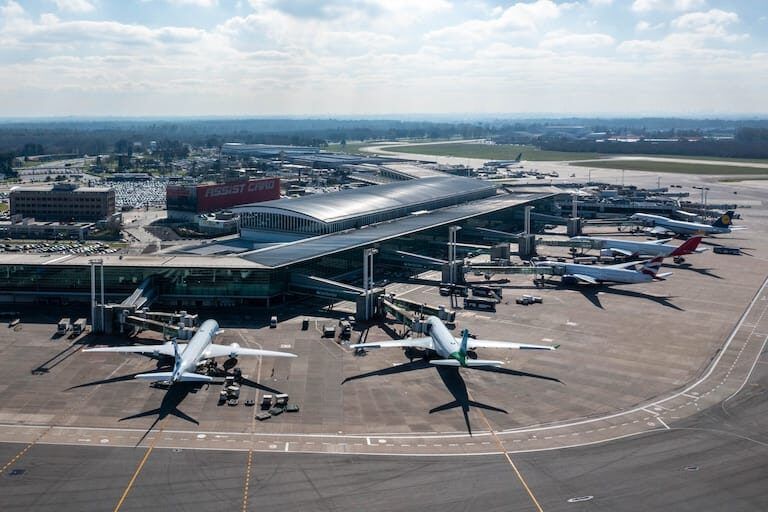
Image of Aeroparque / passengers and aircraft
https://aviacionlinecdn.eleco.com.ar/media/2025/05/pasajeros_abordando_un_boeing_737_800_de_aerolineas_argentinas_en_el_aeroparque_jorge_newbery_de_buenos_aires.JPG
Source: Aviacionline. Verify license, photo credit and reuse conditions.

🔗 Sources consulted
ATE · statement on the day of action on 3 and 4 September 2026: https://ate.org.ar/260901-paros-anac/
LA NACION · 48-hour announcement of protests at airports: https://www.lanacion.com.ar/politica/ate-anuncio-un-plan-de-48-horas-de-protestas-en-los-aeropuertos-de-todo-el-pais-nid01092026/
Diario Río Negro · impact on flights in Neuquén and Río Negro: https://www.rionegro.com.ar/servicios/paro-de-ate-en-aeropuertos-que-vuelos-podrian-sufrir-demoras-o-cancelaciones-a-neuquen-y-rio-negro-4706232/
Argentina.gob.ar · ANAC Resolution 173/2026: https://www.argentina.gob.ar/normativa/nacional/norma-424194/texto
Argentina.gob.ar · ANAC and airport services: https://www.argentina.gob.ar/noticias/todos-los-aeropuertos-funcionan-con-la-seguridad-operacional-adecuada
Editorial note: The information corresponds to the status of the known conflict as of September 2, 2026. Operating conditions may change. For travel decisions, the official communication of the airline and the airport authorities prevails.
 Alert for the "deluge of the year": severe storms, gusts of up to 100 km/h
- 31/08/2026 » 09:47 by cronywell
Alert for the "deluge of the year": severe storms, gusts of up to 100 km/h
- 31/08/2026 » 09:47 by cronywell
⚠️ WEATHER ALERT · WEATHER
Alert for the "deluge of the year": severe storms, gusts of up to 100 km/h and a polar cold wave hit Argentina
The National Meteorological Service maintains a yellow alert in force for this Monday, August 31, which includes hail, strong gusts of wind, electrical activity and risk of flooding in six provinces of the country.
|
📅 Publication date |
August 31, 2026 |
|
⏱️ Reading Time |
Approx. 4 minutes (≈ 780 words) |
|
🗂️ Category |
General Information / Climate |
|
📍 Coverage |
Formosa, Corrientes, Misiones, San Luis, Córdoba and La Rioja |
|
🏷️ SEO keywords |
weather alert Argentina, storms August 31, SMN yellow alert, hail, polar cold wave |
🖼 Cyclogenesis and storm front over the country — see original image
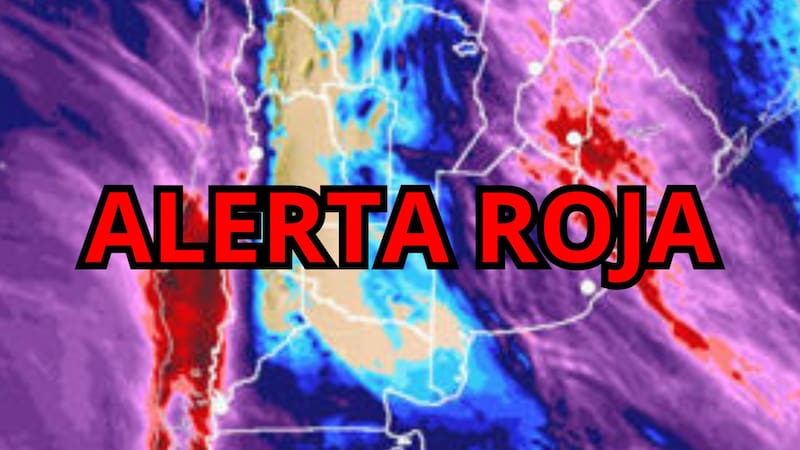
Image source: Meteored / Composition in Canva, via El Cronista.
Argentina started the last week of August under a scenario of strong atmospheric instability. The National Meteorological Service (SMN) has maintained a yellow alert since early Monday morning for strong storms that, according to the agency, could lead to what is already colloquially described as "the deluge of the year". The combination of intense rains in short periods, wind gusts that would reach 100 km/h, hail and a subsequent thermal drop due to the entry of polar air configures a panorama that requires special attention in at least six provinces.
The phenomenon is part of the advance of a frontal system of great development, which specialists link to a cyclogenesis process of up to 48 hours duration. While the center and north of the country remain on alert, the Metropolitan Area of Buenos Aires (AMBA) is not, for the moment, among the areas of severe risk.
🌩️ Six provinces under yellow alert for strong storms
According to the latest report from the SMN, the most unstable conditions of the day are concentrated in Formosa, Corrientes, Misiones, San Luis, Córdoba and La Rioja. In these jurisdictions, some storms could intensify quickly and discharge large volumes of water in very short periods of time, accompanied by frequent electrical activity and hail in a timely manner.
• Formosa, Corrientes and Misiones: greater probability of strong storms and abundant rains.
• San Luis, Córdoba and La Rioja: episodes of severe weather of isolated development but rapid intensification.
☔ Flood risk: how much water could fall
🖼 Storm with heavy rain — see original image
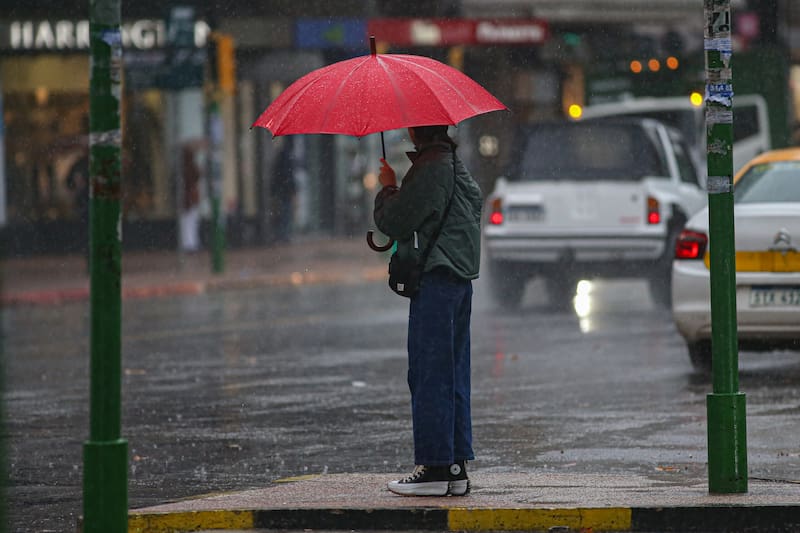
Photo: Foco Uy, via El Cronista.
One of the sources of concern is the volume of water that can accumulate in a short time. Official projections place the accumulated between 20 and 50 millimeters, although it is not ruled out that this threshold will be exceeded occasionally in certain localities. This type of discharge can result in temporary flooding in streets, routes and urban or peri-urban sectors with drainage problems, so it is recommended to avoid driving in areas with water accumulation.
💨 Gusts, lightning and hail: the phenomena that are of most concern
Beyond rain, the risk combo includes intense wind gusts – which in some areas could approach or exceed 90-100 km/h – frequent lightning and hail. Each of these phenomena represents a different threat: the wind can detach branches, signs and light structures; lightning poses a direct risk to those left outdoors; and hail can damage vehicles, roofs and crops when storm cells gain intensity.
❄️ After the storm, the cold arrives: polar air enters
The SMN anticipates that, after the passage of the front, a polar air mass will enter that will cause a marked thermal drop. In Misiones, one of the most compromised provinces, the minimums would range between 15°C and 18°C this Monday, with an additional drop expected for Tuesday. This thermal contrast – heat and humidity before the storm, dry cold afterwards – is common in cold fronts at the end of winter and usually coincides with the moment of greatest instability.
In contrast, the AMBA will go through the day without alerts for severe phenomena, with partly cloudy skies, minimums close to 11°C, maximums around 19°C and moderate winds from the east and southeast.
✅ Official recommendations in the face of the yellow alert
Faced with this scenario, the authorities and the SMN itself recommend taking extreme precautions. Among the main preventive measures are:
• Avoid going out during the development of storms, unless strictly necessary.
• Do not drive on flooded streets, routes or roads.
• Clean drains and drains, and do not take garbage out on public roads.
• Check roofs, gutters and balconies before the wind picks up.
• Secure or remove light objects (flower pots, awnings, garden chairs) that can be displaced by the wind.
• Avoid taking shelter under trees, poles, canopies or unstable signs.
• Disconnect appliances if there is a risk of water ingress.
• Stay informed through official channels and updates from the SMN.
📌 What does the yellow alert mean?
The yellow alert is the first step of the National Meteorological Service's warning system and warns of phenomena with the capacity to generate inconveniences in daily activities and certain specific risks for the population, without yet reaching the level of danger of the orange or red alerts. Its validity can be updated as the frontal system evolves, so it is recommended to closely follow the weather reports during the rest of the day.
❓ Suggested FAQs (for FAQs)
• Which Argentine provinces are on alert for storms today? → Formosa, Corrientes, Misiones, San Luis, Córdoba and La Rioja.
• How much wind is expected? → Gusts that could approach 90-100 km/h in the most affected areas.
• Will it be cold after the storm? → Yes, a polar air mass enters with a marked thermal drop.
 Failure in the Wage Council: the CGT and the two CTAs withdraw and the Government will set the new Minimum Wage by decree
- 29/08/2026 » 10:27 by cronywell
Failure in the Wage Council: the CGT and the two CTAs withdraw and the Government will set the new Minimum Wage by decree
- 29/08/2026 » 10:27 by cronywell
ECONOMY · LABOR POLICY
Failure in the Wage Council: the CGT and the two CTAs withdraw and the Government will set the new Minimum Wage by decree
Without a quorum or agreement between unions and employers, the Executive Branch will have to unilaterally laud the new value of the SMVM, in the midst of a fall in purchasing power that has already accumulated more than four tenths since November 2023.
|
🕒 Reading Time: 8–9 minutes |
📅 Updated: August 29, 2026 |
📍 Location: Buenos Aires, Argentina |
🏛️ What happened: a plenary session that ended without a quorum
The National Council for Employment, Productivity and the Minimum, Vital and Mobile Wage failed again. The plenary meeting, convened for this Friday virtually, ended abruptly after the CGT, the Autonomous CTA and the CTA of the Workers decided to withdraw from the meeting and leave it without a quorum, according to multiple media that covered the day.
The three trade union federations participated only in the technical salary commission – an instance in which each sector presents its proposal for an increase – but refused to continue in the plenary meeting, where the State, employers and unions must agree on the increase or define it by vote. The underlying claim, as it transpired, was both for the amount offered and for the virtual modality of the meeting: the unions had been demanding that the Council return to meet in person.
|
"We demand a true dialogue, with proposals that allow workers to live with dignity" — CGT communiqué after the withdrawal of the plenary |
With the meeting broken and without agreement between the parties, the definition of the new salary floor remains, once again, in the hands of the national Executive Branch, which must set by decree the update of the Minimum, Vital and Mobile Wage (SMVM), as happened in the previous calls of the body.
💰 The numbers on the table: the gap between unions and businessmen
The distance between the parties largely explains the breakdown of the negotiations. While the business sector offered a scheme of gradual increases, the labor federations demanded a much faster recomposition of purchasing power.
|
📊 The positions in conflict • Value effective from August 2026: $376,600 per month for monthly workers and $1,883 per hour for daily workers. • Business proposal: +1.8% in September and +1.7% monthly between October and April, reaching $468,000 in April 2027. • Union demand: not to fall below $911,202 in July and to reach $993,300 in December 2026. • Result: without an agreement, the Executive Branch will set the amount by decree, as in the five previous calls of this administration. |
|
Concept |
Proposed amount |
Validity |
|
Current SMVM floor |
$376,600 |
August 2026 |
|
Business offer (floor) |
$468,000 |
April 2027 |
|
Union claim (floor) |
MX$911,202 |
July 2026 |
|
Union claim (floor) |
$993,300 |
December 2026 |
📉 A salary that fails to recover ground
The Council's new failure comes in a context of sharp deterioration in the purchasing power of the minimum wage. According to a report by the Interdisciplinary Institute of Political Economy (IIEP) of the UBA-CONICET, the real SMVM fell again in July 2026, with a monthly contraction of 0.8%, and accumulates a real loss of 40.5% since November 2023.
To measure the fall, the researchers calculated that the purchasing power of the minimum wage in November 2023 would be equivalent today to $626,106, well above the nearly $372,400 that represents the current value in real terms. The deterioration led the real minimum wage to be below the level it had in 2001, before the collapse of convertibility.
Another study, by the Center for Research and Training of the Argentine Republic (CIFRA-CTA), adds historical perspective: it maintains that the minimum wage was at real levels 45.6% lower than in November 2019 – the end of the Cambiemos government – and 58.4% lower than in November 2015.
|
Comparison |
Cumulative Actual Drop |
|
Since November 2023 (IIEP-UBA) |
-40,5% |
|
Compared to November 2019 (FIGURE) |
-45,6% |
|
Compared to November 2015 (FIGURE) |
-58,4% |
|
Compared to the all-time high of Sept. 2011 |
-66,7% |
⚖️ A pattern that has been repeated since 2024
This Friday's outcome is no exception: it is the continuity of a mechanism that has been repeated since the beginning of Javier Milei's administration. According to a survey by CIFRA, the five previous meetings of the National Council for Employment, Productivity and the Minimum Wage ended without an agreement between workers and employers, so it was the Ministry of Labor that ended up setting the increases, in general very close to the proposal of the employer sector.
Recent timeline of the SMVM
|
Period |
Fixed amount |
Mechanism |
|
December 2023 |
$156,000 |
Starting point of the current management |
|
November 2025 |
$328,000 |
Decree (Resolution 9/2025) |
|
December 2025 |
$334,800 |
Decree (Resolution 9/2025) |
|
August 2026 |
$376,600 |
Last section of the current decree |
|
Next leg |
To be defined |
New decree after the failure of 28/08/2026 |
Accumulated inflation between December 2023 and July 2026 reached about 365%, while the nominal SMVM rose in that period by around 135%, according to calculations released by different economic think tanks, which explains much of the real liquefaction of the minimum income.
🗣️ The voices of the conflict
In addition to the official statement of the CGT, the general secretary of ATE, Rodolfo Aguiar, questioned the functioning of the organization and proposed that it should operate as a salary reference for sectors that do not have their own paritarias. According to his reading, the lack of a real agreement leaves a large portion of informal and low-skilled workers unprotected.
On the official side, the government's strategy – according to reports – aims to make collective bargaining by branch of activity, and not the minimum wage, the main tool to improve incomes: it is sought that the parity agreements place the salary floors of registered workers at around $1,000,000, leaving the SMVM as a reference limited to very specific sectors of the labor market.
The unions, for their part, anticipated that they will take the claim for the modality and result of the Council to international bodies, within the framework of the International Labor Organization (ILO), according to reports collected by specialized media.
📌 What's Next
|
🔜 Next steps • The Ministry of Labor must prepare and publish a decree or resolution with the new scheme of increases in the SMVM. • The amount that is set will also impact unemployment benefits, which take the minimum wage as a calculation reference. • The unions are evaluating additional claims before the ILO for the lack of face-to-face negotiation instances. • The Council could convene again in the coming months to review new sections, following the pattern of staggered decrees of the last two years. |
🔎 Why it matters
The Minimum, Vital and Mobile Wage not only sets the legal floor that a worker must receive for a full day: it also functions as a benchmark for other income and social benefits, including unemployment insurance. For this reason, each decree that updates it – or that fails to recompose its purchasing power – has repercussions beyond the workers directly reached by that wage floor, reaching a broader universe of the popular and informal economy.
The new chapter of this dispute leaves, once again, two certainties: that the Wage Council continues without achieving tripartite consensus since the beginning of the current administration, and that it will be the Executive Branch, by decree, that determines alone the course of the minimum income of millions of Argentine workers.
📚 Sources consulted
• The negotiation for the minimum wage failed and there will be a decree — https://www.infobrisas.com/noticias/2026/08/28/105962-fracaso-la-negociacion-por-el-salario-minimo-y-habra-decreto (Infobrisas)
• Scandalous end of the Minimum Wage Council — https://www.infobae.com/politica/2026/08/28/escandaloso-final-del-consejo-del-salario-minimo-la-cgt-y-las-cta-abandonaron-el-encuentro-y-el-gobierno-fijara-el-aumento/ (Infobae)
• Salary Council: there was no agreement and the Government will define the new amount — https://www.jujuyalmomento.com/consejo-del-salario/consejo-del-salario-no-hubo-acuerdo-y-el-gobierno-definira-el-nuevo-monto-n206516 (Jujuy al Momento)
• In the midst of internal differences, the CGT and the CTA desisted from mobilizing — https://www.infobae.com/politica/2026/08/28/en-medio-de-diferencias-internas-la-cgt-y-las-cta-desistieron-de-movilizarse-hoy-cuando-delibere-el-consejo-del-salario-minimo/ (Infobae)
• The Wage Council failed and the government will define the new minimum wage by decree — https://www.sanrafaeldigital.com/post/fracas%C3%B3-el-consejo-del-salario-y-el-gobierno-definir%C3%A1-por-decreto-el-nuevo-salario-m%C3%ADnimo (San Rafael Digital)
• The CGT and the CTA rejected the new minimum wage and walked out of the meeting — https://www.gentedesalta.com/politica/la-cgt-cta-rechazaron-nuevo-salario-minimo-abandonaron-reunion-milei-debera-definir-monto-decreto-n11309 (Gente de Salta)
• The Wage Council failed and the Government will define the increase — https://www.redboing.com/consejo-salario-gobierno-paritarias/ (RedBoing)
• The Wage Council was reactivated after half a year of paralysis — https://www.lanacion.com.ar/politica/se-reactiva-el-consejo-del-salario-tras-medio-ano-de-paralisis-y-los-gremios-exigen-una-suba-de-100-nid26112025/ (La Nación)
• Historical setback: the minimum wage under Milei is worth less than before the 2001 crisis — https://elargentinodiario.com.ar/zona-destacada/30/05/2026/retroceso-historico-el-salario-minimo-bajo-milei-vale-menos-que-antes-de-la-crisis-de-2001/ (El Argentino Diario)
• To recover its pre-Milei value, the Minimum Wage would have to double — https://www.minutouno.com/economia/para-recuperar-su-valor-previo-la-gestion-javier-milei-el-salario-minimo-deberia-duplicarse-n6312724 (Minuto Uno)
• The Government convened a meeting to update the devalued Minimum, Vital and Mobile Wage — https://www.minutouno.com/economia/el-gobierno-convoco-una-reunion-actualizar-el-devaluado-salario-minimo-vital-y-movil-n6312715 (Minuto Uno)
Note: for copyright reasons, this document does not reproduce journalistic photographs of third parties; it is recommended to incorporate in the CMS of the blog an image of your own or with a free license, citing the corresponding source if using agency material.
 La Rioja sues the National Government for the alleged diversion of more than $1 billion of road funds
- 25/08/2026 » 09:48 by cronywell
La Rioja sues the National Government for the alleged diversion of more than $1 billion of road funds
- 25/08/2026 » 09:48 by cronywell
POLITICS · JUSTICE · ROAD INFRASTRUCTURE
La Rioja sues the National Government for the alleged diversion of more than $1 billion of road funds
The administration of Ricardo Quintela asked to intervene as a plaintiff in a federal case that investigates the destination of resources from the Integrated Road System (SisVial). The filing argues that more than $1 trillion would have been placed in financial instruments while a substantial part of the funds were not applied to road works.
Updated August 25, 2026
Reading Time: 8 minutes
Suggested section: Politics/Economy/Justice
Editorial authorship: Redacción MiDire
SEO Listing for Publication
|
SEO Title |
La Rioja sues the Nation for more than $1 billion in road funds |
|
Meta Description |
La Rioja asked to be a plaintiff in a case that investigates the destination of more than $1 billion of the SisVial placed in financial instruments. |
|
Recommended Slug |
la-rioja-demand-national-government-road-funds-sisvial |
|
Primary Keyword |
La Rioja demands road funds from the National Government |
|
Keywords secundarias |
SisVial, Ricardo Quintela, road funds, National Roads, fixed terms, Treasury Bills, Federal Justice, national routes |
|
Search intent |
Informational / political news / judicial investigation |
|
Open Graph title |
La Rioja takes the controversy over the SisVial funds to court |
|
Open Graph description |
The Province seeks to intervene in the case that investigates the destination of more than $1 billion of road resources. |
Recommended images for the blog
1. Photo by Ricardo Quintela — image available under CC BY-SA 4.0 license on Wikimedia Commons: https://commons.wikimedia.org/wiki/File:RQ_WIkipedia.jpg · Alt: "Ricardo Quintela, governor of La Rioja".

2. Pircas Negras International Pass — free-use photography under CC BY-SA 4.0: https://commons.wikimedia.org/wiki/File:Vista_del_Paso_Pircas_Negras_desde_la_Ruta_76.jpg · Alt: "Route to the Pircas Negras Pass, La Rioja".

3. Reference journalistic image of Pircas Negras: https://cdn.eldestapeweb.com/eldestape/112025/1762527454666.webp?ch=506&cw=900&extw=jpg · Verify reproduction rights before publishing.

La Rioja takes the dispute over road funds to court
The Government of La Rioja, headed by Ricardo Quintela, appeared before the Federal Court to request that the Province be recognized as a plaintiff in the investigation that analyzes the destination of resources from the Integrated Road System (SisVial). The presentation targets President Javier Milei, Economy Minister Luis Caputo and other officials, and seeks to determine if there were irregularities in the management of funds that had a specific impact on road infrastructure.
The data that placed the file at the center of the political agenda is of enormous magnitude: according to the presentation of La Rioja and the journalistic reports that reconstructed the case, as of May 31 there was more than $1 trillion of SisVial placed in financial instruments, including fixed terms and Treasury Bills. At the same time, the information released on the execution of the resources indicates that only 26.2% of the funds allocated during the current administration would have been effectively allocated to road works.
The complaint does not amount to a conviction nor does it prove by itself the existence of a crime. The central point that the Justice must establish is whether the administration and placement of these resources were in accordance with the legal framework of the trust, its specific purpose and the powers of the intervening officials. This distinction is fundamental to understanding the institutional scope of the case.
🔎 The data that explains the controversy
|
Fact |
What it means |
|
More than $1 billion |
An amount that, according to the complaint and the journalistic coverage, remained placed in financial instruments as of May 31. |
|
26,2% |
Percentage of the resources allocated during the current administration that, according to the Rioja presentation, was applied to road works. |
|
SisVial |
Integrated Road System, component of the national trust scheme for transport infrastructure. |
|
Causa federal |
The Province asked to intervene as a plaintiff in a criminal investigation into the destination of the resources. |
What is SisVial and why does it matter?
The Integrated Road System is part of the architecture of trust funds linked to transport infrastructure. Its financing is related to tax resources that have a specific allocation. Decree 301/2018, in its updated text, establishes that the resources integrated into the trust must be distributed among the systems that make up the scheme; after Decree 526/2024, 50% corresponds to SisVial, 32.5% to the integrated automotive transport system and 17.5% to the railway system. [1][2]
The legal importance of this allocation is that it is not, in principle, an undifferentiated box of freely available resources. The legal regime establishes a specific purpose and contains rules on the administration and destination of the funds. Law 27,431, in addition, provides that certain assets assigned to the SisVial and the railway system intended for the payment or financing of works may not be reassigned to different obligations, except in the case of surplus funds once these obligations have been fulfilled. [3]
For this reason, the judicial debate is not reduced to asking whether the State can temporarily place money in a financial instrument. The relevant question is more precise: what funds were placed, under what authorization, for how long, for what purpose, what was their availability to execute works and whether these operations were compatible with the legal allocation of resources.
The presentation of La Rioja: what the Province is demanding
The Quintela administration maintains that the retention or financial placement of road resources had concrete consequences on the territory of La Rioja. The judicial presentation especially mentions the paralysis of works considered strategic, including those linked to the bioceanic corridor and the Pircas Negras International Pass, a connection of logistical interest for integration with Chile. [4][5]
The Province intervened with the sponsorship of lawyer Jorge Yoma and asked that the possible responsibility of national officials be investigated. The coverage of the presentation identifies, among the legal figures that are intended to be investigated, possible crimes such as embezzlement of public funds, fraudulent administration to the detriment of the Public Administration, abuse of authority and breach of the duties of a public official. The final classification, however, corresponds to the Justice and may be modified during the investigation. [4][6]
The Riojan proposal adds a federal dimension to the conflict: if the resources allocated to the road system remained immobilized or were used in financial operations while national works remained paralyzed, the eventual damage would not only be accounting. It could involve infrastructure, regional connectivity, road safety, economic activity and logistical capacity.
The origin of the controversy: $1.5 billion raised and a much lower execution
The discussion gained strength after a journalistic investigation that reconstructed the flow of resources from SisVial. According to data cited by EL PAÍS from that investigation, from the beginning of Milei's administration until mid-2026, approximately $1.5 billion had been collected through the tax route linked to the system, but only about a quarter had been allocated to road works. The rest — equivalent to almost US$668 million according to that publication — appeared to be placed in financial investments such as fixed terms and public securities. [7]
The presentation of La Rioja uses a time cut and a different methodology and places the amount placed in financial instruments at more than $1 trillion as of May 31, while calculating at 26.2% the proportion of resources allocated during the management that came to works. The figures may seem different because they respond to periods and calculation bases that are not necessarily identical. In a responsible journalistic investigation, this difference must be made explicit and not presented as an automatic contradiction.
The most sensitive political fact is that the discussion about the destination of the money occurs in parallel with the deterioration of the national road network. EL PAÍS cited estimates by the National Highway Union according to which about 70% of the roads would be in fair or poor condition. That figure corresponds to a union source and should therefore be distinguished from an independent official audit. [7]
Does money placed in fixed terms necessarily imply a crime?
Not necessarily. The mere existence of a financial placement does not allow us to conclude, by itself, that there was embezzlement or fraudulent administration. In public trusts, there may be liquidity management and fund preservation mechanisms. The decisive thing is to determine the origin and allocation of each peso, the rules applicable at the time of the operation, the instructions given, the deadlines, the yields obtained, the level of availability and, above all, whether the placements were compatible with the legal purpose of SisVial.
The central judicial question is not simply "where was the money?", but "could it legally be there, for how long and under what conditions?"
The official defense and the argument of fiscal balance
The controversy also incorporates a discussion of economic policy. According to the reconstruction published by EL PAÍS, presidential spokesman Adrián Ravier acknowledged that part of the SisVial resources had been allocated to contribute to the objective of fiscal balance. The Government, in turn, questioned the administration of National Roads of previous periods and maintained that the new approach prioritizes private participation in the construction of roads. [7]
This argument raises a fundamental institutional question: even when a government considers it convenient to preserve liquidity or contribute to a fiscal strategy, the administration of resources with specific allocation must respect the legal regime that determines their destination. The fiscal surplus is an economic policy objective; it does not in itself replace the rules for allocating a public fund.
In other words, the debate should not be framed as a simple opposition between "deficit" and "public works." The legal point is whether the State used the resources in accordance with the rules that link them to a specific purpose.
The cause and what the Justice must determine
1. Specify the total amount of resources collected and assigned to SisVial during the period under investigation.
2. Identify the balance that remained in accounts, fixed terms, Treasury Bills or other financial instruments.
3. Determine who ordered, authorized and executed each operation and with what regulatory support.
4. To establish the terms of the placements, their yields and the conditions of availability of the funds.
5. Compare the available resources with the level of execution of the road works committed.
6. Determine if there was financial damage, delay of works or affectation of legal obligations.
7. To define, on the basis of documentary and expert evidence, whether there are sufficient elements to attribute criminal responsibility to specific officials.
The judicial precedent that widened the conflict
The investigation into SisVial did not begin with the presentation in La Rioja. There was already a criminal complaint filed by national deputy Victoria Tolosa Paz. At the same time, a federal judge agreed to process a collective amparo aimed at obtaining information and demanding that the resources collected for the road system be reflected in works. According to EL PAÍS's coverage, Judge Ernesto Kreplak requested reports from the Ministry of Economy, the National Highway Directorate and the National Bank on the use of the funds. [7]
The coexistence of a criminal investigation and actions of a collective nature shows that the problem has two dimensions: one aims to determine whether there were crimes and individual responsibilities; the other seeks to control the destination of resources and the fulfillment of public obligations. They are different ways, although they can share documentary and financial information.
Why La Rioja considers the Pircas Negras Pass strategic
The dispute over funds takes on a territorial dimension when observed from La Rioja. The Pircas Negras Pass connects the province with the Atacama Region in Chile and is part of a vision of a bioceanic corridor that seeks to reduce logistical distances between productive areas in central and northern Argentina and the ports of the Pacific.
The road infrastructure in that area is not only a provincial issue. International connectivity, freight transport, tourism and trade integration depend on routes capable of operating with continuity and safety. Hence, the Government of La Rioja has presented the paralysis of works related to that corridor as a damage that exceeds the local budget discussion. [4][5]
What's at stake: money, roads, and federalism
The case brings to the fore a recurring discussion in Argentina: how national resources are managed for specific purposes and what control mechanisms exist when the execution deviates from the purpose for which they were collected.
It also reactivates the tension between the Nation and the provinces. For the governors, national infrastructure is a condition for territorial development and economic federalism. For the national government, fiscal discipline and the change in the financing model of the routes are part of a strategy that seeks to reduce direct State spending. Judicial dispute should separate those political differences from specific legal obligations.
If the courts conclude that there was a legitimate use of surpluses or liquidity in accordance with the applicable rules, the investigation could be closed without criminal liability. If, on the other hand, it were proven that the resources concerned were used in a manner incompatible with their purpose, the file could acquire a much greater institutional and criminal dimension. In both scenarios, money traceability will be the centerpiece.
📌 Keys to understanding the news in a minute
• La Rioja, governed by Ricardo Quintela, asked to intervene as a plaintiff in a federal case over SisVial funds.
• The investigation analyzes the destination of more than $1 billion that, according to the provincial presentation, remained placed in financial instruments.
• The complaint maintains that only 26.2% of the funds allocated during the current administration were allocated to road works.
• The regulatory framework establishes a specific allocation of resources for transport infrastructure systems.
• The existence of financial placements does not in itself prove a crime: the justice system must establish its legality, purpose, authorization and possible damage.
• The dispute has national and territorial impact, especially over road works and integration projects such as the corridor to Pircas Negras.
❓ Frequently Asked Questions
What is SisVial?
It is the Integrated Road System, a component of the national trust scheme aimed at financing obligations related to road infrastructure.
How much money is under investigation?
The Rioja presentation speaks of more than $1 trillion placed in financial instruments as of May 31. The figure should be read together with the period and the methodology used to calculate it.
Is La Rioja already a plaintiff?
The Province appeared before the Federal Court to be recognized and intervene as a plaintiff in the case. The coverage of the presentation is described as a constitution of the Province in the file.
What crimes are being investigated?
The presentation seeks to investigate possible figures such as embezzlement of public funds, fraudulent administration, abuse of authority and breach of the duties of a public official. The existence of these crimes must be determined by the Justice.
What role does Ricardo Quintela play?
As governor, he led the provincial presentation and stated that La Rioja suffered damages due to the lack of execution of road works of national scope.
Is placing public money in financial instruments illegal?
Not necessarily. The legality depends on the applicable regulations, the nature of the funds, the authorization, the term, the purpose and the conditions of the placement.
What will the investigation have to prove?
Mainly, the route of the funds, the administrative decisions that determined their destination, the regulations applied and the existence or not of damage or criminally relevant conduct.
Conclusion
La Rioja's filing transforms a budget controversy into a federal court dispute. The axis is in more than $1 billion of resources linked to SisVial that, according to the provincial complaint and the journalistic investigation that gave rise to the debate, remained placed in financial instruments while the execution of road works was much lower than the resources collected.
Now the Justice will have to reconstruct the route of the money and establish if each operation had legal and administrative support. The underlying issue exceeds a fight between Quintela and Milei: it compromises the discussion on funds of specific allocation, control of public spending, federalism, infrastructure and transparency in the administration of the resources that Argentines contribute to the State.
In a democracy, the discussion about the destination of public money does not end when it is collected: it begins there.
Journalistic note
This article distinguishes between reported facts, arguments of the parties, and issues still under investigation. The expressions "alleged", "according to the complaint" and "the investigation analyzes" are used deliberately: at the close of this edition there is no conviction that determines the commission of the crimes denounced. The figures may vary depending on the cut-off date, the universe of funds and the accounting methodology used by each source.
Sources consulted and absolute links
1. Argentina.gob.ar — Decree 301/2018, updated text: https://www.argentina.gob.ar/normativa/nacional/decreto-301-2018-308868/actualizacion
2. Official Gazette — Decree 526/2024: https://www.boletinoficial.gob.ar/detalleAviso/primera/309193/20240613
3. Official Gazette — Law 27.431: https://www.boletinoficial.gob.ar/detalleAviso/primera/176942/20180102?anexos=1
4. LA NACION — La Rioja asked to be a plaintiff against Milei for the diversion of road funds (08/23/2026): https://www.lanacion.com.ar/politica/la-rioja-pidio-ser-querellante-contra-milei-por-el-desvio-de-fondos-viales-nid23082026/
5. Agencia Noticias La Rioja — presentation of the Province in case CFP 3960/2026: https://agencianoticiaslarioja.com.ar/el-gobierno-de-la-rioja-denuncio-a-milei-y-caputo-por-el-desvio-de-fondos-viales/
6. El Cronista — La Rioja asked to be a plaintiff for the diversion of funds for road repair (24/08/2026): https://elcronista-el-cronista-prod.web.arc-cdn.net/economia-politica/la-rioja-pidio-ser-querellante-por-el-millonario-desvio-de-fondos-para-arreglo-de-rutas/
7. EL PAÍS — Milei faces a scandal for covering deficit with funds allocated by law to public works (20/08/2026): https://elpais.com/argentina/2026-08-20/milei-enfrenta-un-escandalo-por-cubrir-deficit-con-fondos-asignados-por-ley-a-obras-publicas.html
8. Wikimedia Commons — Ricardo Quintela.jpg / license and image source: https://commons.wikimedia.org/wiki/File:RQ_WIkipedia.jpg
9. Wikimedia Commons — View of Pircas Negras Pass from Route 76 / CC BY-SA 4.0: https://commons.wikimedia.org/wiki/File:Vista_del_Paso_Pircas_Negras_desde_la_Ruta_76.jpg