







Calendar : October 2026
|
☘ ★ EPHEMERIS · OCTOBER 18 World Day for the Protection of Nature From Perón's warning in 1972 to COP17 in Yerevan: origin, data 2026 and the Argentine debate ⏱ Approximate reading: 13 minutes ✎ Editorial midire.ar · October 17, 2026 ☘ Biodiversity · Environment · Argentina |
★ EPHEMERIS · SUNDAY, OCTOBER 18, 2026
World Day for the Protection of Nature: from Perón's warning in 1972 to COP17 in Yerevan
This Sunday, October 18, marks World Nature Protection Day, an event with Argentine roots: the "Environmental Message to the Peoples and Governments of the World", which Juan Domingo Perón disseminated from Madrid in 1972. Fifty-four years later, the Living Planet Report 2026 records an average drop of 73% in monitored wildlife populations, and the biodiversity COP17 opens in Yerevan (Armenia) with the first global review of the Kunming-Montreal Framework.
|
⚡ Summary in 30 seconds • What it is: a day to raise awareness about caring for the environment, originating in Perón's message of February 21, 1972. • De rigueur fact: it is not among the dates officially proclaimed by the UN; the UN environmental calendar has other dates (3/3, 22/5 and 5/6). • 2026 diagnosis: −73% in vertebrate populations monitored between 1970 and 2022 (WWF/ZSL) and 49,505 threatened species out of 175,909 assessed (IUCN). • Agenda: COP17 in Yerevan from October 19 to 30; in Argentina, the reform of the Glacier Law (Law 27,804) is in the courts and the draft 2027 Budget reopens the debate on forests and fire. |
✎ The origin: a message from exile
On February 21, 1972, from his residence in exile in Madrid, Perón released the "Environmental Message to the Peoples and Governments of the World." The text was a few months ahead of the United Nations Conference on the Human Environment, inaugurated in Stockholm on June 5 of that year, and warned about the pollution of the environment and the biosphere, the squandering of natural resources, unbridled population growth and the overestimation of technology. It also called for joint international action.
The document also had a geopolitical reading: it urged countries with natural wealth, particularly those of the Third World, to defend their resources against concentrated interests. This double perspective, ecological and political, explains why the message continues to be cited in the Argentine environmental debate.
|
❝ immediately reverse the direction of that march ❞ Juan Domingo Perón, Environmental Message to the Peoples and Governments of the World (Madrid, 1972) |
The institutional correlation came soon: in 1973 the Secretariat of Natural Resources and Human Environment was created, with Yolanda Ortiz as its head, whom the official Buenos Aires bibliography presents as a pioneer of environmental management in Latin America.
⚖ Is it an official UN date?
It is the clarification that is most often omitted. Many media repeat that the then Secretary General of the UN, Kurt Waldheim, was so impressed by the message that he set October 18 as a world day. However, several sources agree that the event is not a date officially proclaimed by the United Nations, and in the verification for this note no documentation was found to prove that proclamation.
The sources also diverge in the details: some locate the origin in a letter to Waldheim dated March 16, 1972; others, in the public message of February 21; and there are publications that attribute the date to the WHO or record a wrong year. The prudent thing to do is to present it as an anniversary of an informative tradition with documented roots in the 1972 message.
|
Date |
Commemoration |
Status |
|
March 3 |
World Wildlife Day |
UN Official |
|
May 22 |
International Day for Biological Diversity |
UN Official |
|
June 5 |
World Environment Day |
UN Official |
|
September 27 |
Environmental Awareness Day in Argentina |
National Law 24.605 |
|
October 18 |
World Day for the Protection of Nature |
Informative; not on the official UN calendar |
Prepared by the author based on the verification of journalistic sources and the United Nations environmental calendar.
☘ Data 2026: the diagnosis of biodiversity
The Living Planet Report 2026, which WWF prepares with the Zoological Society of London (ZSL) and which it presented in October under the title The Science of Hope, analyzes 35,803 population trends of 5,790 vertebrate species between 1970 and 2022. The result: an average drop of 73% in the size of the monitored populations, a percentage consistent with the 2024 edition.
|
Scope |
Variation 1970–2022 |
Reading |
|
Global average |
−73% |
Average fall in populations |
|
Fresh water |
−85% |
The strongest decline |
|
Terrestrial species |
−69% |
— |
|
Marine species |
−59% |
— |
|
Latin America and the Caribbean |
−95% |
Region with the greatest drop |
|
Africa |
−80% |
— |
|
Asia-Pacific |
−49% |
— |
Source: WWF/ZSL, Living Planet Report 2026. The regional figures come from the journalistic coverage of the report (El Ancasti, 10/10/2026).
|
☀ How to Read 73% It does not mean that 73% of animals have disappeared: it measures the average variation in the relative size of populations that are tracked over time. The report itself stresses that half of the populations included are stable or growing, and that wildlife can recover if energy, food and finance systems are transformed, which should reach "positive tipping points" before 2030, the target year of the Global Biodiversity Framework. |
The IUCN Red List, in its July 2026 update, evaluated 175,909 species and classified 49,505 as threatened with extinction, about 28% of the total assessed and 1.8% more than in the previous edition. Among the novelties, 62% of the molluscs endemic to hydrothermal vents (125 out of 201 species analyzed) were at risk due to the advance of deep-sea mining. The IUCN clarifies that the figures correspond only to the species evaluated to date.
❄ COP17 in Yerevan: the global review of the 2030 targets
The 17th Conference of the Parties to the Convention on Biological Diversity (COP17) is being held in Yerevan, the capital of Armenia, from 19 to 30 October 2026. The Convention Secretariat plans an opening ceremony on 18 October and the formal opening of the sessions on 19 at 10:00 a.m. Armenia had been chosen to host COP16 in Cali, in an unprecedented vote for the Convention: 65 out of 123 votes against Azerbaijan.
The focus will be on the first global review of progress of the Kunming-Montreal Global Biodiversity Framework, adopted in 2022, with a focus on monitoring mechanisms, mobilization of financial resources, and support for implementation. Delegations from some 196 country Parties and thousands of participants are expected.
✦ Argentina 2026: between the hope of the jaguar and the legal debate
➤ Iberá: the return of the jaguar
The Iberá Wetlands (Corrientes) are the largest protected wetland in the country: the Provincial Reserve, created in 1983 by Law 3771, covers about 1.3 million hectares, and in 2018 Congress created the Iberá National Park on land donated by the Douglas and Kristine Tompkins foundation. The reintroduction program of Rewilding Argentina, the National Parks Administration and the province is developed there.
In May 2026, National Parks confirmed that more than 50 jaguars are now living in the wild in Iberá, after about 70 years of absence of the species in the area. On a national scale, the situation remains critical: Rewilding Argentina and Fundación Vida Silvestre estimate that between 200 and 250 specimens survive throughout the country.
➤ Glacier Law: reform and justice
Law 27,804 amended Glacier Law 26,639 of 2010. The Senate approved the bill on February 26, 2026 (40 votes in favor, 31 against, and one abstention) and Deputies approved it on April 9 (137 affirmative, 111 negative, and 3 abstentions). The reform delegates to the provinces the definition of protection standards and allows each jurisdiction to determine which bodies of ice it protects and where it enables productive activities, including mining.
What the promoters maintain: that it is necessary to harmonize the regulations and end the legal ambiguity of the previous law, and that it is up to the provinces, the original owners of the resources, to regulate their territory.
What critics argue: that the reform lowers a federal protection floor, that the Supreme Court had already ratified the constitutionality of the original law in 2019, that it violates the principle of non-regression of the Escazú Agreement and that the parliamentary procedure excluded more than 100,000 registered in a public hearing.
In the courts, the government of La Pampa, the National University of La Pampa and environmental organizations promoted collective injunctions, and on May 5 Greenpeace, FARN and the Argentine Association of Environmental Lawyers filed a lawsuit with more than 850,000 supporters. According to the federal justice report released by Crónica, the court rejected the precautionary measure but enabled the collective injunction. Another injunction, filed by Neuquén legislators, was rejected for lack of standing. As of October 8, 2026, according to Greenpeace, the lawsuit was still without a substantive response and Law 27,804 was still in force.
➤ 2027 Budget: Forests, Fire and Protected Areas
The analysis of the Environment and Natural Resources Foundation (FARN) on the draft 2027 Budget indicates a decrease of 10.84% for the Undersecretary of Environment compared to 2026 and 84.3% compared to 2023. For native forests, it foresees $28,322.56 million, an amount that the report considers to be well below the floor of Article 31 of the Forest Law (26,331), and would finance 23 sustainable management plans, against goals of 1,200 and 1,000 plans in 2022 and 2023. The National Fire Management Service would receive $38,815 million, equivalent to 0.037% of total spending.
The outlook is nuanced: according to the specialized media Bichos de Campo, the National Parks Administration has its own budget and would have a 22% improvement in its resources for fire management compared to 2026. Greenpeace, on the other hand, warns that the Administration has some 400 brigade members to guard more than 5 million hectares, compared to an estimated operational minimum of 700. This is a project subject to change in Congress.
⚑ Legal framework and timeline
|
Standard |
What it states |
|
Art. 41, Constitution (1994) |
The right to a healthy environment and the duty to preserve it; the Nation sets the minimum budgets and the provinces complement them. |
|
Law 25.675 (2002) |
General Law of the Environment. |
|
Law 26.331 (2007) |
Minimum budgets for the protection of native forests (Forest Law). |
|
Law 26.639 (2010) |
Glacier protection regime and periglacial environment; amended by Law 27,804 in 2026. |
|
Law 26.815 (2012) |
Federal Fire Management System. |
|
Law 27,566 (2020) |
Approval of the Escazú Agreement on Access to Information, Participation and Environmental Justice. |
|
Law 24.605 (1995) |
It institutes Environmental Awareness Day (September 27). |
|
Date |
Milestone |
|
21/2/1972 |
Perón spreads the "Environmental Message to the Peoples and Governments of the World" from Madrid. |
|
5/6/1972 |
The UN Conference on the Human Environment begins in Stockholm. |
|
1973 |
The Secretariat of Natural Resources and Human Environment is created. |
|
15/4/1983 |
The Iberá Provincial Reserve is established (Law 3771 of Corrientes). |
|
5/12/2018 |
Congress creates the Iberá National Park. |
|
December 2022 |
The Kunming-Montreal Global Biodiversity Framework is adopted. |
|
9/4/2026 |
Deputies approve the reform of the Glacier Law (Law 27.804). |
|
October 2026 |
The Living Planet Report 2026 is presented and COP17 meets in Yerevan. |
♻ What can be done: eight concrete actions
♻ Reduce and separate waste: clean and dry recyclables, organic composting and less disposable.
✿ Plant native species: in patios, squares and sidewalks, with advice from nurseries and local botanical gardens.
☂ Take care of water: avoid spilling oils or chemicals into drains and repair household leaks.
⚑ Participate: attend public hearings and request environmental information: the Escazú Agreement guarantees this by law.
☀ Choose energy efficiency: insulation, efficient appliances and public transport or cycling when possible.
✎ Adding citizen science: recording observations of fauna and flora on platforms such as iNaturalist or eBird.
⚠ Prevent fires: do not make fires outside authorized places, extinguish fires well and warn the brigade members of smoke.
❖ Consume wisely: do not buy wildlife or products of dubious origin and prefer wood and fish from certified sources.
▣ Referenced Image Gallery
The images are incorporated as references with an absolute link to Wikimedia Commons (not embedded), so that they can be inserted on the website with their attribution. Before publishing, confirm the license and the required credit text in each file.
|
▣ Image 1 · Iberá Wetlands (Corrientes) Credit: Wikimedia Commons archive "Esteros del Ibera Laguna.JPG"; check authorship and license in the file. Wikimedia Commons profile: https://commons.wikimedia.org/wiki/File:Esteros_del_Ibera_Laguna.JPG Absolute link to image: https://commons.wikimedia.org/wiki/Special:FilePath/Esteros_del_Ibera_Laguna.JPG Alternative text (alt): Lagoon surrounded by floating vegetation in the Iberá Wetlands, province of Corrientes. |


|
▣ Image 2 · Perito Moreno Glacier (Los Glaciares National Park) Credit: Luca Galuzzi, 2005; see the license in the Commons tab. Ficha en Wikimedia Commons: https://commons.wikimedia.org/wiki/File:Perito_Moreno_Glacier_Patagonia_Argentina_Luca_Galuzzi_2005.JPG Absolute link to image: https://commons.wikimedia.org/wiki/Special:FilePath/Perito_Moreno_Glacier_Patagonia_Argentina_Luca_Galuzzi_2005.JPG Alternative text (alt): Front of the Perito Moreno glacier on Lake Argentino, in Santa Cruz. |


|
▣ Image 3 · Jaguar (Panthera onca) Credit: Wikimedia Commons file "Jaguar (Panthera onca palustris) male Three Brothers River.JPG"; photo illustrates species and was not taken in Iberá. Check authorship and license in the file. Ficha en Wikimedia Commons: https://commons.wikimedia.org/wiki/File:Jaguar_(Panthera_onca_palustris)_male_Three_Brothers_River.JPG Enlace absoluto a la imagen: https://commons.wikimedia.org/wiki/Special:FilePath/Jaguar_(Panthera_onca_palustris)_male_Three_Brothers_River.JPG Alt text (alt): Male jaguar walking along a river. |
_male_Three_Brothers_River.JPG)
_male_Three_Brothers_River.JPG)
? Frequently Asked Questions
? When is World Nature Day?
Every October 18. In 2026 it falls on a Sunday and is not a holiday in Argentina.
? Who created this date?
It is linked to the Environmental Message that Perón disseminated in 1972 from Madrid. It is an informative anniversary: it does not appear among the dates officially proclaimed by the UN.
? Is it the same as World Environment Day?
No. That is June 5 and it is an official date of the United Nations.
? What is COP17 and why does it matter?
It is the conference of the parties to the Convention on Biological Diversity that meets in Yerevan from 19 to 30 October 2026 and will make the first global review of the Kunming-Montreal Framework.
? How many species are threatened?
According to the IUCN Red List of July 2026, 49,505 out of 175,909 evaluated, about 28%.
? What is happening today with the Glacier Law?
The reform (Law 27,804) is in force and was questioned in the federal courts by collective injunctions that are still awaiting a substantive definition.
✔ To keep in mind
The date is worth less for its exact origin than for the question it leaves: what each society does with the nature on which it depends. The data for 2026 show a sustained deterioration, but also that part of the populations stabilize or recover when there is sustained decision and resources, as is the case with the jaguar in Iberá. The Argentine debate on glaciers, forests and fire, which pits the search for investment and productive development against the conservation of water and biodiversity, will remain open in Congress and in the courts.
To follow: the results of COP17, which closes on October 30, and the judicial resolutions on Law 27,804.
☷ Sources consulted
• Scope: origin of the date (Perón's message) — https://www.ambito.com/informacion-general/medio-ambiente/dia-mundial-la-proteccion-la-naturaleza-que-se-celebra-cada-18-octubre-n5561637
• Letter P: Environmental message of 21/2/1972 — https://www.letrap.com.ar/nota/2022-3-7-17-12-0-peronismo-verde-jornadas-a-50-anos-del-mensaje-ambiental-del-general
• Text of the Environmental Message (UNTREF) — https://materiales.untrefvirtual.edu.ar/documentos_extras/01118/doc/biblioteca/Peron_1972.pdf
• Buenos Aires Ministry of Environment: Yolanda Ortiz — https://www.ambiente.gba.gob.ar/pdfs/008_libroYolanda_ago23_2.pdf
• Unofficial UN Date (Educando, Dominican Republic) — https://educando.edu.do/portal/dia-mundial-de-la-proteccion-de-la-naturaleza/
• UN Environmental Calendar vs. Disclosure Dates — https://elrincon-verde.com/dia-mundial-de-la-conservacion-de-la-naturaleza/
• WWF: Living Planet Report 2026 — https://www.worldwildlife.org/publications/2026-living-planet-report/
• El Ancasti: regional figures from the report — https://elancasti.com.ar/edicion-impresa/una-advertencia-que-debe-atenderse-n623551
• IUCN: Red List Update (July 2026) — https://www.prensa.com/vivir/la-actualizacion-de-la-lista-roja-eleva-a-mas-de-49500-las-especies-amenazadas/
• CBD Secretariat: COP17 document (19–30/10/2026) — https://www.cbd.int/doc/c/04d8/0175/56985cb7614c96ed72e275f4/cop-17-01-rev1-add1-es.pdf
• Armenpress: COP17 and participants — https://armenpress.am/en/article/1257891
• Deputies approve the reform of the Glacier Law — https://www.anbariloche.com.ar/noticias/2026/04/09/103628-diputados-aprobo-la-reforma-de-la-ley-de-glaciares
• Cadena 3: approval in the Senate — https://www.cadena3.com/noticia/politica-y-economia/senado-lla-busca-aprobar-hoy-la-reforma-de-glaciares-y-el-acuerdo-mercosur-ue_523512
• La Nación: amparo with 850,000 adhesions — https://www.lanacion.com.ar/sociedad/presentan-un-amparo-con-850000-adhesiones-para-suspender-la-reforma-de-la-ley-de-glaciares-nid05052026/
• Greenpeace: lawsuit without substantive response (8/10/2026) — https://www.greenpeace.org/argentina/story/noticias/la-demanda-por-la-ley-de-glaciares-acompanada-por-850-000-personas-aun-espera-respuesta-de-la-justicia/
• Sustainable Economy: FARN's analysis of the 2027 Budget — https://economiasustentable.com/?p=142333
• Field Bugs: 2027 Budget, Forests and Fire — https://bichosdecampo.com/proteger-pero-con-cuanto-el-presupuesto-2027-vuelve-a-dejar-a-la-ley-de-bosques-lejos-del-piso-legal-y-recorta-recursos-para-el-manejo-del-fuego/
• Greenpeace: Brigadistas and National Parks — https://www.greenpeace.org/argentina/story/problemas/bosques/incendios-forestales-greenpeace-reclama-no-flexibilizar-las-leyes-ambientales-y-aumentar-prevencion-y-presupuesto/
• Ecoticias: more than 50 jaguars free in Iberá — https://www.ecoticias.com/eco-america/la-caza-y-la-perdida-de-habitat-borraron-al-jaguar-de-los-humedales-de-ibera-hace-casi-70-anos-hoy-ya-hay-mas-de-20-ejemplares-viviendo-y-reproduciendose-en-libertad
• Rewilding Argentina / Wildlife: 200–250 jaguars — https://www.unidiversidad.com.ar/apenas-quedan-250-ejemplares-de-yaguaretes-en-la-argentina

🩺 HEALTH · 📅 EVENTS · 🌍 INTERNATIONAL
World Menopause Day 2026: Chronic Midlife Pain Comes Out of the Shadows
This Sunday, October 18, the International Menopause Society (IMS) focuses on a symptom that many women go through in silence and that health systems tend to minimize: persistent pain. These are the keys to the day.
✍️ Health Editorial Office · 📆 Saturday, October 17, 2026 · ⏱️ Reading time: ≈ 8 min
|
⚡ IN 30 SECONDS • 📅 When: Sunday, October 18, 2026 (every year on that date). • 🎯 Theme 2026: "Chronic pain in midlife", chosen by the IMS. • 📊 Key fact: A meta-analysis estimated musculoskeletal pain in 71% of perimenopausal women. • ⚠️ Note: not all new pain is menopause; persistent pain deserves medical evaluation. |
🌸 What is World Menopause Day and why is it celebrated on October 18?
World Menopause Day is an annual day of awareness about menopause and support options to improve the health and well-being of women in middle age. It is commemorated every October 18 and is promoted by the International Menopause Society (IMS).
Regarding its origin there is a difference in dates in the sources. Several Spanish-language media and calendars place the beginning in the year 2000, as a joint election of the IMS and the World Health Organization (WHO). Other specialized publications indicate that the IMS organizes it every year since 2009. What does not change is the purpose: to inform, break down taboos and improve access to care.
The WHO defines menopause as the stage in which menstruation ceases due to the loss of follicular function of the ovaries. It is considered confirmed after 12 consecutive months without menstruation, and in most women it occurs between the ages of 45 and 55. Perimenopause, the previous period, can last several years.
🎯 The 2026 theme: "Chronic pain in midlife"
IMS President Professor Rossella Nappi announced that the theme for 2026 is chronic pain in midlife. The body published a White Paper in the journal Climacteric, written by ten international experts, along with fact sheets and a quick-read guide for the public.
|
💡 What is meant by chronic pain? It is pain that persists or recurs for more than three months. It can be a health problem in itself and not necessarily a symptom of another disease. |
According to the White Paper's dissemination materials, the document reviews common conditions such as fibromyalgia, migraine and chronic pelvic pain, and warns that the topic is still underestimated both in research and in everyday consultation. It also stresses that more studies are needed to understand how menopause and pain interact and which women are most at risk.
📊 The numbers behind the pain
The figures vary depending on the population studied and the definition of pain, but they all point in the same direction: during the menopausal transition, the probability of suffering joint and muscle pain increases.
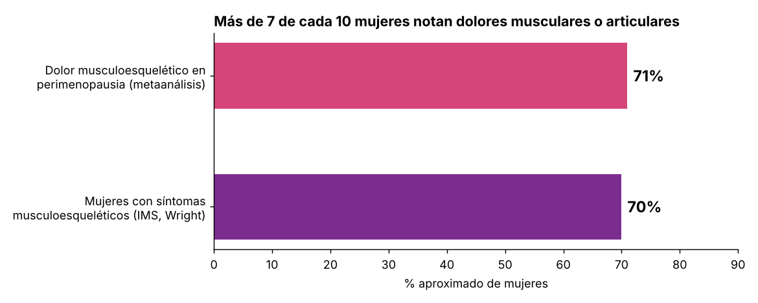
Own graph with data from a meta-analysis (Neural Plasticity, 2020) and the concept of "musculoskeletal syndrome of menopause" disseminated by the IMS.
|
Fact |
Number |
Source |
|
Musculoskeletal pain in perimenopause |
71% (95% CI: 64%–78%) |
Meta-analysis, Neural Plasticity (2020) |
|
Risk of premenopause |
OR 1.63 |
Same meta-analysis |
|
Women with Musculoskeletal Symptoms in Transition |
More than 70% |
IMS/V. Wright (musculoskeletal syndrome) |
|
Women age 50 and older out of the global total |
26% in 2021 (22% a decade earlier) |
WHO |
|
Women in menopause or postmenopause by 2030 |
About 1,200 million |
Estimates cited by FP Analytics |
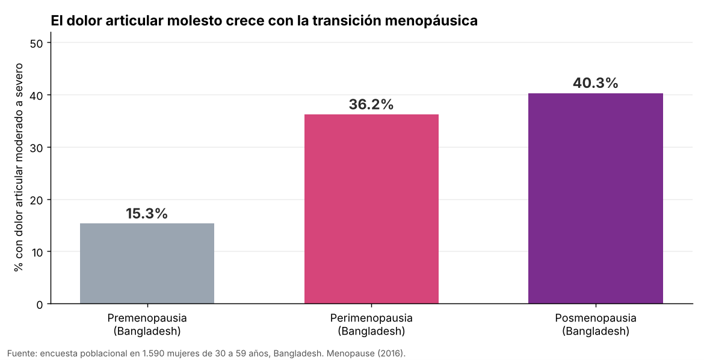
Own graph. A population-based study in Bangladesh found that bothersome joint pain was more than twice as common after transition.
That same study pointed out a fact that challenges health systems: none of the women surveyed received prescribed treatment for their symptoms.
🧬 Why does it hurt more in middle age?
Specialists link the phenomenon to the drop and fluctuations of estrogen, which influence the perception of pain, inflammation, muscles, bones and sleep. A group of researchers even proposed a name for the set of complaints: "musculoskeletal syndrome of menopause", which brings together joint pain, stiffness, loss of strength and muscle mass, and lower bone density.
A contextual fact provided by the clinics: the risk of intense musculoskeletal pain is higher around menopause and in the following years, but not necessarily at older ages.
🚦 Not all pain is menopause: when to consult
One of the most repeated messages of the 2026 campaign is a double-edged warning: the pain is real and should be taken seriously, but it should not be automatically attributed to menopause.
• 🦴 Joint and muscle pain: it can be associated with the transition, but if it is persistent or worsens, arthritis, previous injuries or other inflammatory causes should be ruled out.
• 🩻 Pelvic pain: if it is persistent, unexplained or changing, it should not be considered "normal" and requires evaluation.
• 🧠 Migraine and headaches: They can change your pattern during perimenopause; it's worth checking out.
• 😴 Sleep and mood: Lack of rest and isolation are associated with increased sensitivity to pain.
🧘 What can help: A comprehensive approach
The IMS and the professionals who joined the campaign agree that there is no single solution. The plan is personalized and usually combines several pillars:
• 🏃 Movement: regular exercise, with strength and mobility work adapted to each person.
• 🥗 Healthy diet and weight: less burden on the joints. A guide released by a British hospital recalls that the IMS recommends, after menopause, between 700 and 1,200 mg of calcium and between 400 and 1,000 IU of vitamin D per day, always with professional indication.
• 🌙 Restful sleep: Getting a good night's sleep reduces sensitivity to pain.
• 🤝 Bonds and mental health: A British study of more than 500,000 people associated loneliness with nearly twice as much chronic pain.
• 💊 Medical treatments: Hormone therapy can help with other symptoms, but the evidence for treating established musculoskeletal pain is limited and inconsistent. The decision is individual and should be made by each woman with her doctor.
🌎 The context: a pending conversation
WHO recognizes that awareness of and access to information and services about menopause remain a challenge in most countries. Many women are unaware that their symptoms are related to menopause, and training of health professionals on the subject is limited in many curricula. The agency proposes to include diagnosis, treatment and counseling in universal health coverage.
In Argentina, the Argentine Association for the Study of the Climacteric indicates that symptoms can last between four and twelve years, which reinforces the importance of consulting in time.
The scientific agenda also accompanies: the IMS World Congress was held from September 30 to October 3, 2026 in Rio de Janeiro, Brazil.
🙋 How to join World Menopause Day
• 📣 Share the official IMS materials and factsheets on your networks and in your workplace.
• 🗣️ Talk about it with family, friends, and at work: naming it reduces stigma.
• 📝 Write down your symptoms (when they appear, how long they last, how they affect your day) and bring them to the appointment.
• 🏥 If the pain lasts longer than three months or interferes with your life, ask for a medical evaluation.
❓ Frequently Asked Questions
➤ When is World Menopause Day 2026?
It is celebrated on Sunday, October 18, 2026, as every year on that date.
➤ What is the theme for 2026?
Chronic pain in midlife, chosen by the International Menopause Society.
➤ Does menopause cause joint pain?
It may be associated: studies show more joint and muscle pain during perimenopause and postmenopause. Even so, persistent pain can have other causes and should be evaluated.
➤ At what age does menopause arrive?
According to the WHO, it occurs in most women between the ages of 45 and 55.
➤ How long do the symptoms last?
It varies greatly from one woman to another; in Argentina a range of between four and twelve years is mentioned.
➤ Does hormone therapy work for pain?
The evidence for established musculoskeletal pain is limited and inconsistent. The indication should be individual and medical.
📚 Sources consulted
• International Menopause Society (IMS) – World Menopause Day
• Meta-analysis: musculoskeletal pain in the menopausal transition (Neural Plasticity, 2020)
• Bangladesh Population Study on Hot Flashes and Joint Pain (Monash University)
• The Well News – World Menopause Day 2026
• Cromwell Hospital – Midlife shouldn’t hurt
• Henpicked – Menopause and chronic pain (13/10/2026)
• International Menopause Day... – World Menopause Day
• FP Analytics – Impacts of menopause