








Blog - ArchivesPosts of 04/2026
 PATAGONIA, LAND OF DISCOVERIES: FOUR FOSSIL FINDS THAT REWRITE THE HISTORY OF LIFE IN ARGENTINA
- by
cronywell
PATAGONIA, LAND OF DISCOVERIES: FOUR FOSSIL FINDS THAT REWRITE THE HISTORY OF LIFE IN ARGENTINA
- by
cronywell
|
⏱ ESTIMATED READING TIME: 9 MINUTES | 🗓 APR 2026 | 🦴 ARGENTINE PALEONTOLOGY SEO keywords: paleontology Argentina 2026, Chubut dinosaur, Bicharracosaurus dionidei, Cretaceous reptile Río Negro, fossil crocodile Patagonia, CONICET fossils |
PATAGONIA, LAND OF DISCOVERIES: FOUR FOSSIL FINDS THAT REWRITE THE HISTORY OF LIFE IN ARGENTINA
In less than two weeks, scientific teams from CONICET and international partners published four first-rate paleontological findings in Argentine Patagonia: a 70-million-year-old reptile in Río Negro considered the most complete lizard of the late Cretaceous in South America; Bicharracosaurus dionidei, the first Jurassic brachiosaurid known in the southern hemisphere; an 85-million-year-old land crocodile; and a fossil trunk integrated into the scientific heritage in Neuquén. Argentina once again demonstrates why its soil is the living archive of the planet.
🗺 Four provinces, four windows to the past
|
🦎 70 M.a. |
Paleoteius lakui — Late Cretaceous lizard reptile 📍 Río Negro · Allen Formation, Ojo de Agua Salt Mine |
|
🦕 155–160 M.a. |
Bicharracosaurus dionidei — First Jurassic Brachiosaurid of the Southern Hemisphere 📍 Chubut · Calcáreo Canyon Formation |
|
🐊 85 M.a. |
Notosuchus terrestris (cf.) — Cretaceous land crocodile 📍 Río Negro · Paso Córdoba Natural Protected Area, Gral. Roca |
|
🌲 Millions of years |
Petrified fossil trunk — University scientific heritage 📍 Neuquén · City of Neuquén (rescued private site) |
|
4 Findings in <2 weeks |
155M Years of Seniority (Max) |
<12 Known Southern Hemisphere Mesozoic Lizards |
🦎 1. Paleoteius lakui: the missing link of Cretaceous lizards
🖼 View image: Patagonian landscape, Río Negro — Paleoteius lakui finding area
https://upload.wikimedia.org/wikipedia/commons/thumb/d/df/Patagonia_Argentina.jpg/1200px-Patagonia_Argentina.jpg
▲ Patagonian landscape, Río Negro — Paleoteius lakui find area — Source: Wikimedia Commons / CC
At the site of Salitral Ojo de Agua, south of the city of General Roca, province of Río Negro, an international paleontological team led by CONICET scientists made one of the most significant findings in recent South American paleontology. The new species of reptile, named Paleoteius lakui, lived approximately 70 million years ago, during the late Cretaceous, at the dawn of the mass extinction that would wipe out three-quarters of life on the planet.
The discovery, published in the scientific journal Scientific Reports with the support of the National Geographic Society, was led by Federico Agnolín, a CONICET researcher at the Laboratory of Comparative Anatomy and Evolution of Vertebrates (LACEV) of the Argentine Museum of Natural Sciences. Despite its small size – just 15 centimeters in length – Paleoteius lakui represents the most complete terrestrial lizard known for that period in the entire Southern Hemisphere.
The value of the find is hard to overstate. While more than 150 species of Mesozoic lizards are known in the Northern Hemisphere, the Southern Hemisphere record barely exceeds a dozen. Moreover, the phylogenetic analysis revealed that Paleoteius lakui does not belong to any known group in South America, which evidences the existence of evolutionary lineages completely unpublished by science.
|
🔬 Species |
Paleoteius lakui |
|
📍 Location |
Ojo de Agua Saltpeter, Río Negro — Allen Formation |
|
⏳ Seniority |
~70 million years ago (Late Cretaceous) |
|
📏 Size |
Approx. 15 cm in length — small land lizard |
|
🧬 Lineage |
Scincomorpha — not classifiable in known South American groups |
|
📰 Publication |
Scientific Reports (Nature Portfolio) — apoyo National Geographic Society |
|
⚗️ Technology |
Microcomputed tomography + 3D models (CNEA) |
|
👥 Team |
LACEV-MACN-CONICET, Félix de Azara Foundation, Patagonian Museum |
|
The fossil remains of small animals are generally very scarce... the discovery of Paleoteius fills a void of tens of millions of years. — Federico Agnolín, researcher at CONICET (LACEV-MACN) |
The skull of Paleoteius featured an ornamentation of small protuberances and jaws with numerous thin teeth, probably adapted to feed on insects. To study its internal anatomy without damaging the remains, the team used micro-computed tomography in collaboration with the National Atomic Energy Commission (CNEA), generating high-precision three-dimensional models. The result is the sharpest image ever obtained of a Late Cretaceous terrestrial lizard in South America.
🦕 2. Bicharracosaurus dionidei: the giant that began with a "bicharraco"

https://upload.wikimedia.org/wikipedia/commons/thumb/a/a2/Diplodocus_Carnegie_Labeled.jpg/1200px-Diplodocus_Carnegie_Labeled.jpg
▲ Reconstruction of Diplodocus-type sauropod — reference to the Macronaria group to which Bicharracosaurus belongs — Source: Wikimedia Commons/CC
In a remote corner of northwestern Chubut, Dionide Mesa, a baqueano and rural producer, roamed the countryside on horseback as he had done all his life. Every time he came across a huge bone, he called the scientists of the Egidio Feruglio Paleontological Museum (MEF) with the same phrase: "I found a bug!" That usual gesture, repeated for years, ended up being the starting point of the most relevant paleontological discovery in South America so far in 2026.
The new dinosaur, named Bicharracosaurus dionidei after Mesa, is a long-necked herbivorous sauropod that lived between 155 and 160 million years ago during the Late Jurassic. Its remains were found in the Cañadón Calcáreo Formation, a geological unit internationally recognized for its richness in Jurassic fossils. The study was published in the journal PeerJ and was led by German paleontologist Alexandra Reutter in collaboration with teams from CONICET-MEF, the Ludwig-Maximilians-Universität München and the German Research Foundation (DFG).
The scientific relevance of Bicharracosaurus transcends its enormous size – between 15 and 20 meters long and about 20 tons. The phylogenetic analysis determined that it belongs to the group of the Macronaria, a branch that includes Brachiosaurus and Patagotitan, and that its finding makes it the first Jurassic brachiosaurid known in the entire southern hemisphere.
|
🔬 Species |
Bicharracosaurus dionidei |
|
📍 Location |
Cañadón Calcáreo Formation, northwest of Chubut |
|
⏳ Seniority |
155–160 million years ago (Late Jurassic) |
|
📏 Size |
15–20 m long · ~20 tons weight |
|
🧬 Lineage |
Macronaria — first Jurassic brachiosaurid in the Southern Hemisphere |
|
🦴 Material |
Spine, dorsal ribs, hip fragments |
|
📰 Publication |
PeerJ — German-Argentinian team (CONICET-MEF / LMU München / DFG) |
|
🎖 Tribute |
Name in honor of Dionide Mesa, baqueano discoverer |
|
Our analysis indicates that Bicharracosaurus is the first Jurassic brachiosaurid known in South America. — Alexandra Reutter, paleontologist, lead author of the study — LMU München |
The most distinctive anatomical feature of Bicharracosaurus dionidei is its neural spines – the bony projections on the vertebrae. While in most sauropods these structures are wider than they are long, in this dinosaur they appear compressed and elongated from front to back, forming an unprecedented morphology within the group. The vertebrae also have complex internal cavities: a kind of hollow architecture that lightens the skeleton without losing structural strength, the key that allowed sauropods to reach colossal sizes.
José Luis Carballido, a researcher at CONICET-MEF and co-author of the study, was direct in assessing the significance of the discovery: "Sauropods were a fundamental part of the terrestrial ecosystems of South America; its diversity was much greater than we thought." Diego Pol, another co-author, stressed that "each discovery provides key information about a time for which there are very few records in the southern hemisphere."
🐊 3. The crocodile that walked upright: 85 million years in Paso Córdoba
https://upload.wikimedia.org/wikipedia/commons/thumb/9/9b/Notosuchus_BW.jpg/800px-Notosuchus_BW.jpg

▲ Artist's reconstruction of Notosuchus terrestris — possible species of the Río Negro fossil (Wikimedia Commons) — Source: Wikimedia Commons / CC
Unlike popular imagination, late Cretaceous crocodiles were terrestrial, agile, upright creatures, more like a mammal than the aquatic reptile we know today. In the Paso Córdoba Natural Protected Area, in the vicinity of General Roca, Río Negro, a CONICET campaign led by Agustina Lecuona (Institute for Research in Paleobiology and Geology, IIPG-CONICET-UNRN) brought to light one of these extinct reptiles.
The discovery began when postdoctoral fellow Facundo Riguetti detected a skull fragment in the rock. By expanding the excavation, the team also recovered vertebrae, parts of the limbs and other bones of the post-skull, which were extracted with CONICET protocols in collaboration with the National University of Río Negro and the Azara Foundation-Maimonides University. The geological formation corresponds to the Bajo de la Carpa Formation, an environment of ephemeral rivers and aeolian sectors similar to today's deserts.
Preliminary analysis suggests that the remains could correspond to Notosuchus terrestris, a species of terrestrial crocodile widely distributed in Patagonia during the Cretaceous. However, the researchers do not rule out that it is a different species – and even new to science – which would further raise the value of the find. Lecuona stressed that the almost complete femur allows us to estimate an adult size of around one meter without counting the tail.
|
🔬 Probable species |
Notosuchus terrestris (to be confirmed) |
|
📍 Location |
Paso Córdoba Natural Protected Area, Gral. Roca, Río Negro |
|
⏳ Seniority |
~85 million years ago (Late Cretaceous — Lower Tent Formation) |
|
📏 Estimated size |
~1 meter not including tail (based on femur) |
|
🏃 Locomotion |
Terrestrial · Upright legs · agile mammal-like gait |
|
🦴 Material |
Skull, vertebrae, limb bones (postcranium) |
|
👥 Team |
Agustina Lecuona, Facundo Riguetti, Mattia Baiano · IIPG-CONICET-UNRN |
|
If, on the other hand, it were not the species mentioned, the finding would be just as or more relevant, since few species of crocodiles are known in Paso Córdoba and they are usually represented by a single specimen. — Agustina Lecuona, researcher at CONICET (IIPG-UNRN) |
🌲 4. The fossil trunk of Neuquén: preserving is also researching
The fourth piece of the Patagonian paleontological mosaic of these weeks did not come from a planned scientific excavation, but from an urgent rescue. The Directorate of Cultural Heritage of the province of Neuquén detected a fossil trunk in a private property within the city of Neuquén and proceeded to remove it to deposit it in the paleontological repository of the Museum of Natural Sciences of the National University of Comahue (UNCo).
"What was done was to remove that material and deposit it in the paleontological repository of the University of Comahue," explained paleontologist Juan Porfiri, director of the museum, who stressed that this type of intervention is part of a systematic policy of safeguarding paleontological heritage. The institution acts as a depository of paleontological, archaeological and historical pieces of the region.
The case brings to the fore the constant threat of illegal fossil trafficking. Argentine Patagonia has documented records of petrified trunks, fossil invertebrates and even dinosaur bone material that have been illegally extracted and offered on internet portals. Active preservation – not just research – is, in this context, an essential way of doing science.
|
In times when natural memory faces risks of loss and devaluation, the public university reaffirms its role as guardian of knowledge. — Institutional Declaration, Museum of Natural Sciences — National University of Comahue |
🌍 Argentina, the fossil capital of the world
The concentration of findings in such a short time is not a coincidence. Argentine Patagonia is, along with Montana (USA) and some areas of Central Asia, one of the richest and most diverse paleontological sites on the planet. Its geological formations range from the Jurassic to the late Cretaceous, and the conditions of sedimentation and aridity have preserved remains that in other latitudes would have already disappeared.
Behind each find there are decades of institutional work: CONICET, the Egidio Feruglio Paleontological Museum in Trelew, the Argentine Museum of Natural Sciences in Buenos Aires, the National University of Comahue, the National University of Río Negro and dozens of international collaborators weave a scientific network that, despite structural underfunding, continues to produce world-class results. There are also rural dwellers – such as Dionide Mesa in Chubut or Facundo Riguetti in Río Negro – whose trained gaze and their vocation to collaborate with science are essential.
Each of these four discoveries that occurred in April 2026 adds a piece to the puzzle that science has been trying to complete for centuries: what life was like on Earth before humans inhabited it. And the answer, once again, comes from Patagonian soil.
📚 Primary sources consulted
▸ Paleoteius lakui — Scientific Reports (Nature) · https://www.nature.com/articles/srep
© 2026 · Scientific Writing Patagonia · Typography: Montserrat · All rights reserved · Posted on April 23, 2026
 The most capable AI model available to the public in April 2026: A leader in autonomous programming, vision, and complex reasoning
- by
cronywell
The most capable AI model available to the public in April 2026: A leader in autonomous programming, vision, and complex reasoning
- by
cronywell
🔬 SPECIAL COVERAGE: ARTIFICIAL 🔬 INTELLIGENCE
ANTHROPIC LANZA
CLAUDE OPUS 4.7
The most capable AI model available to the public in April 2026: A leader in autonomous programming, vision, and complex reasoning
📅 April 16, 2026 • ⏱️ Reading time: 9–11 minutes • 🏢 Anthropic / San Francisco, CA
🌐 Coverage: Global AI / programming / tech industry • 📰 Technology & Future
|
🖼️ Logo oficial de Anthropic — Wikimedia Commons https://upload.wikimedia.org/wikipedia/commons/thumb/8/8b/Anthropic_logo.svg/1200px-Anthropic_logo.svg.png |
San Francisco, April 16, 2026. — Anthropic on Thursday unveiled Claude Opus 4.7, its most powerful artificial intelligence model available to the public, with substantial improvements in autonomous programming, computer vision and long-range reasoning. The release, which comes exactly ten weeks after Opus 4.6, completes a dizzying ten-week race in which all the major AI labs unveiled their flagship models: Google's Gemini 3.1 Pro (February), OpenAI's GPT-5.4 (March), and now Anthropic's Opus 4.7. The result is the most competitive race the LLM industry has ever experienced.
🪄 What is Claude Opus 4.7 and what changes compared to its predecessor
Opus 4.7 is the generally available version of Anthropic's flagship model. According to the company itself, this is "a marked improvement over Opus 4.6 in advanced software engineering, with particular gains in the most difficult tasks." Users report being able to delegate their most complex programming jobs—those that previously required constant supervision—to Opus 4.7 with confidence.
Two main axes define the new version: the ability to verify your own answers before reporting them ("self-checking") and an exponential leap in visual resolution. The model can now process images up to 2,576 pixels on the long edge, which is more than three times the capacity of its predecessor (1.15 megapixels vs. 3.75 megapixels). This opens doors to the interpretation of technical diagrams, dense documents and chemical structures with a precision previously unthinkable.
|
📅 Release Date |
April 16, 2026 |
|
🔱 Previous model |
Claude Opus 4.6 (released February 5, 2026) |
|
💰 API Price |
$5 per million input tokens / $25 per million output (no change) |
|
💻 Availability |
Claude Pro, Max, Team, Enterprise, API, Amazon Bedrock, Google Vertex AI, Microsoft Foundry |
|
🧠 Background |
1 million tokens (128k maximum output) |
|
🖼️ Visual Resolution |
3.75 megapixels (3× more than Opus 4.6) |
|
🔎 Model ID (API) |
claude-opus-4-7 |
📊 Benchmarks: how the world model ranking looks
The numbers speak loudly in the territory that matters most to Anthropic: autonomous programming. In SWE-bench Pro – the benchmark that measures the ability to resolve real issues in open source repositories, in multiple languages – Opus 4.7 jumps from 53.4% to 64.3%, beating GPT-5.4 (57.7%) and Gemini 3.1 Pro (54.2%) by a significant margin. That's a jump of more than 10 percentage points in two months.
|
Benchmark |
Opus 4.7 |
Opus 4.6 |
GPT-5.4 |
Gemini 3.1 Pro |
|
SWE-bench Pro (cód. aut.) |
64,3% ↑ |
53,4% |
57,7% |
54,2% |
|
SWE-bench Verified |
87,6% ↑ |
80,8% |
N/A |
80,6% |
|
CursorBench (IDE) |
70,0% ↑ |
58,0% |
N/A |
N/A |
|
OSWorld-Verified (desktop) |
78,0% ↑ |
72,7% |
73,1% |
N/A |
|
GPQA Diamond (reasoning) |
94,2% |
91,3% |
94,4% |
94,3% |
|
GDPVal-AA Elo (prof. work) |
1753 ↑ |
N/A |
1674 |
1314 |
|
BrowseComp (web search) |
79,3% ↓ |
83,7% |
89,3% |
85,9% |
|
MMMLU (multilingüe) |
91,5% |
91,1% |
N/A |
92,6% |
↑ Better — ↓ Backward from previous version. Sources: Anthropic System Card, VentureBeat, The Next Web, Vellum AI — April 2026.
🛑 The exception: BrowseComp drops 4 points
Not everything is the green light. BrowseComp, which measures web search and multipage synthesis capability, falls from 83.7% to 79.3%, falling 10 points behind GPT-5.4 (89.3%) and almost 6 behind Gemini 3.1 Pro (85.9%). Teams using web-intensive research agents should take note: Opus 4.7 isn't the first choice for that specific workflow.
🔥 The five key new features of the model
1️⃣ Automatic verification of results (self-checking)
Opus 4.7 introduces the ability to review your own responses before reporting them. In complex coding workflows, this means that the model catches logical errors during the planning phase, before committing to an incorrect implementation. Early access users confirm this: "Claude Opus 4.7 catches its own logical flaws during the planning phase and accelerates execution, well above Claude's previous models," a fintech platform recounted in Anthropic's launch post.
2️⃣ "xhigh" effort level and task budgets
Opus 4.7 introduces a new level of reasoning called xhigh, located between high and max. This gives developers granular control over the relationship between depth of reasoning and latency. Claude Code now uses xhigh by default on all subscription plans. In parallel, task budgets in public beta allow developers to set a token consumption ceiling for agent loops, avoiding bill surprises during long debugging sessions.
“Opus 4.7 introduces a new xhigh effort level between high and max, giving users finer control over the tradeoff between reasoning and latency on hard problems.”
Anthropic — Official Release Post, 4/16/2026
3️⃣ 3 vision× more resolution and scientific imaging
The visual leap is the most notable in this version: the maximum image resolution goes from 1.15 to 3.75 megapixels. In CharXiv, the benchmark for the interpretation of scientific figures, Opus 4.7 improves by 13 points. On XBOW visual acuity rises from 54.5% to 98.5%. Desktop environment coordinates now map 1:1 to pixels, eliminating the scaling error that limited accuracy in OSWorld.
4️⃣ Persistent memory in long sessions
The model substantially improves the use of file system-based memory. You can recall important notes through long multi-session work sessions and use them to move forward on new tasks with less initial context. For development workflows that span hours or days, this represents a concrete operational advantage.
5️⃣ Command /ultrareview and auto mode for Max plan
Claude Code adds /ultrareview, a command that runs a dedicated review session that reads all changes and flags what a careful human reviewer would detect. In turn, the "auto mode" – previously exclusive to Teams/Enterprise/API – is now available to Max plan subscribers, reducing interruptions in longer tasks.
|
|
🏁 The competitive context: the ten-week race and the state of the art
The release of Opus 4.7 closes a fierce race. Between February 5 and April 16, 2026, the four flagship models of the three great AI powers hit the market in less than ten weeks. The convergence is so pronounced that in university reasoning (GPQA Diamond) the three public models are within 0.2 percentage points of each other. The benchmark has saturated on the border.
According to VentureBeat, Opus 4.7 outperforms GPT-5.4 in 7 of 11 directly comparable benchmarks, but the advantage is not overwhelming. Anthropic itself admits that the model it really aspires to match is its own Claude Mythos Preview, an even more powerful version kept out of public access for security reasons.
💰 The Price Map: Gemini's Pressure
The front where Anthropic doesn't win is price. Gemini 3.1 Pro charges $2 per million tokens input and $12 tokens output, compared to $5 and $25 for Opus 4.7. For high-volume workloads or low code accuracy requirements, the 2.5× difference in price can be decisive. However, analysts and developers conclude that for agentic engineering—where Opus 4.7 saves hours of human labor—the extra cost is justified.
|
💰 Opus 4.7 (API) |
$5 inbound / $25 outbound per million tokens |
|
🔵 GPT-5.4 (OpenAI) |
USD 2.50 entrance / USD 15 exit approx. (general ref) |
|
🟢 Gemini 3.1 Pro |
$2 inbound / $12 outbound per million tokens |
|
🔴 Opus 4.7 (Batch API) |
50% discount on check-in and check-out — up to 90% savings with cache |
🔒 The Elephant in the Room: Claude Mythos and the Glasswing Project
There's one elephant that Anthropic can't hide: Claude Mythos Preview. The company has introduced Opus 4.7 as its most powerful model for general availability, but openly admits that it's not the most advanced model it's ever built. Mythos Preview, described as a system of extraordinarily powerful cyber capabilities, was released the previous week to just a select group of technology and cybersecurity companies under Project Glasswing.
"We released Opus 4.7 with safeguards that automatically detect and block requests that indicate prohibited or high-risk cybersecurity uses," Anthropic wrote. "What we learn from the real-world deployment of these safeguards will help us work toward our ultimate goal of a broad launch of the Mythos-class models."
“Opus 4.7 is the first such model: its cyber capabilities are not as advanced as those of Mythos Preview. We are using it as a testbed for new automated cybersecurity safeguards.”
Anthropic — Post oficial, 16/4/2026
For security professionals who wish to use Opus 4.7 for legitimate purposes—vulnerability research, pen testing, red-teaming—Anthropic launches the Cyber Verification Program, a formal accreditation process that gives access to expanded capabilities under supervision.
💸 Business context: Anthropic's financial moment
The launch comes at the time of the greatest commercial momentum in Anthropic's history. Claude's traffic grew approximately 5 times in the last year. The company reached a valuation of USD 380,000 million in its Series G in February 2026. And at the time of this news, its annualized revenue rate (ARR) had climbed to $30 billion by April 2026, driven primarily by enterprise adoption and the success of Claude Code. Eight of the world's ten largest companies by capitalization are now Claude's clients.
Investment reports suggest that venture capital firms are offering valuations of up to $800 billion — more than double February's Series G valuation — though the company has not confirmed any new rounds. The context is relevant: in a market that converges technically, the battle is fought in distribution, ecosystem of tools and business trust.
|
📈 ARR Anthropic (abril 2026) |
$30 billion (annualized rate) |
|
💳 Rating Series G (Feb 2026) |
USD 380,000 million |
|
🌐 Traffic growth (12 m.) |
Approx. 5× compared to the previous year |
|
🏢 Fortune 10 Customers |
8 of the 10 largest companies in the world |
|
🖼️ Dario Amodei, CEO de Anthropic — Wikimedia Commons https://upload.wikimedia.org/wikipedia/commons/thumb/4/4b/Dario_Amodei_2023.jpg/800px-Dario_Amodei_2023.jpg |
🧐 Journalistic analysis: what changes and open questions
✅ Clear strengths of Opus 4.7
► World's best public model for autonomous programming (SWE-bench Pro: 64.3%).
► Self-checking: reduces errors without human intervention in long workflows.
► More powerful 3× vision: opens up new applications in science, patents, and technical documents.
► Same price as Opus 4.6: more performance at the same cost for those who already use it.
► Multi-cloud availability: AWS Bedrock, Google Vertex AI, Microsoft Foundry — frictionless integration.
⚠️ Points of attention and open-ended questions
► BrowseComp drops 4 points: not the optimal choice for intensive web research agents.
► New tokenizer: the same input can generate up to 1.35× more tokens — price neutrality can be misleading for long prompts.
► Legacy prompts: The increased literality of the model can break down backwards-optimized instructions.
► Mythos as a ceiling: the market knows that there is a more powerful model. The tension between security and access will be the debate next quarter.
► Pricing competition: Gemini 3.1 Pro at $2/$12 pushes on high-volume loads. MiniMax M2.5 (open-weight) at $0.30/$1.20 threatens in the cost segment.
📈 FAQ Schema — Frequently Asked Questions
❓ When was Claude Opus 4.7 released?
Claude Opus 4.7 was released on April 16, 2026 by Anthropic, exactly ten weeks after Claude Opus 4.6 (released on February 5, 2026). It is available from the day of its announcement on all Claude plans and in the API.
❓ How much does Claude Opus 4.7 cost?
The API price remains the same as Opus 4.6: $5 per million input tokens and $25 per million output tokens. The Batch API offers a 50% discount. The prompt cache can reduce the cost of entry by up to 90%.
❓ How does Claude Opus 4.7 beat GPT-5.4?
Opus 4.7 outperforms GPT-5.4 primarily in autonomous programming (SWE-bench Pro: 64.3% vs 57.7%), professional knowledge work (GDPVal-AA Elo 1753 vs 1674), and autonomous desktop use (OSWorld: 78% vs 73.1%). GPT-5.4 maintains the advantage in agentive web search (BrowseComp: 89.3% vs 79.3%).
❓ What is Claude Mythos and why is he not available to everyone?
Claude Mythos Preview is Anthropic's most advanced model, with cybersecurity capabilities far superior to Opus 4.7. It is restricted to a select group of technology and security companies because of the dual-use risks it poses, under Project Glasswing.
📚 Sources consulted
► Anthropic — “Introducing Claude Opus 4.7” (post oficial, anthropic.com/news) — 16/4/2026
► Axios — “AnthropicReleases Claude Opus 4.7, concedes it trails unreleased Mythos” — 16/4/2026
► CNBC — “Anthropicrolls out Claude Opus 4.7, an AI model that is less risky than Mythos” — 16/4/2026
► VentureBeat — “AnthropicReleases Claude Opus 4.7, narrowly retaking lead” — 16/4/2026
► The Next Web — “Claude Opus 4.7 leads on SWE-bench and agentic reasoning” — 16/4/2026
► Vellum AI — “Claude Opus 4.7 Benchmarks Explained” — 17/4/2026
► 9to5Mac — “AnthropicReveals New Opus 4.7 Model” — 16/4/2026
► 9to5Mac — “AnthropicLaunches Claude Design following Opus 4.7” — 17/4/2026
► Nerd Level Tech — “Claude Opus 4.7: Benchmarks, Features & Pricing” — 17/4/2026
► Build Fast With AI — “Claude Opus 4.7: Full Review, Benchmarks & Features” — 17/4/2026
――――――――――
🤖 Professional journalistic coverage with advanced 🤖 SEO optimization
Bell Ville, Córdoba, Argentina — April 18, 2026
 GRAPHENE The material that will rewrite the world
- by
cronywell
GRAPHENE The material that will rewrite the world
- by
cronywell
SCIENCE & TECHNOLOGY
────────────────────────────
⬡
GRAPHENE
The material that will rewrite the world
────────────────────────────
📅 April 2026 • 🕐 Reading time: approx. 14 min • ✍️ Popular science journalism
|
🔍 ARTICLE SEO SHEET SEO title: Graphene: what it is, who discovered it, what it is for and what is its technological future Meta Description: All About Graphene: Definition, Discoverers, Unique Properties, Current Technology Applications, Investments 2025, and the Fascinating Future of This Carbon Supermaterial. Main keywords: graphene, what is graphene, properties of graphene, applications of graphene, graphene inversion, Andre Geim, Nobel graphene, graphene future LSI keywords: nanomaterial, two-dimensional carbon, superconductor, graphene batteries, graphene medicine, graphene transistors, graphene market 2025 Suggested URL: /science/graphene-what-is-future-investment-applications Schema Markup: Article, FAQPage, HowTo (para propiedades), BreadcrumbList Search Intent: Informational + Commercial (Investors) — Mixed Heading structure: Main H1 › H2 per section › H3 for specific subtopics |
Imagine a material 200 times stronger than steel, lighter than paper, almost completely transparent, electrically conductive better than copper, and capable of filtering water with unprecedented efficiency. It's not science fiction: it exists, it's called graphene, and it's already changing the world.
Since its successful isolation in 2004 at the University of Manchester, this nanomaterial composed of a single layer of carbon atoms arranged in a hexagonal lattice – identical to a honeycomb – has sparked a scientific, industrial and financial revolution of historic proportions. Today, in 2025, graphene has ceased to be a laboratory experiment to become a global industry valued at almost a billion dollars, with projections that place it at 15,570 million dollars by 2034.
This article answers the essential questions: what is graphene, who discovered it, what is it for, where is it invested today, and what is the horizon of this supermaterial of the 21st century.
🔬 WHAT IS GRAPHENE?
Graphene is a nanomaterial made up of a single layer of carbon atoms bonded together in a hexagonal two-dimensional structure, extracted from graphite – the same material used in writing pencils. Its name comes from "graphite" with the suffix "-ene", typical of carbon compounds.
What makes graphene extraordinary is not simply its composition – carbon is one of the most abundant elements in the universe – but its structure. When carbon atoms are arranged in a single flat atomic-thick layer, physical and chemical properties emerge that no other known material can match simultaneously.
|
|
"Graphene is the thinnest material that can exist. If we stacked 3 million layers, it would barely reach 1 millimeter thick." |
|
📊 Technical data: Properties of graphene
|
PROPERTY / DATA |
VALUE / DESCRIPTION |
|
Mechanical resistance |
200× stronger than steel; 130 GPa of tensile strength |
|
Electrical conductivity |
Superior to copper; electrons at relativistic speeds (~1/300th the speed of light) |
|
Thermal Conductivity |
~5,000 W/m·K — the highest known in any material |
|
Optical transparency |
Absorbs only 2.3% of visible light — almost completely transparent |
|
Density/Weight |
~0.77 mg/m² — lighter than paper |
|
Flexibility |
Can bend and stretch up to 20% without fracturing |
|
Specific surface area |
~2,630 m²/g — huge contact area per unit mass |
|
Waterproofing |
Impervious to all gases and liquids in their intact form |
|
Thickness |
0.335 nanometers — the minimum possible according to the laws of physics |
🏆 THE DISCOVERY: THE STORY OF SCOTCH ZEAL AND THE NOBEL PRIZE
The history of graphene is, to some extent, the history of an idea that existed in theory decades before anyone could materialize it. Since the 1930s, theoretical physicists have been aware of the existence of individual layers of graphite and their hypothetical properties, but it was believed that it was impossible to isolate them stably at room temperature.
Everything changed in 2004 at the University of Manchester, UK. Physicists Andre Geim and Konstantin Novoselov — both Russian-born — conducted one of the simplest — and most brilliant — experiments in the history of modern science: they used ordinary transparent adhesive tape to rip off successively thinner layers of a block of graphite, until they obtained sheets that were only one atom thick.
|
|
"With a piece of graphite and scotch tape, Andre Geim and Konstantin Novoselov changed science forever. In 2010 they received the Nobel Prize in Physics." |
|
The technique, known as mechanical exfoliation or the adhesive tape method, showed that graphene was stable under normal conditions and could be manipulated and studied. The results, published in the journal Science in October 2004, shook the academic world.
Just six years later – a record time in the history of the Nobel Prizes – the Swedish Academy awarded them the Nobel Prize in Physics in 2010 "for their innovative experiments with the two-dimensional material graphene". It was an unprecedented recognition for the speed with which the scientific community recognized the impact of the finding.
👤 The protagonists of the discovery
|
PROPERTY / DATA |
VALUE / DESCRIPTION |
|
Andre Geim |
Russian-Dutch physicist (b. 1958, Sochi, USSR). Professor at the University of Manchester. Nobel Prize in Physics 2010. He is also known for his experiments with levitating frogs using magnets (Ig Nobel Prize 2000). |
|
Konstantin Novoselov |
Russian-British physicist (b. 1974, Nizhny Tagil, USSR). Collaborator of Geim and co-winner of the 2010 Nobel Prize. The youngest laureate to receive the Nobel Prize in Physics in that century. |
|
University of Manchester |
Headquarters of the historical experiment. Today it houses the National Graphene Institute (NGI), inaugurated in 2015, with an investment of £61 million from the British government. |
|
Year of discovery |
2004 — published in Science. Nobel Year: 2010. |
|
Theoretical background |
P.R. Wallace (1947) calculated the band structure of graphite. P.W. Anderson and other physicists theorized about 2D sheets in the 1960s–1990s. |
⚙️ WHAT IS GRAPHENE USED FOR?
Graphene's properties make it useful in an extraordinary number of applications. Its unique combination of strength, lightness, flexibility, conductivity and transparency has no equivalent in any other known material. This has generated an ecosystem of research and innovation that ranges from nanoelectronics to medicine, energy, sports and construction.
⚡ Power and batteries
One of the most promising applications with the greatest commercial impact is its use in batteries and energy storage. Graphene can significantly improve lithium-ion batteries – those found in every smartphone, laptop and electric vehicle – by increasing their energy density, reducing charging times and extending their lifespan.
Pure graphene batteries, still in commercial development, promise full charges in minutes instead of hours, and charge cycles that far exceed those of current technology. Companies such as Samsung SDI and CATL already incorporate graphene oxide into their most advanced cells.
📱 Advanced electronics
Graphene is a serious candidate to replace silicon in next-generation transistors. While silicon faces physical limits in its miniaturization — the so-called "de Broglie barrier" — graphene makes it possible to manufacture atomic-sized transistors with extremely higher switching speeds. MIT and other research centers have succeeded in creating graphene transistors that operate at terahertz frequencies.
In addition, its transparency and conductivity make it the ideal material for flexible touch screens, which could usher in a new era of foldable, rollable, or even wearable devices built into clothing.
🏥 Medicine and biotechnology
Graphene is transforming medical diagnosis. Biosensors based on graphene transistors allow continuous and real-time monitoring of biomarkers in blood, saliva or sweat, with a sensitivity capable of detecting individual molecules. This ability could revolutionize the early diagnosis of cancer, neurological diseases, or viral infections.
In the realm of drug delivery, graphene oxide can function as a vehicle to deliver drugs directly to cancer cells, reducing the side effects of chemotherapy. Researchers at the University of Manchester are also studying its use in neural interfaces to connect the brain with electronic devices.
💧 Water purification
Single-layer graphene is impermeable to water, but its oxide can act as an ultra-selective membrane that filters pollutants, heavy metals, salt, and bacteria. Lockheed Martin developed the Perforene system, a perforated graphene membrane that desalinates seawater with a fraction of the energy required by conventional reverse osmosis systems.
MIT showed that graphene nanopore membranes filter salt 2 to 3 times faster than current technologies. On a planet with increasing water scarcity, this application can literally be vital.
🚀 Aerospace & Defense
The combination of extreme lightness with superior strength makes graphene a strategic material for the aerospace industry. Graphene compounds make it possible to reduce the weight of aeronautical structures by 20 to 30%, improving fuel efficiency and maneuverability. NASA and ESA actively fund research projects in this field.
In defense, graphene is researched for ultralight armor. The company Graphene Composites already markets GC Shield, a ballistic protection technology based on graphene nanoplatelets, used in military and security applications.
|
|
"Graphene can be used in everything from tennis rackets and bulletproof vests to quantum transistors and membranes that save lives by purifying water." |
|
🌿 Sustainability and the environment
Graphene has natural antimicrobial properties – its hostility to multiple pathogens has already been documented – which opens up possibilities in sterilizing packaging, sanitary textiles and contact surfaces in hospitals. Likewise, graphene oxide can capture radioactive particles in aqueous suspension, offering innovative solutions for the treatment of contaminated water in areas with nuclear incidents.
In construction, graphene added to cement and concrete can increase their strength by 30 to 40%, reducing the amount of material needed and therefore the carbon footprint of the works.
💰 GRAPHENE INVESTMENTS: THE MAP OF MONEY IN 2025
The global graphene market reached a value of $940 billion in 2025, according to Fortune Business Insights, and is projected to grow to $15.57 billion by 2034, with a compound annual growth rate (CAGR) of 36.60%. These numbers aren't just statistics: they represent one of the biggest materials investment opportunities of the 21st century.
🌐 Institutional and Government Investment
The European Union was a pioneer in betting on graphene at an institutional level: in 2013 it launched the Graphene Flagship initiative with an investment of 1,160 million euros over ten years, making it one of the largest research projects in European history. The project brought together more than 150 research groups from 23 countries.
The UK invested £61 million in the National Graphene Institute in Manchester, which opened in 2015, and continues to be a global benchmark in basic and applied research. China, meanwhile, dominates 70% of the world's graphene production, with massive state support and industrial incentive policies that have made the country the largest manufacturer of the material.
The United States, through DARPA, the NSF, and the Department of Defense, funnels hundreds of millions of dollars annually into graphene projects applied to defense, semiconductors, and energy.
📈 The Capital Market: Companies and Stocks
Investing in graphene through capital markets is possible, but it requires an understanding of the risk profile. Most pure graphene companies are small to mid-cap, in early commercialization stages. Analysts project a CAGR of more than 30% between 2026 and 2033. Here are the most relevant companies in the sector:
|
COMPANY |
PURSE/TICKER |
SEGMENT |
PROFILE |
|
NanoXplore Inc. |
TSX: GRP — Canada |
Production at scale |
Largest producer of graphene in North America. It supplies the automotive and manufacturing sectors. |
|
Black Swan Graphene |
TSXV: SWAN — Canada |
Producer + supply chain |
It tripled capacity in 2025. Strategic partner of Thomas Swan & Co. (UK). Focused on composites. |
|
Zentek Ltd. |
TSXV: ZEN — Canada |
Antimicrobial/Health |
Develops antibacterial graphene coatings for medical equipment and PPE. |
|
CVD Equipment Corp. |
NASDAQ: CVV — U.S. |
Manufacturing Equipment |
It produces CVD systems to manufacture graphene and 2D materials. Growth of 7.1% in 2025. |
|
Direct Plus PLC |
AIM: DCTA — RU |
Textile + Environment |
It operates in environmental services. Active lines in smart textiles and composites. |
|
First Graphene Ltd. |
ASX: FGR — Australia |
High Purity Producer |
Verified supplier for the cement industry, paints and high-performance composites. |
|
Graphene Manufacturing Group |
TSXV: GMG — Canada |
Batteries & HVAC |
It develops aluminum-ion batteries with graphene and efficient air conditioning systems. |
⚠️ Note to the investor reader: the graphene sector is volatile and most of these companies are pre-profitable or in the scale phase. The information provided here is journalistic and informative. It does not constitute financial advice. Always consult a certified advisor before making investment decisions.
📦 ETFs and diversified exposure
For those seeking exposure to graphene with lower individual risk, there is the DMAT (iShares Disruptive Materials) ETF, which includes graphene companies along with other materials critical to disruptive technologies: rare earths, lithium, palladium, copper, and carbon fiber. It has been operating in the US market since January 2022.
The graphene battery market specifically — valued at $244 billion in 2025 — is projected to reach $2.1 billion by 2033, with a CAGR of 31%, driven by vehicle electrification and grid storage.
🖥️ TECHNOLOGICAL APPLICATIONS: FROM THE LABORATORY TO THE PRODUCT
After two decades of intense research, graphene has begun to materialize into real products that can already be purchased or that are in the imminent launch phase. Here's the state of the art for the most advanced technology applications:
▶ Padel and tennis rackets: In 2013, Novak Djokovic presented the first racket with graphene. Since then, brands such as HEAD and Babolat have incorporated graphene into their premium lines to improve resistance and reduce vibration.
▶ Tires with graphene: Pirelli incorporates graphene oxide in high-performance tires (Cinturato and P Zero line), achieving lower rolling resistance and greater durability.
▶ Vests and smart clothing: The British company Vollebak markets graphene-coated T-shirts that improve the conduction of body heat. The University of Exeter developed flexible graphene electrodes that can be integrated into textile fibres.
▶ Supercapacitors: Graphene supercapacitors can charge and discharge thousands of times faster than conventional batteries, with applications in regenerative vehicle braking and energy peak storage.
▶ High-frequency transistors: IBM, Samsung, and Intel have developed graphene transistors that operate at frequencies of 100–400 GHz, vastly outperforming silicon for radio frequency applications.
▶ Nanoscale water filters: Lockheed Martin (Perforene) and startups from the University of Manchester are leading the commercial development of graphene membranes for desalination and wastewater purification.
▶ Ultra-sensitive sensors: Graphene biosensors capable of detecting concentrations of a single molecule are being evaluated for early diagnosis of lung cancer, cardiovascular disease, and COVID-19.
▶ Antistatic and anti-corrosion coatings: Graphene as an additive in paints and coatings protects metal structures, pipes and ship hulls with five to ten times greater effectiveness than traditional coatings.
▶ Next-generation solar panels: Graphene can replace indium-tin oxide (ITO) as a conductive transparent electrode, reducing costs and increasing the efficiency of photovoltaic cells.
▶ Quantum computing: The magic angle of bilayer graphene, discovered at MIT in 2018 (1.1 degrees of misalignment), turns the material superconducting at ultra-low temperatures, opening up pathways for more stable qubits.
🚀 THE FUTURE: HORIZONS THAT WILL STILL SURPRISE US
Graphene is at a historic turning point. After twenty years of predominantly academic research, the transition to mass industrialization is now unstoppable. The question is no longer whether graphene will transform the world, but when and in what order.
|
|
"By 2030 we will know whether graphene is as disruptive as silicon or steel." — Henning Döscher, Fraunhofer ISI / Graphene Flagship |
|
🌐 Convergence with artificial intelligence
The combination of graphene with artificial intelligence is perhaps the most exciting frontier. Neuromorphic chips—processors designed to mimic the human brain—could benefit greatly from graphene's electrical properties to process information with radically lower energy consumption than today's silicon. In a context where AI data centers consume as much electricity as entire countries, this can be a civilizational change.
🧬 Medicine of the future: brain-machine interfaces
Researchers at the National Graphene Institute are working on ultra-thin graphene neural interfaces capable of reading and writing nerve signals with unprecedented precision. Unlike silicon, graphene is biocompatible and flexible, allowing for implants that adapt to brain tissue without causing rejection. Applications range from the treatment of Parkinson's and epilepsy to, eventually, direct interfaces between the human mind and digital devices.
🌍 Clean energy and climate change
On the horizon of the energy transition, graphene can play a decisive role on three fronts: high-density batteries to store solar and wind energy, supercapacitors to manage peaks in demand, and more efficient hydrogen cells. Australian company CSIRO demonstrated that graphene can be produced from soybean oil – a safer and cheaper process than conventional methods – paving the way for truly mass and sustainable production.
⚠️ Pending challenges: the dark side of sleep
The path of graphene is not without obstacles. The main challenges that the industry must overcome are production at scale with consistent quality – defects in the crystal structure affect its properties – the still high cost of high-purity graphene, and integration into established value chains that have been committed to silicon, aluminum and plastic for decades.
At the safety level, the scientific community is actively studying the impact of graphene on living organisms: although graphite is harmless, graphene nanoparticles could have unwanted biological effects if inhaled or ingested in large quantities. International regulation – led by organisations such as the OECD and the EU – is moving in this direction with caution and rigour.
📅 Estimated timeline of mass adoption
|
PROPERTY / DATA |
VALUE / DESCRIPTION |
|
2025 – 2027 |
Commercial consolidation in composites, tires, paints, consumer electronics and high-end sports equipment. |
|
2026 – 2028 |
First mass deployment in EV batteries with graphene oxide. Graphene membranes in industrial water purification plants. |
|
2028 – 2031 |
Graphene transistors in cutting-edge semiconductors. Commercial biomedical sensors. Smart textiles with graphene in the mass market. |
|
2030 – 2035 |
Graphene in quantum computing. Clinical neural interfaces. Partial replacement of silicon in AI chips. |
|
Post 2035 |
Speculative horizon: self-repairing buildings, superconducting power grids, ultralight spacecraft, and massive brain-machine integration. |
🎯 CONCLUSION: THE MATERIAL THAT IS ALREADY HERE
Graphene is not a promise of the distant future. It's a material that's already in your car's tires, in your neighbor's padel racket, in the next-generation batteries that will determine who wins the electric vehicle race, and in the most advanced labs on the planet quietly working on cures for diseases that today have no treatment.
Its story — from a piece of duct tape in Manchester to a multibillion-dollar industry — is also the story of how basic, seemingly abstract science can transform the world in less than a generation.
Andre Geim and Konstantin Novoselov were not looking to become millionaires when they exfoliated that first graphene sheet in 2004. They sought to understand nature. And in doing so, they opened a door that no human force can close.
|
|
"Graphene is not the material of the future. It is the material of the present that we still do not fully understand." |
|
❓ FREQUENTLY ASKED QUESTIONS — FAQ
Is graphene dangerous to health?
Graphene itself is non-toxic under normal conditions of use. However, nanoparticles inhaled in industrial settings can be problematic. Developing international regulations will set safe exposure limits.
How much does graphene cost today?
The price varies greatly depending on the quality and shape: graphene powder (nanoplatelets) can cost between 50 and 500 USD/kg for industrial use. High-purity graphene (monolayer for electronics) can exceed 100,000 USD/m².
Where can I buy graphene stocks?
The main graphene stocks are listed on Canadian (TSX, TSXV), Australian (ASX) exchanges and the London AIM market. In the US, the DMAT ETF offers diversified exposure. Always consult a financial advisor before investing.
When will pure graphene batteries arrive in smartphones?
Analysts estimate that the first graphene batteries with massive commercial scale in consumer electronics will arrive between 2026 and 2028. Chinese companies have already presented prototypes with charging times of 8 minutes for a full charge.
Can graphene replace plastic?
Partially. Graphene composites can replace plastics in high-performance applications where strength, conductivity or extreme lightness are required. It is not a universal substitute for plastic in everyday uses, at least for the time being.
📚 SOURCES AND REFERENCES
This article was prepared with information from the following verified sources:
▶ MIT Technology Review — Research on Multilayer Graphene and Quantum Computing (2024)
▶ MAPFRE Global Risks — "Graphene: a material of the future that is already revolutionizing the present" (May 2025)
▶ Fortune Business Insights — Graphene Market Size, Share, Growth Analysis Report (2025)
▶ MarketsandMarkets — Graphene Market worth $3.58 billion in 2030 (2024)
▶ Graphene Flagship (UE) — Roadmap Briefs y estudios de mercado (2021–2025)
▶ Fraunhofer ISI, Karlsruhe — Thomas Reiss, Market Penetration Studies
▶ Grand View Research — Graphene Market CAGR 35.1% forecast 2024–2030
▶ Nature / Carbon / Science — Original publications by Geim & Novoselov and UFMG team
▶ Investing News Network — Graphene Stocks Report (febrero 2026)
▶ Bullish Bears / Intellectia.ai — Graphene Stock Analysis (2025–2026)
──── ⬡ ────
#grafeno #nanomateriales #cienciaytecnologia #innovacion #futurismo #Nobel #supermaterial
 Genetic research and health prevention
- by
cronywell
Genetic research and health prevention
- by
cronywell
#CienciaHoy #SaludPública #Astronomía #GenéticaMédica
Genetic research and health prevention drive the most relevant scientific advances of the moment
New routes to combat blood cancer, the resurgence of the Swiss model of layered prevention and the inauguration of the Vera C. Rubin Observatory in Chile mark the global scientific agenda in 2025.
|
📅 April 15, 2026 |
⏱️ Reading Time: ~7 minutes |
✍️ Science & Health Editorial Team |
|
🔑 HIGHLIGHTS |
|
|
✔ |
The study of the rs17834141 gene opens new avenues for the prevention of blood cancer by modulating the MS12 protein. |
|
✔ |
The Swiss layered prevention model demonstrates multiplied efficacy against respiratory viruses by combining respirators, air filtration, adequate ventilation, and vaccination. |
|
✔ |
The Vera C. Rubin Observatory, inaugurated in June 2025 in Cerro Pachón (Chile), detected 2,104 unknown asteroids in its first 10 hours of operation. |
|
✔ |
Community mapping and human history research reinforce the collective memory and understanding of our species. |
|
🧬 GENETIC INNOVATION: THE GENE THAT COULD REDEFINE PREVENTIVE ONCOLOGY |
Medical genetics is advancing at an unprecedented rate, and 2025 is no exception. At the center of international scientific discussion is the discovery of the rs17834141 gene and its relationship with the MS12 protein, a molecular mechanism whose understanding opens up unprecedented horizons in the fight against blood-borne cancer.
For decades, oncology relied mainly on the early detection of tumors that have already formed. Today, precision preventive medicine proposes a radical turn: identify, before any symptoms appear, which individuals have a high genetic predisposition and act proactively. The analysis of single nucleotide polymorphic variants (SNPs) such as rs17834141 is one of the most promising tools of this paradigm.
|
"The real revolution is not in curing cancer, but in preventing it from appearing. Genetic markers like rs17834141 are the first line of defense." — Researchers in Preventive Oncogenetics, 2025 |
How does the MS12 protein work?
The MS12 protein, encoded in part by the region where the rs17834141 polymorphism is located, participates in DNA repair processes and in the regulation of the cell cycle. When this protein does not work properly – as can occur in carriers of certain variants of the gene – cells accumulate genetic errors more easily. In the context of haematological malignancies (leukaemias, lymphomas, myelomas), this functional deficit may represent a significant risk factor.
Advances in massive genomic sequencing have made it possible to cross-reference huge databases of patients with their molecular profiles, identifying more precisely which variants are associated with a higher incidence of disease. At the same time, messenger RNA-based therapies and gene editing using CRISPR open up the possibility of correcting these predispositions directly in the patient's DNA in the future.
From research to clinical diagnosis
The American College of Medical Genetics (ACMG) updated its list of genes with relevant clinical implications for secondary findings in 2025, incorporating new markers that laboratories must proactively communicate to patients. This decision reflects the growing scientific certainty that knowing one's own genetic profile has direct preventive value. In parallel, the European Society for Medical Oncology (ESMO) has identified the most relevant germline mutations in different types of cancer, moving towards universal genetic screening protocols.
Liquid biopsies – analysis of circulating tumour DNA in the blood – complement this scenario by offering minimally invasive and continuous monitoring of the patient's oncological status. The combination of preventive genomics, liquid biopsy and artificial intelligence promises to transform oncology into a fundamentally predictive discipline.
[ See image: DNA and preventive genetics ]
Visual representation of DNA methylation, a key process in cancer epigenetics. (Source: Wikimedia Commons)
|
🛡️ HEALTH PREVENTION: THE LAYERED STRATEGY TRANSFORMING PUBLIC HEALTH |
At the intersection between the COVID-19 pandemic and routine surveillance of respiratory diseases, a concept that public health experts have known for decades has emerged with renewed force: the layered prevention model, popularized during the pandemic as the "Swiss cheese model."
The premise is seemingly simple but enormously effective: no single prevention measure offers complete protection, but the combination of multiple layers – each with its own holes or imperfections – creates a very robust collective barrier. Each slice of Swiss cheese represents a different measure; together, they block the passage of the virus.
|
The Swiss model of layered prevention recognizes that no measure is one hundred percent perfect, but its strategic combination multiplies collective protection exponentially. |
The four fundamental layers of the model
• High-efficiency respirators (FFP2/N95): filter out more than 94% of airborne particles, protecting both the wearer and the environment.
• Air filtration and purification: HEPA systems and controlled airflows in enclosed spaces drastically reduce the ambient viral load.
• Adequate ventilation: the renewal of indoor air with outdoor air dilutes the concentration of infectious aerosols and is one of the most accessible and economical measures.
• Updated vaccination: adds the individual and collective immune layer, reducing the severity of the disease even when the other layers fail.
Beyond these four main layers, the model integrates other complementary measures: hand hygiene, avoiding crowds, self-isolation in the event of symptoms and contact tracing. The key to its success lies in the sum: the more layers that are activated simultaneously, the lower the residual risk.
The institutional response in 2025
In December 2025, the Spanish Public Health Commission approved a strategic framework for the control of Acute Respiratory Infections (ARIs), which defines four epidemiological scenarios with staggered responses: from the baseline inter-epidemic phase to the very high-level epidemic, where extraordinary coordination between territories is activated and exceptional measures can be implemented.
This phased approach, in line with the guidelines of the European Centre for Disease Prevention and Control (ECDC) and the World Health Organization (WHO), incorporates the learnings from the COVID-19 pandemic and establishes integrated surveillance systems that monitor in real time the transmissibility, severity and impact on healthcare resources.
[ See image: Vaccination and public health ]
Vaccination is the last and decisive layer of the layered prevention model against respiratory viruses. (Source: Wikimedia Commons)
|
🔭 ASTRONOMY: VERA C. RUBIN OBSERVATORY USHERS IN GOLDEN AGE |
June 23, 2025 will be marked in the annals of modern astronomy. On that day, from the slopes of Cerro Pachón, in the Coquimbo Region (Chile), at 2,682 meters above sea level, the Vera C. Rubin Observatory released its first images of the cosmos, triggering a cascade of headlines in media around the world.
The Washington Post headlined "A powerful new telescope in Chile has released its first stunning images." Deutsche Welle wrote that the observatory "unveils never-before-seen photos of the cosmos." It was no journalistic exaggeration: in just ten hours of test operations, Rubin detected 2,104 previously unknown asteroids – including seven near Earth, with no risk of impact – and captured images of millions of galaxies with unprecedented resolution.
|
"It is an observatory that has no competition in the world. With Rubin, we're going to have a movie of the universe in motion." — Collaborating astronomer on the Rubin/NOIRLab project |
The figures that make it unique
• Primary mirror: 8.4 meters in diameter, manufactured by the Richard F. Caris Mirror Lab at the University of Arizona.
• LSST camera: 3,200 megapixels (3.2 gigapixels), the largest astronomical digital camera ever built, weighing 2,800 kilograms.
• Observing cadence: it photographs the entire sky of the southern hemisphere visible every three or four nights, taking about 1,000 images per day.
• Data generation: approximately 20 terabytes of astronomical information each night, processed in real time with global alerts in less than 60 seconds.
• Scientific horizon: for ten years it will explore 17,000 million stars and 20,000 million galaxies, tracking dark matter, dark energy, supernovae and trans-Neptunian objects.
Chile, laboratory of the universe
The choice of Cerro Pachón is not accidental. Chile concentrates more than 40% of the world's astronomical capacity thanks to its unique conditions: dark skies, low humidity, exceptional altitude and atmospheric stability. Rubin joins facilities such as ESO's Very Large Telescope (VLT), ALMA and the future ELT (Extremely Large Telescope), making the northern Andes the most powerful natural observatory on the planet.
The observatory is named after the American astronomer Vera Cooper Rubin (1928–2016), a pioneer in providing the first convincing evidence for the existence of dark matter through the study of galactic rotation curves. A tribute to those who glimpsed the invisible.
[ See official image of the Vera C. Rubin Observatory ]
Aerial view of the Vera C. Rubin Observatory on Cerro Pachón, Chile. (Credit: RubinObs/NSF/DOE/AURA)
|
🌍 SCIENCE AND COLLECTIVE MEMORY: THE OTHER SIDE OF SCIENTIFIC ADVANCES |
Scientific advances are not limited to molecular biology laboratories or state-of-the-art telescopes. A less visible, but equally powerful, dimension is the one that connects science with human history and collective identity.
Community mapping—a discipline that combines modern geospatial techniques with the local knowledge of indigenous, rural, and urban communities—is experiencing an unprecedented boom. Through drones, publicly accessible satellite imagery and GIS (Geographic Information Systems) tools, communities around the world are documenting their territories, recovering ancestral place names and creating maps that link geographical space with cultural memory.
At the same time, ancient population genomics—the analysis of DNA extracted from skeletal remains thousands of years old—is rewriting the history of human migration. Recent findings in South America, Europe, and Southeast Asia reveal patterns of population mixing that challenge conventional historical narratives and enrich our understanding of who we are as a species.
|
The most relevant science not only expands knowledge: it also helps us remember. Community mapping and historical genomics are tools of identity as much as they are of research. |
🔎 CONCLUSION: SCIENCE AT THE SERVICE OF LIFE
The advances that star in this installment – preventive genetics with the gene rs17834141, the layered health model, the astronomical milestone of Vera C. Rubin and the recovery of collective memory – share a common denominator: they represent the best use that humanity can make of scientific knowledge.
It's not just academic publications or isolated technological milestones. These are advances that, sooner or later, translate into fewer diseases, better health policies, a deeper understanding of the cosmos and a more conscious relationship with our own history. Science, at its best, is not an end in itself: it is a tool at the service of life.
📚 SOURCES AND REFERENCE LINKS
1. Genotype — Advances in Medical Genetics and Precision Medicine 2025: genotipia.com/genetica_medica_news/avances-genetica-medica-2025
2. Vera C. Rubin Observatory — First images: rubinobservatory.org/es/news/first-imagery-rubin
3. NOIRLab — Rubin Observatory Begins Observations: noirlab.edu/public/es/news/noirlab2521
4. Ministry of Health Spain — Acute Respiratory Infections: sanidad.gob.es
5. PAHO/WHO — Influenza and respiratory viruses, Southern Hemisphere 2025: paho.org
6. CDC — Background to Respiratory Virus Guidance: espanol.cdc.gov/respiratory-viruses
7. Scientific Culture — The Dynamic Revolution of the Vera Rubin Observatory: culturacientifica.com
#InvestigaciónGenética #Prevención #ObservatorioRubin #SaludPública #Ciencia2025 #Astronomía
🚀 Artemis II: The Triumphant Return That Marks the Beginning of the Lunar Age
By Redacción Científica
📅 April 13, 2026
⏱️ Reading time: 8 minutes
🏷️ Keywords: Artemis II, NASA, return to the Moon, astronauts, SpaceX, Orion, space science 2026, lunar exploration, Artemis program.
🌍 Executive Summary
After ten days of a journey that kept the world on tenterhooks, the Orion capsule of the Artemis II mission returned to Earth on Friday, April 10, 2026. The successful splashdown in the Pacific Ocean not only marks the end of a technical mission, but the beginning of the permanent human presence in deep space. Unlike the Apollo missions, which were brief forays around, Artemis II has shown that humanity is ready to stay: on the Moon, on space stations in lunar orbit, and eventually on Mars.
This 10-day manned flight around the Moon has been NASA's biggest step since 1972, and its results redefine the boundaries of collaborative space exploration.
🌊 The Return: A Surgical Precision Splashdown
Last Friday, at 2:47 p.m. local Pacific time, the skies lit up with the deployment of the three main parachutes of the Orion spacecraft. On board, the heroes of this feat: Reid Wiseman (commander), Victor Glover (pilot), Christina Koch (mission specialist) and Jeremy Hansen (CSA mission specialist) reported in perfect health after the impact with the water.
The U.S. Navy Recovery Team and NASA extracted the crew in a lightning operation of just 35 minutes, closing a cycle of 10 days, 20 hours and 14 minutes outside our atmosphere.
"Today we are not only returning home; We brought with us the future of exploration. Each of us touched the Moon with our eyes, and soon we will touch it with our hands."
— Victor Glover, moments after exiting the capsule.
🛰️ Records that defy history
Artemis II has pulverized landmarks that have remained intact since December 1972 (Apollo 17):
|
Milestone |
Artemis II Achievement |
|
Maximum distance from Earth |
432,000 km (absolute record for a manned spacecraft) |
|
Historical inclusion |
First woman (Christina Koch) and first Canadian person (Jeremy Hansen) to orbit the Moon |
|
Re-entry rate |
40,000 km/h – heat shield resisted 2,800 °C |
|
Deep Space Durability |
More than 240 hours out of the protection of the Earth's magnetic field |
|
Laser Communications |
4K video streaming from beyond the Moon for the first time |
In addition, the crew broke the record for experiments in continuous microgravity conducted outside a space station: 27 different studies, from plant growth to autonomous navigation.
🧬 Cutting-Edge Science: "Organs on Chips" and Beyond
Beyond engineering, the scientific value of this mission lies in the biology of deep space. For the first time, microfluidics devices (organs-on-chips) were used to study in real time how cosmic radiation and microgravity affect:
- Cardiovascular tissue (heart on a chip)
- Kidney tissue (risk of stones in space)
- Blood-brain barrier (neurological effects)
This data is vital for the future Artemis III mission (lunar descent scheduled for 2027) and the eventual trip to Mars, which would last more than 2 years.
Other notable experiments:
- Growth of fungi for recycling materials in lunar habitats.
- 3D printing of tools with simulated regolith powder.
- First miniaturized atomic clock for deep autonomous navigation.
👨 🚀 Crew profile: the first humans in deep space of the 21st century
- Reid Wiseman (NASA) – Commander. ISS veteran. Naval Engineer.
- Victor Glover (NASA) – Pilot. First African American to travel around the Moon.
- Christina Koch (NASA) – Electrical Engineer. Women's record holder in space (328 days).
- Jeremy Hansen (CSA) – Former fighter pilot. First non-American astronaut to orbit the Moon.
The team's chemistry was key: they performed more than 30 emergency simulations before the flight, including fire on board and loss of communications.
🌕 Artemis II vs Apollo 8 Comparison (Historical Lunar Orbital Missions)
|
Feature |
Apollo 8 (1968) |
Artemis II (2026) |
|
Duration |
6 days, 3 hours |
10 days, 20 hours |
|
Maximum altitude |
377,000 km |
432,000 km |
|
Heat Shield Technology |
Analog avionics |
Advanced ablative materials + 3D printed titanium |
|
Communications |
Analog radio |
Laser + Deep Space Network 2.0 |
|
Scientific load |
4 experiments |
27 experiments + 12 commercial payloads |
🖼️ Visual Gallery (official reference links)
Note: To respect rights, original sources are indicated where you can find high-resolution images:
- [PHOTO] Artemis II launch from the SLS – Kennedy Space Center. Lanzamiento
- [PHOTO] The Earth from the Orion capsule at lunar apogee
(Earthrise modern – available in NASA JPL historical archive) - [PHOTO] Successful splashdown – recovery team*(US Navy / NASA – Pacific Ocean, 10 April 2026)* Amerizaje
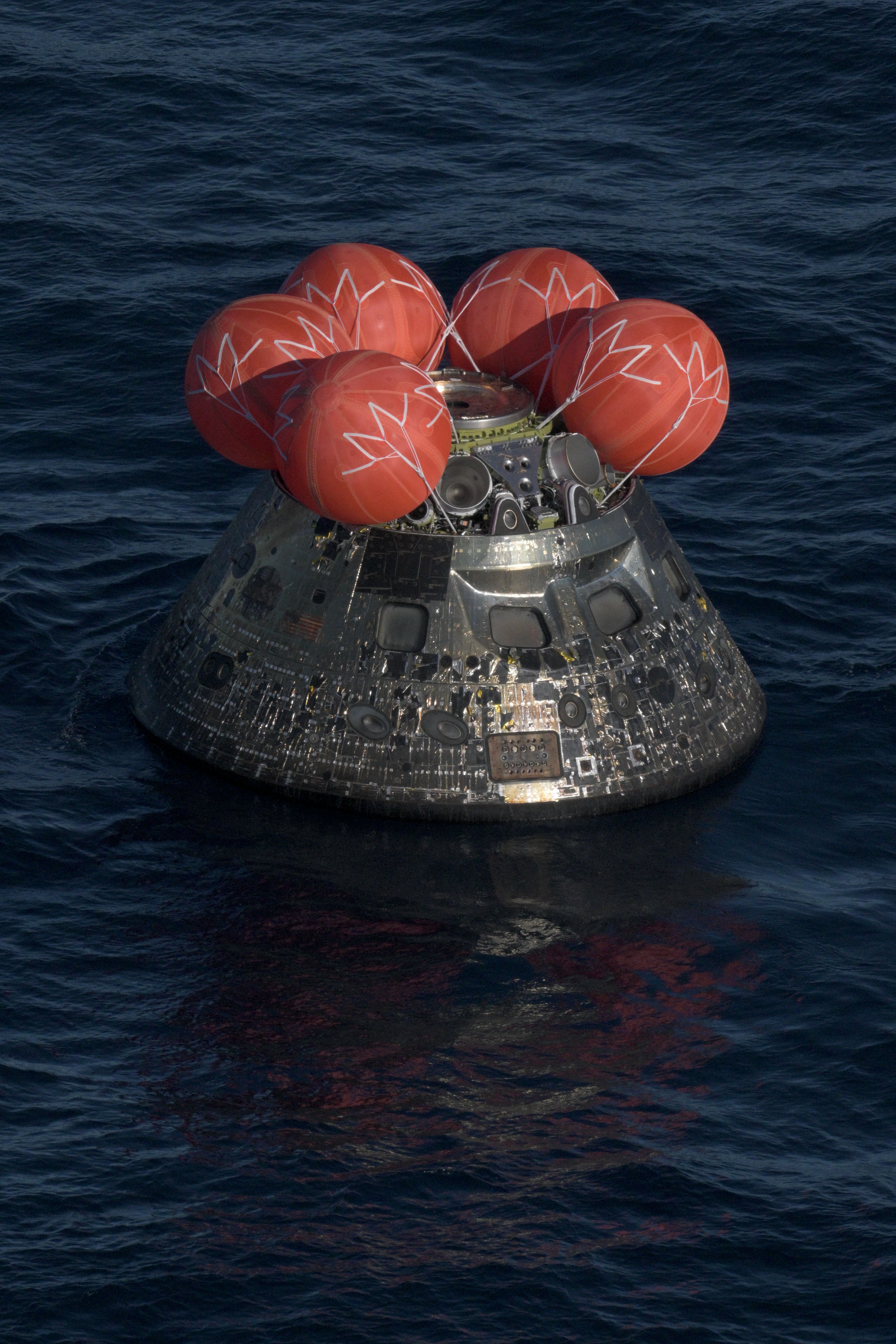
📅 What's next? Artemis III and the future of human presence on the Moon
With Artemis II validated, Artemis III (scheduled for 2027) will attempt the first manned moon landing since 1972. What's new:
- Landing at the lunar south pole (Shackleton region) where there is water ice.
- Axiom Space AxEMU spacesuits, more flexible and resistant to radiation.
- Gateway: The lunar space station will receive its first modules in 2026-2027.
- International cooperation: ESA, JAXA, CSA and agencies from the United Arab Emirates and Brazil participate.
"Artemis II has been the dress rehearsal. Now we're going to live there."
— NASA Administrator Bill Nelson at a post-splashdown press conference.
📌 Conclusion: The Beginning of an Era
Artemis II isn't just a successful mission. It's the litmus test that we can operate safely in deep space with 21st-century technology. We have regained the ability to leave low-Earth orbit, and this time we will not go back.
The new lunar era has begun. And it's not just America's: it's all of humanity.
 The island that no one built
- by
cronywell
The island that no one built
- by
cronywell
|
🏝️ 🐚 🦀 🌊 🔬 The island that no one built,
But everyone created unintentionally
An islet in Fiji happens to be the first "midden island" in the South Pacific east of Papua New Guinea: 1,200 years of shells discarded by settlers living on stilts lifted it from the bottom of the sea 🗓️ Publicado en Geoarchaeology | Patrick D. Nunn, University of the Sunshine Coast | Abril 2026 ⏱ Estimated reading time: 7 minutes |
|
🏷️ SEO keywords: shell island Fiji · midden island Culasawani · human-created island Pacific · archaeology Vanua Levu · Patrick Nunn · Islet shells mollusks · Geoarchaeology 2026 · Archaeological Garbage Island 📌 Meta description: A small islet in Fiji turns out to be the first "midden island" in the South Pacific: formed 1,200 years ago by settlers discarding shells from houses on stilts. Study published in Geoarchaeology (2026). |
A small patch of land surrounded by mangroves on the north coast of Vanua Levu, Fiji's second-largest island, turns out not to be what it seems. It is not a natural promontory, nor the remains of a rocky outcrop, nor the product of a giant wave. According to a study published in April 2026 in the journal Geoarchaeology, this islet of just 3,000 square meters – the equivalent of fifteen tennis courts – is made, almost entirely, of edible shellfish shells. And they were put there by humans, without having any purpose of building an island.
|
📐 3,000 m² Islet surface |
🐚 70–90% Composition of shells |
📅 ~760 A.D. Date of formation |
🦀 20 Surveys Samples Analyzed |
📰 An Island That Started as a Dinner Party
The story begins in January 2017, when two researchers were conducting geoarchaeological surveys along the northern coast of Vanua Levu. They observed a prominent coastal shoal that seemed to be made, for the most part, of mollusc remains. It wasn't just the surface: the digging crabs of the species Scylla serrata had brought materials 30 to 50 centimeters deep to the surface, and those materials were also, for the most part, shells.
What at first appeared to be an extension of the coast turned out, after detailed mapping in 2024, to be an independent island surrounded by mangroves and an estuary, raised just between 20 and 60 centimeters above the level of high tide. Patrick D. Nunn's team from the University of the Sunshine Coast in Queensland, Australia, returned twice that year to excavate, sample and date the deposits.
The results are conclusive: 70 to 90 percent of the material that makes up the island are shells of edible marine species – mainly the Añadara clam – mixed with a matrix of sandy clay and, here and there, small fragments of undecorated pottery. Ten shell samples were radiocarbon dating, and all point to the same period: the islet began to form around 760 AD, with a range ranging from about 420 to 1040 AD.
|
📋 FINDING FILE |
|
📍 Location: Culasawani, north coast of Vanua Levu, Fiji (South Pacific archipelago). |
|
🔬 Publicación: Geoarchaeology (Wiley, 2026). DOI: 10.1002/gea.70052 |
|
👨 🔬 Principal Investigator: Patrick D. Nunn, University of the Sunshine Coast, Queensland, Australia. |
|
🏅 Relevance: First documented "midden island" in the South Pacific east of Papua New Guinea. |
🗑️ What is a "Midden Island": Garbage That Turns to Earth
Archaeology has a precise term for what was found at Culasawani: midden. In Spanish we could call it a conchero or, in a broader sense, archaeological garbage dump. It is an accumulated repository of organic waste: shells, bones, plant remains, broken pottery, anything that a human community repeatedly discarded in the same place for generations.
The idea that a landfill could be turned into a habitable island may sound outlandish, but it has documented precedents in different parts of the world. A midden island is just that: an emerged formation built, unintentionally, by the sustained vertical accumulation of human remains on a shallow seafloor. Over time, and combined with relative changes in sea level, that accumulation can exceed the high tide line and become land.
What makes Culasawani's case special is the geographical context: if Nunn's team's interpretation is correct, it would be the first documented midden island in the South Pacific east of Papua New Guinea. Earlier examples are known from the Bismarck Archipelagos (Papua New Guinea) and the Solomon Islands, but not in the arc that includes Fiji, Tonga, Samoa, or Vanuatu.
|
💡 "Dump island" is not a pejorative term: in archaeology, middens are one of the richest sites in information. They allow us to reconstruct diets, technologies, supply routes, climate changes and coastal occupation dynamics over centuries. |
|
🌍 Other famous middens: the Muge shell midn (Portugal, 8,000 years BP), the shell mounds of the Jomon culture (Japan), or those of the Atlantic coast of Brazil. |
🔬 How They Proved It Wasn't Natural
The team's main challenge was not to find the site, but to prove that what they saw was the result of human action and not a natural phenomenon. The most plausible alternative hypothesis was that a tsunami or wave of great magnitude had dragged shells from the seafloor to that point, forming the deposit accidentally.
To rule it out, the researchers used several converging arguments. First, they extracted twenty boreholes with manual augers in different parts of the island and excavated four one-square-metre pipes. The pattern they found is not that of a natural deposit: a massive wave event deposits shells evenly over a wide surface and the thickness progressively decreases towards the margins. At Culasawani, the deposit does not show that pattern of lateral decline.
Second, and more decisive: all shells belong to edible species. A tsunami or a large wave washes away a random mixture of the seafloor, including inedible species, coral fragments, and varied sediments. The fact that 100 percent of the identified mollusk remains are from species that humans consume is an unmistakable signature of human selection.
Third, the pottery fragments mixed between the shells point directly to domestic activity. Although no stone tools or animal bones were found, the presence of these sherds—typical of post-Lapita pottery from the Pacific—is consistent with a food processing site, not a natural sedimentary event.
|
Evidence |
Description and interpretation |
|
🐚 100% edible shells |
All identified species are mollusks that humans consume. A natural deposit would contain a random mixture of inedible species, coral, and sediments. |
|
🏺 Ceramic Shards |
Small pots of undecorated pottery, consistent with post-Lapita household utensils. Present on various levels of the tank. |
|
📊 Sedimentary pattern |
No lateral decrease in the deposit is detected: it rules out wave dragging, which would produce a fan that thins towards the edges. |
|
🦀 Digging crabs |
Scylla serrata crabs brought material 30-50 cm deep to the surface, revealing that the shell composition remains constant at depth. |
|
⏱ C14 Date Clustering |
The 10 radiocarbon samples are clustered around 760 A.D. (range 420-1040 A.D.), consistent with a continuous accumulation by a stable community, not a one-off event. |
🏠 The Most Fascinating Hypothesis: Houses on Water
If the islet of Culasawani is indeed a midden island, the next question is where exactly the people who generated that deposit lived. The answer proposed by Nunn's team is, at least from the point of view of human history, extraordinarily evocative.
The researchers suggest that the most parsimonious thing – that is, the simplest explanation that fits all the data – is that the community that produced these shells lived on the accumulation zone itself, at a time when that place was flooded at high tide. The architectural solution: platforms on stilts, raised over the shallow waters of the coast.
Coastal stilt constructions are a well-documented solution in the island's Pacific, dating back to the Lapita period—the archaeological culture associated with the first settlers of Fiji, who arrived on the islands more than 3,000 years ago. Sites such as Talepakemalai in Papua New Guinea, or Bourewa and Qoqo in Fiji itself, show that coastal settlements often began on elevated structures above intertidal zones or submerged at high tide.
Under or from these platforms, the inhabitants discarded directly into the water or mud the shells they generated when processing and consuming the shellfish. Over the centuries, this accumulation increased. And, with the help of a relative drop in sea level—a phenomenon documented in the western Pacific during the late Holocene—the deposit emerged above the high-tide line. What had been the sea floor beneath the houses became dry land.
|
🏠 The mechanism proposed by Nunn and his team 1. Post-Lapita settlers (~760 AD) build houses on stilts in shallow water. 2. For centuries, they discarded mollusk shells under/next to the platform. 3. The deposit grows vertically: tens of tons of shells accumulate. 4. The relative sea level drops (late Holoc. phenomenon in the western Pacific). 5. The shell shell emerges: solid ground where there used to be water. Mangroves colonize it. |
🌊 The Pacific, Seafood, and Unintentional Landscape Building
To understand why this finding is relevant beyond the islet itself, look at the bigger picture. Seafood has been a critical food source in the western Pacific for more than 3,000 years. In some modern Fijian communities, mollusks still account for 15 percent of their diet. Along coasts and reefs, generations of foragers would go out in search of clams, cockles, and gastropods within a few hundred yards of their settlements—exactly what the composition of the islet of Culasawani suggests.
This practice, repeated thousands of times over the centuries, had unnoticed geographical consequences. At several sites in the western Pacific—notably in the Bismarck Archipelago and the Solomon Islands—archaeologists had documented similar processes: middens that gradually raised the ground of ancient coastal settlements, creating habitable land where there had once been intertidal mud. The case of Culasawani would be the first manifestation of this phenomenon known in the South Pacific east of Papua New Guinea.
Nunn's team also highlights another side effect of the settlement's abandonment: When the inhabitants left, the mangroves did not exist there. The mangrove forests that surround the islet today grew later, fed by sediments resulting from deforestation that humans themselves caused inland. A chain of consequences that began with the simple gesture of opening a clam.
|
Compared site |
Description and relevance |
|
🇵🇬 Talepakemalai (PNG) |
Lapita settlement on stilts in Papua New Guinea. One of the classic references of coastal occupation on elevated platforms in the Pacific. |
|
🇫🇯 Bourewa and Qoqo (Fiji) |
First known settlements in the Fijian archipelago. They show the initial installation pattern over low-lying coastal areas, possibly on stilts. |
|
🇸🇧 Langalanga Lagoon (Solomon Islands) |
Documented example of intentional use of shells as filler to stabilize artificial islands. Oertle & Szabo, 2019. |
|
🇵🇹 Shell Shells of Muge (Portugal) |
8,000-year-old Mesolithic middens documenting the power of everyday waste to modify the European coastal landscape. |
|
🇯🇵 Jomon Mounds (Japan) |
Network of middens covering the entire Japanese coast during the Jomon period (14,000-300 BC): canonical example of "garbage archaeology" as a window into prehistory. |
🔭 Why It Matters and What Comes Next
🗺️ A blank map that begins to fill up
Vanua Levu is Fiji's second-largest island, but it has received much less archaeological attention than the main one, Viti Levu. The discovery of Culasawani – and the parallel work at the Rokodavutu deposit, on the same island – begin to fill that gap. Each site is a window into the past of the first communities that colonized these islands after the Lapita culture, between 1,200 and 3,000 years ago.
🌡️ Climate Change and Sedimentary Archives
Coastal middens are also climate archives. By analyzing the species present at different levels of the reservoir, researchers can track changes in water temperature, the availability of different mollusks, and variations in sea level over centuries. At a time when the insular Pacific is one of the most vulnerable scenarios to climate change and sea level rise, understanding how that level fluctuated in the past has real practical value.
🏘️ The search for the settlement on land
Nunn's team has work ahead of them: to track down the remains of the land settlement associated with the islet on the nearby coast of Culasawani. If the stilt house hypothesis is correct, there must be a site on dry land—pottery, tools, possibly remains of habitat structure—that is directly related to the shell pit. Finding that piece would close the puzzle and confirm the complete model.
|
🔮 NEXT STEPS OF THE TEAM |
|
🗺️ Search for contemporary settlements on the coast of Culasawani (mainland). |
|
🧪 Analysis of plant microfossils and micro artifacts in sediment samples. |
|
📡 Cross-referencing of radiocarbon dates with known tsunami records in the area. |
|
🌱 Study of the current mangrove ecosystem: how shell deposits nourish the vegetation that today surrounds the islet. |
✍️ The Island Nobody Wanted to Build
There is something deeply human about Culasawani's story. A coastal community, more than twelve centuries ago, settled on the shallow waters of a Fijian bay. He had no intention of creating an islet. I probably didn't even imagine it. He just wanted to eat: open clams, extract the meat, throw the shells. Day after day, generation after generation. And without knowing it, he was building earth.
In a very literal sense, that islet is an involuntary monument to human daily life. There is no heroism or collective intention there: only the infinite repetition of a minimal gesture – eat, open, throw away – that added to itself millions of times ended up modifying the geography of a coast. The landscape as a sediment of the ordinary.
For archaeologists, this kind of finds reminds us that the record left by human societies does not consist only of their great works or their ceremonial burials. It consists also, and perhaps above all, in its waste. In what they threw without thinking twice. In the material that they considered so insignificant that it is not even worth keeping. Sometimes, that's the only thing that survives. And sometimes, that becomes an island.
|
🐚 "If Culasawani Island is a midden island, this is the first to be recorded in the South Pacific west of Papua New Guinea." — Patrick D. Nunn et al., Geoarchaeology (2026) |
📚 Sources and References
• 🔗 Nunn, P.D. et al. Shell-Dense Island Off Culasawani, Vanua Levu Island, Fiji: Midden or Muddle? Geoarchaeology (2026). DOI: 10.1002/gea.70052
• 🔗 Phys.org — Scientists discover a 1,200-year-old Fijian island likely built from discarded shellfish remains (abril 2026)
• 🔗 Interesting Engineering — 1,200-year-old island found in Fiji is made of shellfish remains (abril 2026)
• 🔗 Greek Reporter — Scientists Discover Island Formed Entirely From Shellfish Left by Early Humans (abril 2026)
• 🔗 The Fiji Times — Vanua Levu find sheds light on early Fijian settlers (abril 2026)
• 🔗 Ancientist.com — Scientists Discover 1,200-Year-Old Island Built from Shellfish Remains in Fiji
• 🔗 Anthropology.net — An Island Built from Dinner (abril 2026)
• 🔗 Archaeology Magazine — Midden Island Identified in Fiji Archipelago (abril 2026)
• 🔗 OCSEAN / University of the South Pacific — Field School Vanua Levu 2024 Report
☕ Harvard Study Reveals Drinking Coffee and Tea Reduces the Risk of Dementia: The Exact Amount You Should Consume
Research published in JAMA followed more than 130,000 people for 43 years and confirms that caffeine is the key compound in cognitive protection
📅 April 7, 2026 | ⏱️ Reading Time: 7 minutes | 🏷️ Neuroscience · Nutrition · Prevention
Boston, USA — For decades, millions of people have started their mornings with a cup of coffee or tea without knowing that, beyond the immediate energy boost, they could be quietly protecting their brain. Now, a monumental study published in JAMA, the journal of the American Medical Association, confirms it with strong data: regular consumption of caffeinated coffee and tea is associated with a significant reduction in the risk of dementia and improved cognitive performance throughout life.
The research, led by the Harvard T.H. Chan School of Public Health and Brigham and Women's Hospital, represents the most extensive follow-up to date on this question: 43 years of observation and more than 130,000 participants who meticulously answered questionnaires about their eating habits every two to four years.
🧠 A growing problem: why this study is relevant now
Alzheimer's disease and other forms of dementia currently affect more than 6 million people in the United States, a number that is projected to double to 13 million by 2050. With limited therapeutic options, considerable side effects in the available drugs, and the absence of a definitive cure, early prevention has become the most promising strategy to face this public health crisis.
In this context, diet and lifestyle emerge as modifiable factors of enormous potential. "What we eat and drink on a daily basis could have a cumulative impact on our brain health decades later," the researchers explain.
🔬 Here's how the study was conducted: 43 years of data in two flagship cohorts
The researchers analyzed data from two of the world's longest-running epidemiological studies:
|
Cohort |
Participants |
Profile |
Follow-up period |
|
Nurses' Health Study (NHS) |
86,606 women |
Nursing professionals, mean initial age 46.2 years |
1980-2023 |
|
Health Professionals Follow-up Study (HPFS) |
45,215 men |
Health professionals, mean initial age 53.8 years |
1986-2023 |
All participants were free of cancer, Parkinson's disease, and dementia at baseline. Beverage intake was assessed using validated food frequency questionnaires, administered every 2 to 4 years, which allowed changes in habits to be captured over time — a crucial methodological advantage over previous studies that only measured diet once.
During a median follow-up of 36.8 years, 11,033 incident cases of dementia were documented, identified through death records and medical diagnoses.
📊 Main results: caffeine makes a difference
Caffeinated coffee: 18% less risk
Participants who consumed the most caffeinated coffee — a median of 4.5 cups daily in women and 2.5 cups daily in men — performed markedly better on all indicators:
- Risk of dementia: 18% reduction compared to those who consumed almost no coffee (141 vs. 330 cases per 100,000 person-years; HR = 0.82; 95% CI: 0.76-0.89)
- Subjective cognitive impairment: prevalence of 7.8% in frequent users vs. 9.5% in the lowest consumption group (15% reduction)
- Target cognitive performance (assessed only in the NHS female cohort): higher scores on the TICS telephone test (mean difference: 0.11 points; p=0.03) and positive trend in global cognition (p=0.06)
Caffeinated Tea: Similar Benefits with Fewer Cups
Caffeinated tea showed a comparable pattern of protection:
- Dementia risk: 14% reduction in the tertile of highest consumption (HR = 0.86; 95% CI: 0.83-0.90)
- Subjective cognitive impairment: 14% reduction in prevalence
- Cognitive performance: mean difference of 0.16 points in ICTs (p=0.001)
Decaffeinated coffee: no protective effect
A particularly telling finding was that decaffeinated coffee did NOT show any significant association with reduced risk of dementia or improvements in cognitive function. This lack of benefit points directly to caffeine — and not to other compounds in coffee such as polyphenols — as the main neuroprotective agent in these beverages.
📈 The "perfect dose": nonlinear relationship and sweet spot
Dose-response analysis revealed a nonlinear pattern of great clinical interest. The benefits do not increase indefinitely with each additional cup; There is a point of maximum benefit beyond which additional consumption does not bring advantages and could even be counterproductive:
|
Drink |
Optimal daily intake |
Observations |
|
Caffeinated coffee |
2-3 cups |
Higher consumption does not offer additional benefits |
|
Caffeinated tea |
1-2 cups |
Higher consumption does not improve results |
This pattern has a plausible biological explanation. According to the researchers, "the absorption, transport, metabolism and storage of caffeine and other bioactive compounds have physiological limits". Specifically, liver enzymes responsible for caffeine metabolism — particularly CYP1A2 — can become saturated at high doses, creating a threshold effect.
In addition, excessive caffeine consumption could have counterproductive effects: altered sleep quality, increased anxiety, and other adverse effects that could neutralize or even reverse the neuroprotective benefits seen with moderate consumption.
🔍 How does caffeine protect the brain? Proposed mechanisms
Although the study is observational and cannot establish definitive causality, the researchers and neurologists consulted propose several biological mechanisms that would explain these findings:
- Blocking adenosine receptors: Caffeine acts as an antagonist of adenosine A2A receptors in the brain, structures involved in inflammatory processes and in communication between neurons. "In laboratory studies and in animal models of Alzheimer's, blocking these receptors has been linked to a reduction in beta-amyloid protein accumulation and improved memory performance," explains Lynette Gogol, M.D., a neurologist specializing in lifestyle medicine.
- Improved vascular health: Caffeine is associated with improved endothelial function and brain circulation, which may reduce the risk of vascular dementia — the second most common form of dementia after Alzheimer's.
- Increased insulin sensitivity: Moderate caffeine consumption improves metabolic response, helping to prevent obesity, type 2 diabetes, and dyslipidemia — all established risk factors for cognitive decline.
- Anti-inflammatory and antioxidant properties: Although the study suggests that caffeine is the main component, the polyphenols and other bioactive compounds present in both coffee and tea could also contribute by reducing oxidative stress and chronic neuroinflammation.
⚠️ Study Limitations: What It Does NOT Test
The authors and independent experts themselves point out important cautions that should be considered when interpreting these results:
- Reverse causality not ruled out: It is possible that early cognitive changes — even before clinical diagnosis — modify drinking patterns or affect the accuracy of dietary self-reports. People who are already experiencing incipient cognitive decline may be able to reduce their caffeine intake, creating an artificial association.
- Specific population: Both cohorts are composed of health professionals, a group with a higher educational and socioeconomic level than the general population, privileged access to medical care, and healthier lifestyle habits. This limits the generalizability of the findings to other demographic groups.
- Lack of granularity in the data: The questionnaires did not capture details such as the specific type of tea (green, black, oolong), the level of coffee roasting, or brewing methods, variables that affect caffeine and antioxidant content and could influence the observed effects.
- Observational study: By design, research can only identify statistical associations, not causal relationships. It would take randomized clinical trials — difficult to conduct for decades — to establish definitive causation.
🩺 Clinical implications: what does it mean for you?
Despite these limitations, the magnitude and duration of the study give it considerable weight in the scientific literature. Dr. Nikhil Palekar, director of the Alzheimer's Disease Center of Excellence at Stony Brook Medicine, said: "The multi-decade extension of follow-up adds credibility to the findings.
For the general public, the message is clear but nuanced:
✅ If you already consume caffeinated coffee or tea and tolerate it well, you can confidently maintain a habit of 1-3 cups daily as part of a brain-healthy lifestyle.
❌ The study does NOT recommend that people who do not consume caffeine start doing so solely because of these findings. Caffeine can cause adverse effects in sensitive people: anxiety, insomnia, tachycardia, arrhythmias and dehydration. Always consult with your doctor before significantly modifying your intake.
⚠️ More is not better: Exceeding 3 cups of coffee or 2 cups of tea a day does not seem to provide additional cognitive benefits and could carry risks.
🔮 Next steps in the investigation
The Harvard team will continue to investigate this line. Priorities include:
- Elucidate the precise molecular mechanisms by which caffeine and other compounds in coffee and tea influence cognitive health.
- Analyze differences by type of tea (green vs. black) and coffee preparation method (filtered, espresso, French press).
- Exploring genetic interactions: Do people with variants in the CYP1A2 gene (which metabolize caffeine more slowly) get the same benefits?
📚 Study data sheet
|
Item |
Detail |
|
Original title |
Coffee and Tea Intake, Dementia Risk, and Cognitive Function |
|
Magazine |
JAMA (Journal of the American Medical Association) |
|
Publication |
February 9, 2026 (online); Vol. 335, No. 11, pp. 961-974 |
|
DOI |
10.1001/jama.2025.27259 |
|
Lead author |
Yu Zhang, MBBS (Hospital Brigham and Women's) |
|
Correspondence Author |
Dong D. Wang, MD, ScD (dow471@mail.harvard.edu) |
|
Funding |
National Institutes of Health (NIH) of the USA |
|
Conflict of interest |
Dr. Frank Hu reports funding from the Analysis Group; Other authors without conflicts |
📎 The full article is available at: JAMA Network
📬 Press Contact: Department of Communication, Harvard T.H. Chan School of Public Health
This article is for informational purposes only and is not a substitute for professional medical advice. Consult your neurologist or GP before making any changes to your diet or caffeine intake.