








Blog - ArchivesPosts of 06/2026
 The Argentinian who deciphered the secret past of the Milky Way
|
🔍 ARTICLE SEO DATA SEO Title: Amina Helmi: the Argentinian who won the "Nobel" of astronomy for deciphering the secret past of the Milky Way META DESCRIPTION: Amina Helmi, an astronomer born in Bahía Blanca and trained at the UNLP, won the 2026 Kavli Prize for revealing that the Milky Way was built through galactic mergers. Learn about his story. KEY WORDS: Amina Helmi, Kavli Prize 2026, galactic archaeology, Milky Way, Gaia-Enceladus, Helmi currents, Argentine astronomer, University of Groningen, UNLP, Argentine astronomy SLUG: amina-helmi-argentina-premio-kavli-astronomia-via-lactea | READING TIME: ∼ 11 minutes |
|
★ ARGENTINE SCIENCE ★ Amina Helmi: The Argentinian who deciphered the secret past of the Milky Way By: Science Journalism · June 28, 2026 · ⏱ Reading Time: 11 minutes |
A woman born in Bahía Blanca, Argentina, trained in the classrooms of the National University of La Plata and today a professor in the Netherlands, has just received one of the most prestigious awards in world science: the 2026 Kavli Prize for Astrophysics. Her name is Amina Helmi, and her work forever changed the way humanity understands our own galaxy, the Milky Way.
🔭 Biographical Profile
|
Full Name |
Amina Helmi |
|
Birth |
October 6, 1970, Bahía Blanca, Argentina |
|
Family origin |
Egyptian father (soil chemist), Dutch mother |
|
Training |
Bachelor's Degree in Astronomy, National University of La Plata (UNLP) |
|
Doctorate |
Leiden University, The Netherlands (2000, Honors Diploma) |
|
Current Position |
Senior Lecturer, University of Groningen, The Netherlands |
|
Specialty |
Galactic archaeology, stellar dynamics, dark matter |
|
Kavli Award 2026 |
Astrophysics (shared with Belokurov and Ibata) |
|
Spinoza Prize |
2019 (one of the highest in the Netherlands) |
|
Member of |
Royal Netherlands Academy of Arts and Sciences (since 2017) |
🏆 A Nobel Prize for astronomy: what is the Kavli Prize?
The Kavli Prize is not the Nobel, but in the world of astronomy, neuroscience and nanotechnology it represents exactly the same thing: the pinnacle of international recognition. Awarded every two years by the Norwegian Academy of Science and Letters, in collaboration with the Kavli Foundation – created by the Norwegian-American businessman Fred Kavli in 2000 – this award exists precisely to cover the disciplines that the Nobel does not systematically cover.
Each category has an endowment of one million dollars. The ceremony is held in Oslo, Norway, and the names of the laureates are announced by the same Academy that awards the Nobel Prizes. On June 10, 2026, that institution chose Amina Helmi for the Astrophysics category, recognizing three decades of work that reconstructed the deepest history of our galaxy.
|
Kavli Prize — The highest scientific recognition in astrophysics, neuroscience and nanotechnology |
|
"It was a moment of deep gratitude. I was there, 10 billion years later, putting the puzzle together." — Amina Helmi, on the discovery of Gaia-Enceladus |
🌟 From Bahía Blanca to the cosmos: a vocation that was born in a planetarium
Amina Helmi came to the universe in the most unexpected way: during a winter vacation in Buenos Aires, when she was just eleven years old, her parents took her to the Galileo Galilei Planetarium. The dome illuminated with artificial stars did the rest. Something in that projected sky ignited a spark that would never go out.
Her family history is as unique as her career. The daughter of an Egyptian father – a soil chemistry teacher whose passion for science she passed on to her since she was a child – and a Dutch mother, she grew up in Bahía Blanca in a home where knowledge was commonplace. But it was a book, years later, that ended up sealing his fate: Contact, by Carl Sagan. The protagonist was an astronomer who deciphered mathematical messages from the universe. "That's what strikes me the most: using the beauty of mathematics to understand the Universe," Helmi confessed in later interviews.
He studied a degree in Astronomy at the National University of La Plata, one of the oldest and most prestigious astronomy careers in Latin America. In the second half of the 1990s, she left for Europe thanks to an Amelia Earhart scholarship – a recognition that in itself speaks of her precocious talent – to obtain a doctorate at the University of Leiden, in the Netherlands. In 2000 he obtained his doctorate with honors. He was 30 years old.
|
Galileo Galilei Planetarium, Buenos Aires — where Amina Helmi's vocation was born (Credit: Wikimedia Commons) |
|
When the Argentine financial crisis of 2001 hit the country, Helmi had a contract that divided his time between Argentina and Germany. He chose to stay in Europe. In 2003 she joined the University of Groningen, where she has been a full professor since 2014. |
🔬 Galactic archaeology: deciphering stellar fossils
To understand Amina Helmi's work, one must first understand a relatively new discipline: galactic archaeology. Just as an archaeologist reconstructs ancient civilizations from pottery shards or bones buried in the ground, Helmi reconstructs the history of the Milky Way from the stars.
Each star is a living archive. Its chemical composition has a record of where and when it was born, what material the gas cloud that originated it was made of, and in which galaxy it spent its first billions of years. "It's like DNA that is marked in the atmosphere of the star," Helmi explained. Combined with the measurement of their movements and ages, this record allows the history of the Milky Way to be traced with a precision that is not possible in other galaxies more distant.
Helmi's work is, at its core, almost all computational: models, simulations, massive database exploration. "Basically you program, you make graphics, you try to interpret what you are seeing," he described pragmatically. But behind this technical routine are hidden discoveries that shook the world's astrophysics.
|
The Milky Way as seen from ESO's Very Large Telescope (VLT) — the setting for Helmi's research (Credit: ESO) |
⭐ 1999: The First Discovery That Changed Everything
Helmi's first major discovery came during his PhD in 1999, using data from the Hipparcos satellite – the precursor of the more powerful Gaia – which measured the position and motion of stars near the Sun with unprecedented circumstances.
By analyzing that data, Helmi detected something no one had noticed before: a cluster of stars in the Sun's vicinity that were moving in a radically different way from the rest. Their pattern of movement was systematic, coherent, as if they belonged to the same current. And so it was. It was the remains of a dwarf galaxy that the Milky Way had devoured billions of years ago, and whose stars still traveled together through the galactic halo, like ghosts of a vanished world.
The work was published in the prestigious journal Nature and was immediately recognized as a fundamental finding. "They were the remnants of a smaller galaxy that the Milky Way had absorbed billions of years ago, and that was the first direct evidence that our galaxy formed through mergers," Helmi said. Over time, the scientific community named these structures the Helmi Currents, in honor of the Argentine researcher. To this day they appear with his surname in the reports of the most important scientific journals in the world.
|
"They were the remnants of a smaller galaxy that the Milky Way had absorbed billions of years ago. It was the first direct evidence that our galaxy formed through mergers." — Amina Helmi, on her discovery published in Nature (1999) |
🛰️ Gaia and the Eureka moment: Gaia-Enceladus
The European Space Agency's (ESA) Gaia satellite was launched in 2013 with an ambitious goal: to map with unprecedented precision the position and motion of more than a billion stars in the Milky Way. For Helmi, Gaia was the tool he had waited for all his scientific life. "Gaia was built to answer these questions," he said.
On April 25, 2018, during the launch event of the mission's second data catalog, something extraordinary happened. Helmi and his colleagues were looking at the first real-time charts when, suddenly, the data revealed something monumental.
|
"It was clear from the first charts we did that day that there was something extraordinary about the data. Together with a group of colleagues, we spent four weeks of intense work analyzing what we saw: a huge object that dominated the stellar halo of the galaxy, with very particular orbits and chemical signals that clearly distinguished it from the stars formed within the Milky Way." — Amina Helmi |
What Helmi and his team had found was evidence of our galaxy's last great merger: a colossal collision with a dwarf galaxy they named Gaia-Enceladus, in homage to one of the giants of Greek mythology—the son of Gaia and Uranus—who according to legend was buried beneath Mount Etna. The name was perfect: the stars of Gaia-Enceladus were buried deep in Gaia's data, and when they collided with the Milky Way they shook the entire galaxy.
The impact had occurred between 8,000 and 11,000 million years ago. It was, in Helmi's words, "an encounter between titans." The collision warped the Milky Way's original disk, heated it, and gave rise to what we know today as the thick galactic disk and much of the stellar halo that surrounds the galaxy. The result of the work was published in Nature in 2018 and was considered one of the most important astronomical discoveries of the year.
|
Artist's impression of the Gaia-Enceladus merger with the Milky Way — European Space Agency (ESA) |
|
Hertzsprung-Russell diagram showing the distinct stellar population of Gaia-Enceladus (Credit: ESA/Gaia/DPAC) |
🌌 The great mystery solved: why does the Milky Way seem so orderly?
The discovery of Gaia-Enceladus was not only extraordinary in itself: it also resolved a contradiction that had troubled astronomers for decades. The standard cosmological model predicts that galaxies grow through successive mergers and collisions. But the Milky Way has an orderly and structured disk shape that seemed incompatible with a history of cosmic violence. How could a galaxy that supposedly collided with others be so neat?
The answer Helmi and his team found is elegant in its simplicity: mergers did happen, but they happened very early in the galaxy's history. "From this merger to the present day, no major events have happened," Helmi explained. The galaxy had ten billion years to recover, stabilize, and acquire the serene shape that we observe today. It's like discovering that a person who always seems calm had a turbulent childhood: time healed everything.
|
The Milky Way seen with the naked eye: an orderly disk that hides a violent history (Credit: Wikimedia Commons/Bruno Gilli/ESO) |
📅 Timeline: Three Decades of Discoveries
|
1970 |
Birth in Bahía Blanca Argentina. She is the daughter of an Egyptian chemist and a Dutch mother. |
|
~1981 |
The Buenos Aires Planetarium A visit during the winter holidays awakens your fascination with the cosmos. |
|
1990s |
UNLP — Astronomy Career He studied at the National University of La Plata, one of the best in Latin America. |
|
1990s |
Beca Amelia Earhart He left for Europe to study for his doctorate at the University of Leiden, the Netherlands. |
|
1999 |
Helmi Currents Discover stellar streams in Nature: first direct evidence of galactic mergers in the Milky Way. |
|
2000 |
Doctorate with honours He obtained his PhD in Leiden with honors. The community baptizes its findings as "Helmi Currents". |
|
2001 |
Argentine crisis Faced with the crisis, he chose to stay in Europe. He works in Germany and the Netherlands. |
|
2003 |
University of Groningen He definitively joined the Dutch institution. |
|
2013 |
Gaia Launch (ESA) The satellite that maps one billion stars comes into operation. |
|
2014 |
Associate Professor He attains the highest academic rank at the University of Groningen. |
|
2017 |
Royal Netherlands Academy Elected a member of the Royal Netherlands Academy of Arts and Sciences. |
|
2018 |
Gaia-Enceladus Discover the Milky Way's last major merger: a collision from 10 billion years ago. Published in Nature. |
|
2019 |
Spinoza Prize He receives the highest scientific award in the Netherlands. |
|
2021 |
Brouwer Award He wins the Brouwer Prize from the Division of Dynamic Astronomy of the American Astronomical Society. |
|
2026 |
Kavli Prize for Astrophysics The Norwegian Academy distinguishes it with the equivalent of the Nobel Prize in astronomy. Shared with Belokurov and Ibata. |
🔭 Hierarchical accretion: the new image of the galaxy
The technical concept behind the 2026 Kavli Prize is hierarchical accretion: the idea that galaxies like ours were not born already formed but grew progressively, absorbing and digesting smaller structures over billions of years. It is, in a sense, a cosmic cannibalism perfectly ordered by gravity.
Helmi, along with Vasily Belokurov (University of Cambridge) and Rodrigo Ibata (Strasbourg Observatory), were recognized for providing concrete fossil evidence of this process. It's not just a theory: it's real data, real stars, with motions and chemical compositions that tell a story of collisions that occurred when the universe was young.
The Milky Way today contains, scattered in its stellar halo, the stars of dozens of dwarf galaxies that it absorbed throughout its life. Those stars still travel in streams, in coherent flows that mirror the orbits of their home galaxies. They are the fossils of worlds that disappeared billions of years ago, and Helmi learned to read them.
👩 🔬 Being a mother and an astronomer: the double journey of genius
Amina Helmi does not shy away from conversations about the status of women in science. In interviews, she has spoken candidly about the specific challenges of jutting a high-level career with motherhood.
|
"For us, and even more so if you are a mother, it is not easy, because you want to do everything right and you can't. But what motherhood teaches you is to be much more efficient in your work. When Manu was little, I slept three hours, I gave him the bottle, I changed it, I had an hour left to organize myself and then I had to start again. I learned to work super efficiently." — Amina Helmi, on motherhood and science |
Far from giving up, Helmi turned the restriction into strength. And her message to young women who want to follow similar paths is clear: "Know that if you like it, there is no difference between the talent of men and women." In a field where women are still a minority, Helmi represents not only an example of scientific excellence but also of perseverance in conditions that have historically been adverse.
🇦🇷 Argentina's public university on the world podium
The recognition of Amina Helmi has a dimension that transcends the personal: it is also a tribute to the Argentine public university. The Astronomy degree at the UNLP – which is part of a scientific tradition that has more than a century of history – is at the root of a researcher who today figures in the annals of world science.
In a context where the financing of science and the value of public universities are the subject of permanent political debate, Helmi's trajectory is a concrete answer: the knowledge produced in the classrooms of La Plata can change the way humanity understands the cosmos. And it has.
|
🎓 The Astronomy degree at the UNLP, where Helmi completed his bachelor's degree, is one of the oldest in Latin America and has produced world-class researchers. The Kavli Award 2026 is the highest recognition obtained by a graduate of this institution. |
🚀 What comes next? The Questions Helmi Still Wants to Answer
Despite the recognition, Helmi has his sights set on the future. The Gaia satellite still has pending data releases that promise to revolutionize the field once again. "There are two major data releases planned for the next few years," he said. This material will allow us to deepen the study of the early history of the Milky Way with a level of detail that was impossible until now.
Among the questions Helmi still wants to answer is one of the most profound in modern astrophysics: what was the Milky Way like before the great merger with Gaia-Enceladus? And another that connects with fundamental physics: what can stellar currents reveal to us about the distribution of dark matter, that mysterious substance that makes up 27% of the universe and that we have never been able to observe directly?
Dark matter, invisible but massive, shapes the orbits of stars and galaxies. Studying how stellar streams move in the Milky Way's halo can reveal where that invisible mass is concentrated. It's a cosmic detective story, and Helmi has been in the investigation for three decades.
💡 Context: why does it matter to know the past of the Milky Way?
The question may seem abstract: what is the point of knowing how our galaxy formed ten billion years ago? The answer is multi-layered.
First, understanding the Milky Way's merger history helps us understand the standard cosmological model: the theory that describes how the universe was organized after the Big Bang. Each confirmation that galaxies grow by hierarchical accretion is one more brick in that theoretical edifice.
Second, Helmi's work has direct implications for understanding dark matter, the distribution of which in the galactic halo can only be inferred through the motion of stars. Third, and perhaps most fundamentally: we are children of this galaxy. The Sun, Earth, and ourselves are made of material that went through the fusions Helmi studies. To know the history of the Milky Way is to know our own cosmic history.
🏅 Awards and recognitions: a top-level career
|
Year |
Award/Recognition |
Institution |
|
2004 |
Premio Christiaan Huygens |
Netherlands |
|
2010 |
Pastoor Schmeits Award |
Netherlands |
|
2017 |
Member of the Royal Academy of C&A |
Netherlands |
|
2019 |
Spinoza Prize (max. Dutch science) |
NWO, Netherlands |
|
2019 |
Scientific Suffrage Award |
Netherlands |
|
2019 |
Helmi Current — official name |
Global scientific community |
|
2021 |
Brouwer Prize (Dynamic Astronomy) |
American Astronomical Society |
|
2026 |
Kavli Prize for Astrophysics |
Norwegian Academy of Sciences |
✨ Conclusion: an Argentinian who rewrote the history of the universe
Amina Helmi didn't just discover how the Milky Way formed. She showed that the biggest questions in the universe can be answered—at least in part—from the classrooms of an Argentine public university, with perseverance, mathematics and a good dose of the curiosity that ignited that dome of the Buenos Aires Planetarium when she was a child.
Today, at 55, Helmi works in Groningen surrounded by stellar data, computer simulations and the questions that still have no answers. The 2026 Kavli Prize is the recognition of three decades of work on the edge of what humanity knows about the cosmos. But for her, as for any good scientist, recognition is not the end of the road: it is the fuel to continue the journey.
And while Helmi continues to search for the secrets that the Milky Way still holds, those stars — those of the halo, those of the currents, the ghosts of Gaia-Enceladus — continue to travel through space, carrying with them the memory of collisions that occurred when the universe was half its current age. Now we know them a little better, thanks to an Argentinian from Bahía Blanca.
|
🏷️ TAGS / TAGS SEO: #AminaHelmi #PremioKavli2026 #ArqueologiaGalactica #ViaLactea #GaiaEnceladus #CorrientesDeHelmi #AstronomiaArgentina #UNLP #CienciaArgentina #Astrofisica #MujeresCiencia #UniversidadPublica #SateliteGaia #MateriasOscura #FormacionGalactica #Nobel Astronomy |
📚 Sources and references
• Infobae, June 2026: "From Bahía Blanca to the highest astrophysics award"
• El Destape, June 2026: "Kavli Award for Amina Helmi"
• El Día, La Plata, June 2026: "Amina Helmi, the UNLP astronomer awarded"
• ESA (European Space Agency): "Galactic ghosts: Gaia unveils the formation of the Milky Way"
• Wikipedia EN: Amina Helmi
• Astronomy & Astrophysics: "Characterization and history of the Helmi streams with Gaia DR2" (2019)
• IAC (Instituto de Astrofísica de Canarias): Interview with Amina Helmi
• Helmi, A. et al. (2018): "The merger that led to the formation of the Milky Way's inner stellar halo and thick disk", Nature.
• Kavli Foundation: Autobiography of Amina Helmi
|
★ Science ★ journalism article Typography: Montserrat ★ ⏱ Read: ~11 min ★ SEO optimized — June 2026 — Science & Technology Argentina |
 2,000-Year-Old Grape Seed DNA Reconstructs the Origin of Modern Wine

2,000-Year-Old Grape Seed DNA Reconstructs the Origin of Modern Wine
An unprecedented genetic study in the Etruscan and Roman wells of Cetamura del Chianti reveals that the cradle of Tuscan red wine was, for centuries, a white vineyard, and traces a genetic thread that reaches the oldest vine in the world, still alive in Slovenia.
⏱ Reading Time: 10 minutes 📖 Category: Wine 📅 Science & Culture Updated: June 16, 2026
Eighty grape seeds, recovered from the bottom of two deep wells in Tuscany and preserved for two millennia thanks to a practically oxygen-free mud, have just rewritten an entire chapter in the history of wine. A team led by the University of York, in collaboration with Florida State University, sequenced the DNA of these small plant fossils and discovered that the region now synonymous with the red Sangiovese was, between the third century BC and the third century AD, the almost exclusive domain of a white variety. The finding, published in the Journal of Archaeological Science, does not stop there: it also connects this ancestral lineage with a vine that, sixteen centuries later, continues to bear fruit on the façade of a house in Slovenia.
|
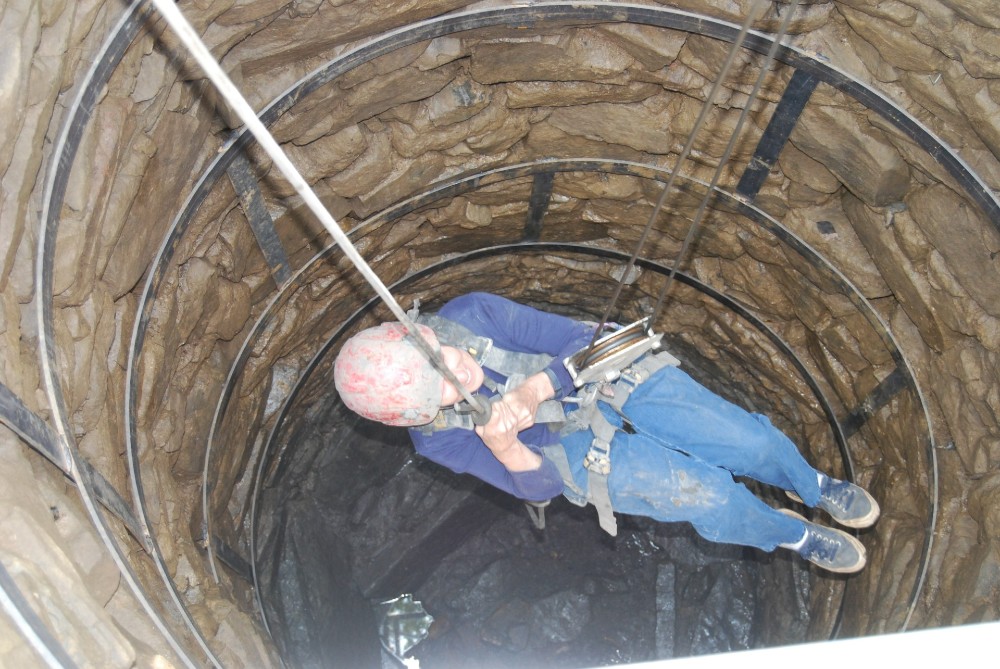
🏺 Reference image: the Etruscan well of Cetamura del Chianti See reference image (external link) View of the deep well where, two thousand years ago, the inhabitants of Cetamura threw grape seeds along with other household waste. Credit: Florida State University, via York University |
🏺 Etruscan wells: a time capsule under the Tuscan mud
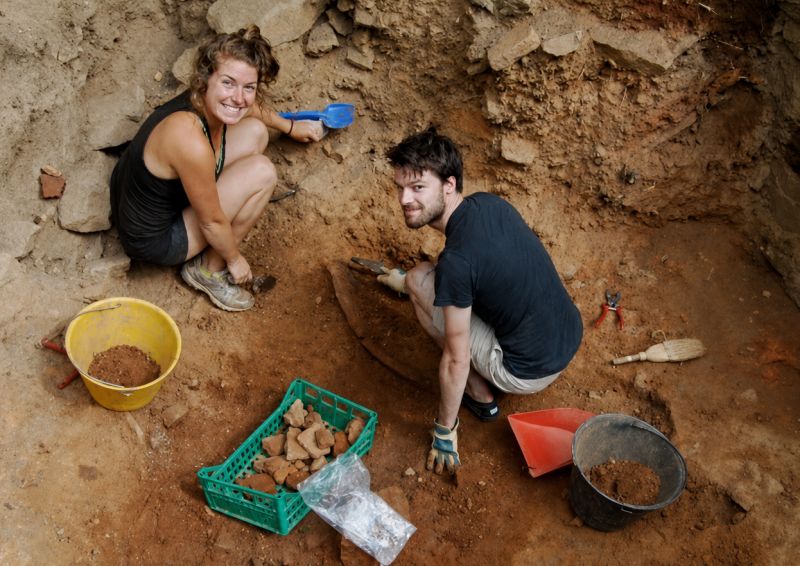
Cetamura del Chianti is a settlement located on a 695-meter hill, in the heart of Italy's most photographed wine region, about 30 kilometers northeast of Siena and 60 kilometers southeast of Florence, within the municipality of Gaiole in Chianti. The site was discovered in 1964 by Alvaro Tracchi, an amateur archaeologist in the area, but its systematic exploration only began in 1973, when Florida State University obtained excavation permission and turned the site into an archaeological field program that continues, uninterrupted, more than five decades later.
Among the most unique finds at Cetamura are two wells originally dug by the Etruscans and later reused by the Romans. For generations, locals dumped domestic and agricultural waste, including thousands of grape seeds, until the pits were finally sealed under layers of moisture-saturated, virtually oxygen-free mud. That combination proved decisive: in the absence of oxygen, the microorganisms that normally degrade organic matter cannot act with the same intensity, and plant material can survive intact for millennia.
Thanks to this exceptional preservation, the researchers were able to date and sequence seeds deposited between 300 BC and 300 AD: an arc of six centuries that covers both the late Etruscan phase and much of the Roman domination over the region.
🧬 How to read the DNA of a seed that is 2,000 years old
Working with DNA from ancient seeds is not easy. Genetic material fragments and degrades over time, so the team, led by Dr Oya Inanli, who developed this research as part of her PhD at the Department of Archaeology at the University of York, combined several techniques to extract as much information as possible from each nugget.
First, the genetic material of the 80 selected seeds was sequenced. Inanli described the result as "a remarkable story of continuity": the vast majority of the specimens analyzed corresponded to a single, identical genetic clone that was maintained from generation to generation for hundreds of years. To achieve this propagation without genetic variation, Etruscan-Roman farmers had to resort to cuttings and vegetative propagation techniques, the same principle that today allows a Malbec planted in Mendoza to be, genetically, a clone almost identical to the one grown centuries ago in Cahors, France.
The team wasn't satisfied with identifying the variety: they also used specific genetic markers to determine the color of the grape, a piece of information that normally disappears along with the flesh and skin of the fruit. And he added two complementary tools. On the one hand, near-infrared spectroscopy, a non-destructive technique that made it possible to anticipate, even before sequencing, which seeds best preserved their genetic material. On the other, a morphological analysis of the shape of the seeds, capable of distinguishing between domesticated grapes and wild grapes harvested spontaneously. Radiocarbon dating of the samples, funded by a classical studies fund at Florida State University, finalized the precise chronology of each well. The project also received European funding through the Marie Skłodowska-Curie actions of the European Union's Horizon 2020 programme.
|
❝ "We found a remarkable history of continuity." — Dr. Oya Inanli, University of York |
🍇 The varietal surprise: Chianti was born white
The most striking result of the study completely contradicts the image that any wine lover has of the region. Chianti has been synonymous with red for more than a century: Sangiovese dominates vineyards and labels, and since Baron Bettino Ricasoli systematized the classic Chiantigiano cut in the nineteenth century, the color red has become part of the very identity of the place.
However, the DNA of Cetamura's seeds tells a different story for the centuries before the turn of the era: the dominant variety, the one that is repeated over and over again in Etruscan and Roman samples, produced white berries. Professor Nancy De Grummond, from Florida State University and director of the excavations in Cetamura, called the find a surprise: the red wine that today gives world fame to the region was preceded, for centuries, by a white variety carefully selected and maintained by Etruscans and Romans.
The fact does not imply that there were no red grapes in ancient Tuscany, in fact some white varieties are still grown today in the area, although in minority proportions, but that the dominant and best documented variety in this specific site was white. It is, in any case, a wake-up call about how recent the varietal identity that we associate, almost as an immutable fact, with an entire wine region may be.
|
🔬 Reference image: reconstruction of the analyzed seeds See reference image (external link) Representation of grape seeds found in the wells of Cetamura del Chianti, whose DNA preserved for 2,000 years allowed the identification of a white variety cultivated by Etruscans and Romans. Credit: Sergio Parra, via Muy Interesante |

🏛 The wine network of the Roman Empire
The arrival of Rome in Cetamura was not a simple change of political flag. The genetic record shows that, after the Roman conquest of the settlement, entirely new vine varieties began to appear in the wells, suggesting that authorities or traders introduced selected vines from other regions under Roman rule.
The most striking piece of this hypothesis appears when comparing the dominant Cetamura clone with genetic material from other European sites: the researchers found a close genetic relationship with two ancient seeds previously analyzed in the south of France. For the team, this coincidence is biological evidence of a far-reaching agricultural network, organized by Rome to standardize wine production in different provinces of the Empire. It was not only a matter of marketing the wine already made: cuttings, plants and the agronomic knowledge necessary to reproduce specific varieties hundreds of kilometers from their place of origin were also circulating.
The study also found evidence of wild grape harvesting, detected through morphological analysis of the seeds, indicating that even in the midst of the expansion of organized viticulture, local communities continued to take advantage of spontaneous resources from the environment. Far from the image of isolated peasants, the winegrowers of Cetamura participated in a sophisticated agricultural economy, with commercial and even political implications.
📊 Technical file of the research
|
Fact |
Detail |
|
Site |
Cetamura del Chianti, Gaiole in Chianti, Tuscany (Italy) |
|
Material analyzed |
80 grape seeds recovered from two Etruscan-Roman wells |
|
Chronological period |
Approximately 300 B.C. – 300 A.D. |
|
Applied techniques |
Ancient DNA Sequencing, Color Genetic Markers, Near-Infrared Spectroscopy, Seed Morphometry, Radiocarbon Dating |
|
Publication |
Journal of Archaeological Science (2026) |
|
Institutions |
York University (UK) and Florida State University (USA) |
|
Principal investigators |
Oya Inanli, Nathan Wales and Nancy De Grummond |
|
Financing |
European Union Horizon 2020 Programme (Marie Skłodowska-Curie Actions) and Florida State University Classical Studies Fund |
🌍 The oldest vine link in the world
Among the 80 seeds analyzed, one particularly caught the team's attention: it belongs to a genetic family that is still cultivated in central and eastern Europe. Its closest modern relative is a rare variety, almost unknown outside Hungary, called Baratcsuha szürke.
But the most fascinating finding is in the following connection: this genetic lineage links directly to a legendary vine that grows today in the city of Maribor, Slovenia, on the façade of the so-called House of the Old Vine, in the Lent neighborhood, on the banks of the Drava River. Planted towards the end of the Middle Ages, estimated between 1550 and 1570, during the Ottoman invasions, this plant of the Žametovka variety is more than 400 years old and continues to produce fruit every season. Since 2004 it has been listed in the Guinness Book of Records as the oldest productive vine in the world.
For Dr Nathan Wales, also from the Department of Archaeology at the University of York, the find shows that this varietal family is both ancient and extraordinarily resilient: the grapes enjoyed by the Romans are one genetic step away from the varieties that are poured into a glass of wine today. Every time someone drinks a wine made from these heirloom varieties, the researcher argues, they are tasting a history that is just a handful of generations away from what was served on Roman tables thousands of years ago.
|
🍷 Reference image: wine and its genetic continuity See reference image (external link) The find connects Etruscan and Roman viticulture with genetic lineages that still survive in European vineyards, including the world's oldest vine in Maribor, Slovenia. Credit: Vinetur |
🍷 What does this finding say to today's viticulture?
The case of Cetamura is not an isolated event within the paleogenomics of the vine. In France, another international team managed to reconstruct more than 4,000 years of winemaking history from archaeological seeds found at different sites in the country, in a paper published in Nature Communications that documented the coexistence of wild and domesticated varieties from the Bronze Age to the Middle Ages. That same field of research had previously identified, in the latrine of a medieval French hospital, a 600-year-old seed genetically almost identical to today's Pinot Noir, as well as evidence of clonal propagation dating back to the Iron Age, between 625 and 500 BC.
The pattern that emerges from these studies is consistent: the vine varieties that we now consider traditional are neither fixed nor eternal. They are the result of thousands of human decisions (selection, propagation by cuttings, commercial exchange, climate adaptation) made over centuries by farmers who rarely left a written record of their criteria. Paleogenomics allows, for the first time, to read these decisions directly into DNA.
This perspective also challenges Argentine viticulture. Malbec, the flagship variety of Mendoza and San Juan, has its own chapter of varietal migration: it was born in the southwest of France, in the Cahors region, and arrived in Argentina only in the nineteenth century, by the hand of the French agronomist Michel Aimé Pouget. The same logic of clonal propagation that kept the white variety of Cetamura alive for two thousand years is, in essence, the one that today allows a producer from Mendoza to cultivate, generation after generation, the same genetic material that came from Europe. Understanding how varieties traveled and were preserved in Antiquity offers, in this sense, a useful mirror to think about the varietal identity of contemporary Argentine wine.
✍ In summary
What began as household garbage thrown into a pit two thousand years ago ended up becoming one of the most complete genetic reconstructions ever achieved on the ancient vine. The discovery of Cetamura not only rewrites the varietal history of one of the most famous wine regions in the world: it also reminds us that each glass of wine contains, in addition to tannins and aromas, a silent tale of human selection that crosses empires, borders and millennia.
❓ Frequently Asked Questions
❖ Where were the 2,000-year-old grape seeds found?
In two Etruscan wells reused by the Romans at Cetamura del Chianti, an archaeological site in Tuscany, Italy, excavated by Florida State University since 1973.
❖ What did DNA reveal about the color of ancient grapes?
Genetic markers showed that the dominant variety in the wells, maintained for centuries by the Etruscans and Romans, produced white berries, a surprising fact for a region today almost exclusively associated with the red Sangiovese.
❖ How is this find connected to the oldest vine in the world?
One of the seeds analyzed belongs to a genetic family related to the 400-year-old vine that grows in Maribor, Slovenia, recognized by the Guinness Book of Records as the oldest productive plant on the planet.
❖ What does this study prove about the Roman wine trade?
The genetic similarity between the dominant clone of Cetamura and seeds found in southern France suggests that the Roman Empire organized an agricultural network that distributed cuttings and selected varieties among different provinces to standardize wine production.
❖ Who published the research and where?
The study was led by Oya Inanli and Nathan Wales of York University, along with Nancy De Grummond of Florida State University, and was published in 2026 in the Journal of Archaeological Science.
🔗 Sources consulted
1. University of York — Ancient DNA from Tuscan wells reveal origins of modern wine
2. EurekAlert! — Ancient DNA from Tuscan wells reveal origins of modern wine
3. ScienceDirect — Grapevine cultivation at Cetamura del Chianti (Journal of Archaeological Science)
4. Vinetur — Chianti was born white 2,000 years ago, ancient DNA reveals
5. Very Interesting — DNA from 80 Seeds Found in Tuscan Wells Reveals the Origins of Modern Wine
7. Mundo Agropecuario — DNA from ancient seeds reveals the origin of modern wine
8. Cetamura del Chianti Excavations and Research — Florida State University
Insert the following blocks of structured data into the <head> or via the CMS SEO plugin: