








Blog - ArchivesPosts of 07/2026
 CONICET alert: Argentine science, on the brink between cuts, layoffs and wage claims
🚨 INSTITUTIONAL CRISIS · CONICET · ARGENTINE SCIENCE
CONICET alert: Argentine science, on the brink between cuts, layoffs and wage claims
Almost 400 postdoctoral fellows remain without renewal while the Science and Technology budget reaches its historic low. The national scientific system accumulates protests, dismissals at the CNEA and a letter signed by 24 Nobel laureates that warns of the brain drain.
📅 July 30, 2026 · ⏱️ Reading time: 11 min · ✍️ Writing specialized in science policy
The Argentine scientific and technological system is going through one of the most tense weeks since the beginning of Javier Milei's administration. On Friday, July 31, the contracts of almost 400 CONICET postdoctoral fellows expire who, despite having won the entrance contest to the Scientific and Technological Researcher Career (CIC), have not yet received the administrative extension that would allow them to continue receiving a salary while the final results are published. The lack of an additional budget item, estimated by the workers themselves between 2,000 and 3,000 million pesos, is what keeps hundreds of researchers in institutes throughout the country on tenterhooks.
The conflict is not isolated. It is in addition to a series of cuts that, according to the sector's unions, have already destroyed around 2,800 jobs in scientific organizations since December 2023, the sustained fall in the purchasing power of salaries and scholarships, and the layoffs registered in the National Atomic Energy Commission (CNEA). The result is a picture that the National Academy of Exact, Physical and Natural Sciences itself described as a process of "emptying" capable of accelerating a new brain drain.
⏳ The time bomb of the 379 scholarship recipients
At the center of the conflict are the so-called "CIC entrants": scientists who have already taken and passed the competition to become CONICET staff researchers, but whose formal incorporation has not yet been resolved by the Board of Directors. Until that definition arrives, his postdoctoral fellowships — his only income — expire. The number circulating among the workers themselves ranges between 375 and 400 people throughout Argentina, with at least 17 cases identified at the Rosario headquarters.
The CONICET Board of Directors itself pronounced itself mostly in favor of supporting these scholarship holders: five of its eight members asked for the continuity of the contracts and stressed that the money to do so must come from the Chief of Staff, in charge of Diego Santilli. The president of the organization, Daniel Salamone, abstained in that vote and did not raise the request for funds, a sign that the unions read as a gesture of institutional weakness in the face of the adjustment.
Official sources consulted by specialized media maintained that, for the moment, there is no budget availability to expand the resources transferred to CONICET. On the other side of the counter, delegates from the Association of State Workers (ATE) warn that, if the departure does not appear, all these personnel "have to go out to look for another job" as of August 1, with the consequent loss of lines of research that in some cases have been years in the making.
|
📌 The key fact To avoid the interruption of the almost 400 lines of investigation at risk, the workers calculate that a budget expansion of between 2,000 and 3,000 million pesos would be enough, a figure that depends exclusively on a political decision of the Chief of Cabinet. |
📉 The numbers of an unprecedented adjustment
The demand for extensions is the most visible face of a fundamental process: the sustained fall in public funding for science. According to calculations made on official budget execution, between 2023 and 2026 the financing of the Science and Technology function accumulated a real contraction of close to 50%. CONICET itself, although with a somewhat smaller drop than the system average, lost about 35% of its real budget since 2023 and, during 2026 alone, it fell by an additional 8% compared to the previous year.
This reduction hits particularly hard because almost all of the agency's spending — about 96% — is allocated to the payment of salaries and scholarships. Any nominal cut translates, almost directly, into less income, fewer renewals and less coverage for retirements, vacancies or leaves within research teams.
|
Indicator |
Value |
Detail |
|
Actual Fall C&T 2023–2026 |
≈ 50% |
Financing of the Science and Technology function at the national level |
|
CONICET 2023–2026 Real Drop |
≈ 35% |
Agency-specific budget execution |
|
Additional 2026 Setback |
≈ 8% |
Compared to fiscal year 2025 |
|
Investment in C&T / PBI |
0,14% |
The lowest level in 25 years, according to workers in the sector |
|
Loss of purchasing power |
40–45% |
Salaries of researchers and fellows in two and a half years |
|
Lost scientific jobs |
≈ 2,800 |
Cumulative estimate since December 2023 |
💸 Pulverized salaries and social work in crisis
In addition to the brake on income, the other axis of the claim is wages. According to testimonies of scholarship holders and union delegates, CONICET workers lost between 40% and 45% of their purchasing power in the last two and a half years, a collapse that pushes a large part of the scientific community to look for odd jobs, unpaid leave or directly job offers in the private sector or abroad.
Added to this is an additional complaint filed at the beginning of this year: a group of researchers detected that the agency had stopped making the contributions corresponding to social contributions and social work during December and January, which left numerous scholarship holders without medical coverage in the middle of summer. The unions interpreted the episode as one more sign of the administrative and financial deterioration of the agency, beyond the fact that the authorities have explained it as a specific technical problem.
⚛️ CNEA: the other trench of scientific adjustment
The conflict in CONICET does not occur in a vacuum. At the same time, the National Atomic Energy Commission (CNEA) went through a wave of between 60 and 62 layoffs of professionals, technicians and administrative staff, within the framework of a restructuring framed in Decree 655/2026. Workers grouped in the CNEA Personnel Association (APCNEAN) maintain that the agency's staffing was already below the optimal level defined in previous administrations, and warn that the cuts put at risk strategic capacities such as the production of heavy water by the Heavy Water Industrial Plant (PIAP).
The protests in front of the agency's headquarters led to an operation by the National Gendarmerie that prevented, according to the workers themselves, the re-entry of dismissed personnel, in an episode that ended up being prosecuted for the alleged lack of an order authorizing the intervention of the federal force. Trade union organizations went so far as to compare the situation to the historic "Night of the Long Batons", alluding to the violent intervention on scientific institutions during the 1966 dictatorship.
Voices from the sector itself, including the national deputy and physicist Adriana Serquis, remarked that a good part of the dismissed personnel had gone through formal evaluation processes before being incorporated, which —in their opinion— makes it more difficult to justify the magnitude of the dismissals.
🔬 The scientific community stands up
The discontent exceeds the state unions. The National Academy of Exact, Physical and Natural Sciences issued a statement in which it expressed "deep concern" about what it defined as an "emptying" of strategic organizations, and warned that the national government's policies could accelerate a new brain drain, referring to the exodus of qualified researchers to universities and companies abroad.
In the same vein, a letter is circulating promoted by molecular biologist Alberto Kornblihtt and physicist and deputy Adriana Serquis, which gathered the signatures of 24 Nobel laureates and other personalities of world science. The text denounces that, since the beginning of the current administration, the Argentine scientific system loses on average about 8 jobs per day as a result of financial asphyxiation and the lack of institutional predictability, and also repudiates the entry of security forces to the headquarters of the CNEA, the National Institute of Industrial Technology (INTI) and CONICET itself during the protests.
From ATE, delegates such as the physicist and independent researcher Fabricius, from La Plata, describe the situation as "one more step" in a process of sustained deterioration: salaries with a delay of more than 50% in some cases, a social work that fails to normalize its operation and the absence of new subsidies to finance research projects since 2023.
📅 What's next: calls, strikes and new mobilizations
In the midst of the conflict, CONICET itself opened a new 2026 call for doctoral, doctoral and postdoctoral scholarships, with staggered registrations between July 27 and early March 2027. The call provides for 1,000 doctoral scholarships, 300 doctoral completion scholarships and 800 postdoctoral scholarships, although with a particularity that generates controversy within the organization itself: 70% of the quotas are reserved for projects framed in "prioritized topics" defined by the political leadership, while only 30% remain for topics of free choice by discipline.
For the unions, this scheme is equivalent to an indirect intervention on the country's research agenda, which leaves out – or in a situation of vulnerability – lines of work not included in the official list, even when they are areas with recognized social or environmental relevance.
At the union level, ATE has already called for a national strike of state workers for Monday, August 3 and anticipated a new joint mobilization of workers from science and technical organizations for August 12, with a focus on salary recomposition, the reactivation of support personnel competitions, the restitution of medical coverage and the continuity of work for interns at risk.
🧭 The underlying dilemma
Beyond the immediate outcome of the 379 cases in dance, the conflict exposes an underlying tension between two visions of the role of the State in science. The libertarian administration prioritizes results with an immediate productive impact and a reorientation of funds towards sectors such as mining, agribusiness and hydrocarbons, under the premise of a knowledge economy more linked to the market. On the other hand, a large part of the scientific community – and a not insignificant portion of the CONICET Board of Directors itself – warns that dismantling consolidated teams, scholarships and salaries in the short term can compromise capacities that took Argentina decades to build, with effects that will only become visible several years later, when it is already difficult to reverse them.
The definition of the scholarship holders at risk, the eventual budget expansion and the result of the next days of protest will function, in the coming weeks, as a thermometer of where this dispute is leaning.
🖼️ Reference Images
Below is a selection of images available on the internet linked to the theme, with their absolute link of origin for verification and responsible use of rights.
🖼️ Headquarters and institutional logo of CONICET

Official logo of the National Council for Scientific and Technical Research. Source: Wikimedia Commons / Presidency of the Argentine Nation (CC BY 2.5 AR).
🖼️ CONICET — institutional file
Institutional profile of CONICET, an organization created in 1958 and directed by its first director, the Nobel Prize winner Bernardo A. Houssay. Source: Wikipedia.
🖼️ Coverage of the mobilization of scholarship holders in the Scientific Pole
Photographic and video record of the protest on July 29, 2026 in front of the Scientific and Technological Pole of Palermo. Source: La Izquierda Diario.
🖼️ Protest and repression against scientific bodies
Coverage of the police operation during a protest by CONICET workers. Source: teleSUR.
📚 Sources consulted
● UNQ Science News Agency — agencia.unq.edu.ar
● Institutional post on Instagram about the situation of the scientific system
● Pescare — "CONICET: what's happening with funds, researchers and grants"
● La Capital (Rosario) — "Conicet denounces that there are almost 400 scholarship holders in danger"
● Estación Sur Digital — "Alert from CONICET: there would already be 2,800 fewer jobs"
● First Edition — "Almost 400 CONICET researchers could be left without income"
● La Izquierda Diario — "New protest of Conicet"
● El Diario AR — "Argentine science workers march against 379 layoffs at CONICET and 60 layoffs at the CNEA"
● teleSUR — "Argentine Police Repress Protest by CONICET Workers"
● Canal Abierto — "Brain drain: the National Academy of Sciences denounced Milei's adjustment"
● Chronicle — "Conicet workers denounced the collapse of Argentine science"
● Periphery — "Science Organizations Against the New Libertarian 'Night of the Long Sticks'"
● InfoGremiales — Complaints about dismissals in science organizations
● APFDigital — "Conicet: authorities of the organization supported 379 scholarship holders and rejected dismissals"
● ATE — "ATE denounces that the budget for Science in 2026 will be the lowest in history"
● Periphery — "They denounce that CONICET has not paid social charges since December"
● CONICET — Call for scholarships 2026 (official rules)
● Wikipedia (EN) — National Scientific and Technical Research Council
 An atmosphere in LHS 1140 b: the super-Earth that reignites the search for life beyond the Solar System is confirmed
- by
cronywell
An atmosphere in LHS 1140 b: the super-Earth that reignites the search for life beyond the Solar System is confirmed
- by
cronywell
🔭 SCIENCE · ASTRONOMY
An atmosphere in LHS 1140 b: the super-Earth that reignites the search for life beyond the Solar System is confirmed
A Harvard-led team detected helium escaping from this rocky world in the habitable zone of a red dwarf 49 light-years away, the first firm indication of a persistent atmosphere on such a planet.
✍️ Redacción de Ciencia 📅 July 17, 2026 🕒 Reading time: 7 minutes 📍 Source: Science magazine
An international team of astronomers led by Harvard University confirmed the presence of an atmosphere on LHS 1140 b, a rocky super-Earth orbiting within the habitable zone of a red dwarf located about 49 light-years from Earth, in the constellation of Cetus. The finding, published on July 16 in the journal Science, is based on the detection of helium escaping from the upper layers of the planet, a signal that, according to the authors themselves, opens more questions than it closes, but which constitutes the strongest evidence to date that a rocky world in the habitable zone can conserve air after billions of years.
📊 Exoplanet data sheet
|
Planet |
LHS 1140 b (rocky super-Earth) |
|
Distance to Earth |
≈ 49 light-years (constellation Cetus) |
|
Host Star |
LHS 1140 (M-type red dwarf, also GJ 3053), 3 billion years >, inactive |
|
Dough |
5.60 ± 0.19 Earth masses |
|
Radio |
1.73 Terrestrial radios |
|
Orbital period |
24.7 days |
|
Stellar irradiation received |
42% of that which the Earth receives from the Sun |
|
Equilibrium temperature |
226 K (≈ −47 °C), within the liquid water zone |
|
Key instrument |
WINERED spectrograph on the Magellan Clay telescope (Las Campanas Observatory, Chile) |
|
Publication |
Science, 16 de julio de 2026 · DOI 10.1126/science.aea9708 |
🔭 The finding: how helium was detected
The team, led by astronomer Collin Cherubim, used the WINERED (Warm Infrared Echelle Spectrograph to Realize Extreme Dispersion) spectrograph, installed on the 6.5-meter Magellan Clay telescope at the Las Campanas Observatory in Chile. In September 2024, a rare alignment took place that allowed the transit of LHS 1140 b and the other rocky planet in the system, LHS 1140 c, to be observed in front of its star on the same night.
During the transit of LHS 1140 b, the spectrum showed clear helium absorption at high altitude, above the planet's solid radius; in the transit of LHS 1140 c, on the other hand, no equivalent signal was observed. The researchers interpret that difference as evidence that helium is actively escaping from LHS 1140b's upper atmosphere, heated by its star's extreme X-ray and ultraviolet radiation.
"My model predicted that helium was going to escape, and in large quantities." — Collin Cherubim, Harvard University
🌡️ A temperate world, but not confirmed as habitable
LHS 1140 b has a mass 5.6 times that of Earth and a radius 1.73 times greater, figures compatible with a rocky composition similar to that of Earth combined with a layer of low density, either a substantial atmosphere or a high proportion of water. Its equilibrium temperature of 226 kelvin (about −47 °C) puts it within the so-called liquid water zone, although that does not automatically imply that there are oceans on its surface.
The host star, LHS 1140, is an unusually quiet red dwarf for its kind, more than 3 billion years old and with low magnetic activity. That stellar calm could explain, according to the researchers, why the planet has managed to retain atmospheric gases for so long, instead of losing them completely as has happened with other rocky worlds observed in habitable zones of more active stars.
"We now know that at least one of them has managed to conserve an atmosphere." — Robin Wordsworth, professor at Harvard University
⚖️ What the study does not yet confirm
The authors themselves insist on qualifying the scope of the finding. The helium signal was clearly detected in the 2024 observations, but did not reappear in a second campaign conducted in 2025, which the researchers interpret as evidence of a time-varying gas leak, rather than a measurement error.
That variability leaves open a central question for the team: whether LHS 1140 b is actually a virtually bare rock that occasionally releases bursts of gas that escape immediately, or whether it maintains a stable atmosphere that, as on Earth, continuously loses and replenishes gases.
"Is it a bare rock that sometimes belches gas, or is there a stable atmosphere that renews itself?" — Jason Dittmann, University of Florida
At the moment, the exact composition of the lower atmosphere remains unknown. Previous studies with the James Webb Space Telescope had already ruled out a dense envelope of hydrogen around LHS 1140 b, leaving as the most likely hypothesis a thin atmosphere dominated by nitrogen or carbon dioxide, with inconclusive indications of water vapor.
🧭 LHS 1140 c and the concept of "cosmic coast"
The LHS 1140 system is also home to LHS 1140 c, a smaller planet much closer to the star, with an orbital period of just 3.78 days and a stellar irradiation about five times greater than that received by Earth. No sign of escaping helium was detected on this planet, suggesting that it lacks a comparable atmosphere.
The authors frame this contrast within the concept of the "cosmic shoreline": a theoretical boundary that would separate planets capable of retaining atmosphere for billions of years from those that lose it rapidly due to stellar radiation and stellar wind. LHS 1140 b and LHS 1140 c, despite orbiting the same star, would appear to be located on opposite sides of that boundary.
🔬 What's Next: The Role of the James Webb Telescope
The next step, according to the team, will depend on additional observations with the James Webb Space Telescope over the next four to five years, aimed at looking for the spectral signature of water in the planet's atmosphere. If those molecules appear consistently, the researchers believe it would be a strong indication that LHS 1140 b supports a stable and long-lasting atmosphere, and not a transient phenomenon.
"If there's water in the atmosphere, it's probably a stable atmosphere that's going to persist." — Jason Dittmann, University of Florida
🌊 A candidate for ocean world? A hypothesis to be confirmed
The idea that LHS 1140 b could host a temperate global ocean, covered by a layer of ice or directly exposed under a thick atmosphere, has been circulating for years among exoplanet specialists, supported by its density and its position within the habitable zone. However, both Cherubim's team and external specialists consulted by the journal Science stress that the current finding confirms the existence of gas in the upper atmosphere, not the presence of liquid water or habitable conditions on the surface.
Independent astronomers, such as René Doyon, from the University of Montreal, described the result as extraordinary if confirmed, although they stressed that it is a first step in a verification process that will still take years. In this sense, cataloging LHS 1140 b as "the most solid candidate" for ocean world reflects the legitimate enthusiasm of the scientific community, but it should be read as a working hypothesis and not as a confirmed fact.
🔎 Why this finding matters
Methodologically, this is the first case in which an atmosphere around a rocky planet in the habitable zone of another star has been clearly documented, among the more than 6,000 exoplanets catalogued so far. For years, whenever astronomers located a rocky world in the habitable zone, subsequent observations ended up revealing bare surfaces, with no trace of air. LHS 1140 b breaks, for now, that pattern.
🖼️ Related Images
For copyright reasons, the original images are not embedded in this document; The absolute links published by the media and the scientific journal are listed below.
🔗 Artist's concept of LHS 1140 b and LHS 1140 c — https://cdn.sci.news/images/2026/07/image_14925-LHS-1140.jpg (Credit: Melissa Weiss/Harvard & Smithsonian's Center for Astrophysics, via Sci.News)

🔗 Original article with spectroscopic figures — https://www.science.org/doi/10.1126/science.aea9708 (Science / AAAS)
🔗 Coverage with image of the planetary system — https://www.sci.news/astronomy/atmosphere-habitable-zone-exoplanet-lhs-1140b-14925.html (Sci.News)
📚 Sources consulted
🔗 Helium escaping from the atmosphere of a nearby rocky exoplanet orbiting in a habitable zone — https://www.science.org/doi/10.1126/science.aea9708 (Science, artículo original, 16 jul. 2026)
🔗 Astronomers spot first atmosphere around a potentially habitable alien world — https://www.science.org/content/article/astronomers-spot-first-atmosphere-around-potentially-habitable-alien-world (Science / AAAS, noticia)
🔗 Potential Atmosphere Detected on Habitable-Zone Exoplanet LHS 1140b — https://www.sci.news/astronomy/atmosphere-habitable-zone-exoplanet-lhs-1140b-14925.html (Sci.News)
🔗 Astronomers detect first atmosphere on rocky 'super-Earth' — https://www.rt.com/news/643172-astronomers-superearth-atmosphere-helium/ (RT)
🔗 Nearby rocky planet may be replenishing helium from atmosphere, study finds — https://phys.org/news/2026-07-nearby-rocky-planet-replenishing-helium.html (Phys.org)
🔗 Astronomers Detect A Long-Lasting Atmosphere On A Planet That Could Resemble Earth — https://dailygalaxy.com/2026/07/astronomers-detect-atmosphere-on-a-planet/ (Daily Galaxy)
Note: This coverage is based on the article published in Science (DOI 10.1126/science.aea9708) and the news coverage available at the time of writing; The exact nature of the atmosphere and the possible existence of liquid water remain under investigation.
 How does the state control itself?
- by
cronywell
How does the state control itself?
- by
cronywell
How does the state control itself?
Institutions, Comparative Evidence, and the False Dilemma Between Left and Right
The State does not control itself as if it were a single subject, but through a system of institutions that limit and control each other. This principle, typical of the constitutional and democratic rule of law, is based on the idea that all power requires limits to avoid its concentration and arbitrary exercise.
The division of powers, oversight bodies, judicial independence, accountability, transparency and citizen control are mechanisms designed to ensure that the exercise of power remains subject to the Constitution and the law. Its purpose is not to hinder the action of the State, but to preserve the public interest, protect the rights of individuals and prevent corruption.
From a philosophical and republican perspective, corruption does not depend exclusively on the size of the State, but on the quality of its institutions and the effectiveness of its control mechanisms. A small state can be as corrupt as a large one if it lacks transparency, institutional independence and effective sanctions. Similarly, a state with broad functions can manage public resources with integrity when there are strong controls and a true culture of public accountability.
Therefore, the solution to corruption is not simply to shrink or enlarge the State, but to strengthen institutions, guarantee the independence of control bodies, promote transparency and ensure that all exercise of power is subject to limits, supervision and accountability. In a republic, the problem is not how much power the state has, but how controlled, responsible and transparent its exercise is.
Comparative evidence: institutions, corruption and well-being
These statements cease to be a philosophical intuition when they are contrasted with data. The Corruption Perceptions Index (CPI) published annually by Transparency International measures, on a scale of 0 to 100, how experts and businessmen perceive the level of corruption in the public sector in 182 countries. The 2025 edition shows a global average of just 42 points, the lowest in more than a decade, with 122 out of 182 countries below 50 points.
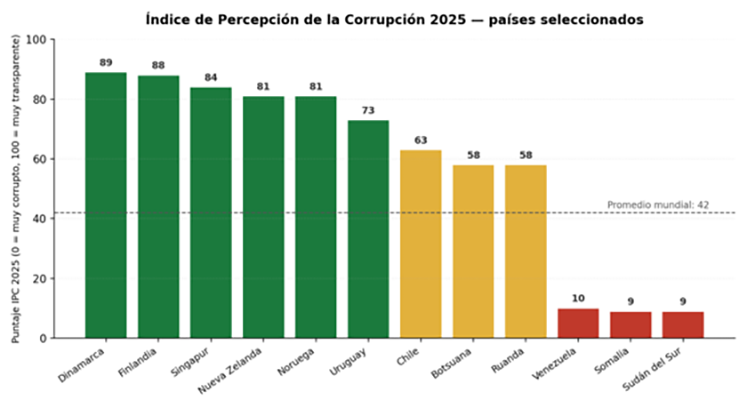
Figure 1. Score of the 2025 Corruption Perceptions Index in selected countries. Source: Authors' elaboration with data from Transparency International, CPI 2025.
The graph above does not order countries by ideology or by the size of their state, but by the quality of their control institutions. Denmark, Finland, Singapore, New Zealand, and Norway—with very different state and economic traditions—share something more relevant than their political orientation: independent judiciaries, a free press, a professionalized civil service, and effective accountability mechanisms.
Why this matters for the well-being of the population
Institutional quality is not an abstract discussion: it has measurable effects on people's daily lives. Economic research on the CPI has found an association between higher index scores and higher long-term economic growth, with estimates placing the effect at around an additional 1.7 percentage points of GDP growth for each point of improvement in the index, in addition to a greater attraction of foreign investment.
Transparency International also documents links between corruption and very specific areas of well-being: countries with lower levels of corruption generally show better access to and affordability of justice for their citizens; there is a relationship between health service coverage – as measured by the World Health Organization's Universal Health Coverage Index – and levels of corruption; and more than ninety percent of journalists killed in recent years for covering corruption cases died in countries with CPI scores below 50.
These data allow us to trace the causal mechanism that underlies the first section of this document: when judicial controls, a free press and accountability are lacking, the resources allocated to hospitals, schools, infrastructure and social protection are diverted or mismanaged, and it is the people with lower incomes who pay the highest cost, because corruption works as a regressive tax that falls more heavily on poor households.
Specific cases in the world
The following table summarizes examples from different regions and models of state. The objective is not to present a ranking of "good" or "bad" countries, but to show that the variable that explains the result is not the size of the State or its ideological orientation, but the strength of its control mechanisms.
|
Country |
State model |
CPI 2025 |
Key institutional factor |
|
Denmark |
Broad welfare state |
89 |
Professional civil service, free press, budget transparency |
|
Singapore |
Reduced state, highly regulatory |
84 |
Independent judiciary, severe and consistent sanctions against corruption |
|
New Zealand |
Mid-sized status |
81 |
Transparent political financing, low concentration of power |
|
Estonia |
Digitized Administration |
76 |
E-government that reduces discretionary contact between officials and citizens |
|
Uruguay |
Social State, Latin America |
73 |
Stable democratic alternation, high social mobility and judicial independence |
|
Botswana |
African state, natural resources |
58 |
Transparent management of diamond income and parliamentary control |
|
Rwanda |
State in post-conflict reconstruction |
58 |
Administrative reform and low formal tolerance for minor corruption |
|
Venezuela |
State with captured institutions |
10 |
Collapse of judicial independence and public oversight |
|
Somalia / South Sudan |
Fragile or conflict-ridden state |
9 |
Absence of control institutions and the rule of law |
Table 1. Comparative cases of institutional control and perception of corruption. Source: Authors' elaboration with data from Transparency International, CPI 2025.
The case of Botswana is particularly illustrative: it is one of the few diamond-rich countries that avoided the so-called "curse of natural resources" thanks to the fact that, since its independence, it subjected mining income to parliamentary controls and public audits, in contrast to Venezuela, where the capture of control institutions coincided with economic and social collapse despite having the largest oil reserves in the world. Rwanda, for its part, built a public administration with a low formal tolerance for minor corruption after a devastating conflict, which allowed it to achieve levels of control comparable to those of much richer countries.
At the other extreme, Somalia and South Sudan show what happens when there are practically no institutions of control: there is no state to supervise itself because the basic functions of justice, security and public administration have collapsed, with severe humanitarian consequences.
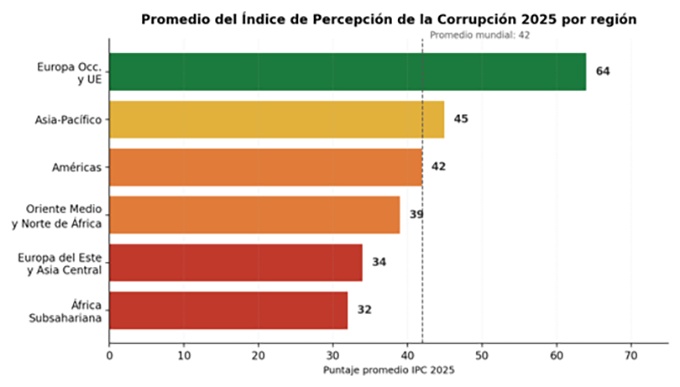
Figure 2. Regional average of the Corruption Perceptions Index 2025. Source: Authors' elaboration with data from Transparency International, CPI 2025.
The regional average confirms the pattern: no region in the world is exempt from the problem—even Western Europe, the highest-scoring region, has been declining faster than any other in the past decade—but the differences between regions mostly reflect differences in the strength of their control institutions, not a single economic model.
Beyond the false dilemma between left and right
One of the biggest obstacles to discussing anti-corruption policies effectively is the trap of reducing the debate to whether the state should be bigger or smaller, more left-wing or more right-wing. The comparative data show that such discussion, while legitimate for other purposes, does not predict the level of corruption in a country.
● Denmark and Finland have large welfare states, with high tax burdens and strong public intervention, and are among the least corrupt countries in the world.
● Singapore and New Zealand combine comparatively smaller or more market-oriented states with similarly high levels of transparency.
● Uruguay, with a consolidated social state, leads the Latin American region in controlling corruption, while countries with states of similar size in the same region occupy much lower positions.
● Venezuela shows that a State with enormous resources and broad powers can collapse in terms of integrity when judicial independence and oversight disappear.
What distinguishes the best-evaluated countries is not their place on the left-right spectrum, but a common set of institutional conditions: independence of the judiciary, freedom of the press, protection of civic space for social organizations and journalists, transparent political financing, and public procurement systems open to scrutiny. In fact, Transparency International warns that, in recent decades, the restriction of civic space – that is, limitations on the press, non-governmental organizations and social protest, promoted indistinctly by governments of different political persuasions – systematically coincides with falls in corruption control scores.
Discussing public policies under the slogan of "more State" or "less State" diverts attention from the real problem and makes it easier for actors of any political orientation to evade accountability. The relevant question for policy-making is not how much state is needed, but what controls, what institutional independence, and what transparency accompany public decisions, no matter who governs.
Conclusion
The state controls itself through a network of mutually limiting institutions, and international evidence confirms that the quality of these institutions—not their size or political color—determines whether power is exercised in the public interest or diverted to private gain. Strengthening judicial independence, transparency, freedom of the press and citizen control is not an ideological preference: it is the condition common to all countries, large or small, left or right, that manage to translate the power of the State into effective well-being for their population.
Sources: Transparency International, Corruption Perceptions Index 2025 (published on 10 February 2026); World Health Organization, Universal Health Services Coverage Index; Committee to Protect Journalists (CPJ).